Guidelines for submitting manuscripts
The information presented below was updated in august 2026.
GENERAL INFORMATION
The Revista Brasileira de Atividade Física e Saúde (RBAFS) accepts articles that have not been previously published or are under review in another journal. The information and concepts presented in the articles, as well as the accuracy of the research content, are the sole responsibility of the author(s).
For studies involving data collection with human subjects, approval by a Research Ethics Committee is required, with the participants signing the Free and Informed Consent Form. Studies that do not meet these requirements will not be accepted for publication in the journal.
The RBAFS values manuscripts that use language promoting equity, diversity, and respect for all individuals. Authors are encouraged to avoid expressions, descriptors, or examples that reflect stereotypes, cultural biases, or irrelevant personal characteristics. Gender-neutral or plural terms should be prioritized where appropriate, and care should be taken to ensure that coding, labels, or classifications do not contain exclusionary or offensive language. Beyond language, the RBAFS emphasizes the importance of systematically considering sex and gender in research, in alignment with the SAGER guidelines. This includes explicit reporting of how these variables are defined, measured, and analyzed, as well as presenting results disaggregated by sex and/or gender whenever relevant. Authors should also discuss the potential influence of sex and gender on study outcomes and their implications for the interpretation and generalizability of the findings.
All articles accepted for publication in RBAFS will receive a Digital Object Identifier (DOI) at the time of publication.
Authorship criteria
The Revista Brasileira de Atividade Física e Saúde adopts the Contributor Roles Taxonomy CRediT. The contribution of all authors to the preparation of the manuscript must be described in the Submission Form.
Revista Brasileira de Atividade Física e Saúde requires that all authors must have made significant contributions to the conception and/or development of the research, and must have been involved in the writing and revision of the manuscript. In addition, all authors must have approved the final version of the manuscript. In the submission form, the contribution of each author meeting these criteria must be indicated.
Article language
Articles may be submitted in Portuguese, Spanish, or English. However, if an article accepted is in Portuguese or Spanish, the submission of the article in English within 30 days will be mandatory. For articles submitted in English, it is suggested, when possible, to publish the article in both Portuguese and English, thereby increasing RBAFS's reach in Portuguese-speaking countries.
Conflict of interest
Conflicts of interest may be of a personal, commercial, political, academic, or financial nature. Conflicts of interest can arise when authors, reviewers, or editors have interests that may influence the preparation or evaluation of manuscripts. Upon submission, authors are responsible for acknowledging and disclosing any financial or other conflicts that may have influenced their work. If there is, even potentially, a conflict of interest, the author(s) must indicate it in the Submission Form. For more information, see: Disclosure of Financial and Non-Financial Relationships and Activities, and Conflicts of Interest.
Reporting checklists
Authors are required to follow international reporting guidelines according to the type of study (e.g., STROBE, SRQR, PRISMA, CONSORT, CHERRIES, etc.), and must attach the corresponding checklist at the time of submission. This material will be considered during the peer review process. In case of doubts, please consult the guidelines on the EQUATOR Network website.
Adoption of software using artificial intelligence resources
The use of artificial intelligence in the preparation of manuscripts submitted to the Brazilian Journal of Physical Activity and Health is permitted, provided that it is consistent with the ethical principles of scientific research. Accordingly, artificial intelligence tools and language models cannot be listed as authors, nor can they be held responsible for any part or content of the manuscript. Acceptable uses of these tools include: (i) assistance with manuscript writing when used to paraphrase or improve the author's original content; and (ii) literature searches, provided that the author(s) assume full responsibility for the selection and critical appraisal of the retrieved evidence. The use of these tools must be declared in the Submission Form. However, the use of artificial intelligence to generate images, graphical elements, or the text of the article is not permitted, even if such use is disclosed in the figure caption, the Materials and Methods section, or in the dedicated section at the end of the article. For infographics intended for publication on the Brazilian Journal of Physical Activity and Health's social media platforms, the use of artificial intelligence is permitted, provided that its use is declared and the specific tool employed is identified. In all cases, the authors remain fully responsible for the accuracy, integrity, and originality of their research articles.
Research Involving Human Participants
Research involving human participants must be conducted in accordance with internationally recognized ethical principles and with the laws, regulations, and applicable standards of the country where the research was conducted. Studies must be submitted for review and approval by a competent Research Ethics Committee or Institutional Review Board (IRB) before the research begins, when required by applicable regulations.
Authors must state in the manuscript the name of the Research Ethics Committee or institution responsible for the approval and the corresponding approval number or code. Informed consent must be obtained from participants before their inclusion in the research, in accordance with applicable ethical standards, and the procedures used to obtain consent must be described in the manuscript.
When applicable legislation or ethical standards permit a waiver of informed consent, authors must state this condition and provide the corresponding justification and/or ethical approval.
Research Involving Vulnerable Populations
Research involving vulnerable populations, including children and adolescents, must incorporate additional measures to protect the rights, safety, privacy, dignity, and well-being of participants.
In the case of children and adolescents, consent must be obtained from parents or legal guardians, when applicable, and participant assent must be obtained according to the participant's age, ability to understand, maturity, and applicable ethical standards. Authors must describe in the manuscript the procedures used to obtain consent and, when applicable, assent.
Researchers must adopt appropriate measures to minimize risks to participants and avoid any form of coercion, undue influence, or unnecessary exposure. The same principles must be observed in research involving other groups or individuals who may be particularly vulnerable, taking into account the characteristics of the population and the research context.
Clinical Trials
Clinical trials involving human participants must receive approval from a competent Research Ethics Committee or Institutional Review Board (IRB) before participant recruitment or data collection begins, in accordance with applicable regulations.
Clinical trials must be prospectively registered in a recognized public clinical trial registry, in accordance with applicable ethical and regulatory standards. Examples of recognized registries include ClinicalTrials.gov and the Brazilian Registry of Clinical Trials (ReBEC).
The name of the registry and the registration number must be reported in the manuscript, preferably in the abstract and Methods section. Whenever applicable, authors must report the registration date and indicate whether registration occurred before the beginning of participant recruitment.
Any substantial amendment to the protocol after the study has begun must be reported in the manuscript, including, when applicable, its justification and potential impact on the conduct or interpretation of the results.
Formatting
Manuscripts must be prepared in a Microsoft Word text editor. Files must have a DOC, DOCX, or RTF extension. The following formatting must be adopted when preparing the text file:
- pages in A4 format, numbered in the upper right corner starting from the “title page”, with margins of 2.5 cm (bottom, top, left, and right);
- Times New Roman font, size 12;
- double spacing;
- line numbering (page layout), restarting on each page;
- Footnotes are not permitted.
Title page
This document must include, in this order, the following information:
- Text disseminating the main results with a maximum of 200 characters (including spaces), for dissemination on the social networks of the Revista Brasileira de Atividade Física e Saúde (Twitter, Facebook, Instagram).
- Type of article;
- Complete title, with a maximum of 150 characters including spaces (avoid using acronyms in the title)
- Running title, with a maximum of 50 characters including spaces;
- Author(s) and respective institutional affiliations, organized in the following sequence (note: after submission of the manuscript, changes to the authorship will not be permitted):
- institution, center, department, city, state, and country – for example: Federal University of Santa Catarina, Department of Physical Education, Florianopolis, Santa Catarina, Brazil;
- abbreviations of the names of authors, states, and institutions are not permitted;
- after the name of each author, indicate the ORCID registration number (https://orcid.org) – for example:
João Santos1
https://orcid.org/0000-0002-9647-3448
1 Federal University of Santa Catarina, Department of Physical Education, Florianópolis, Santa Catarina, Brazil.
- Information about the author responsible for contacting the Journal's editorial team, in the following sequence: author, email, full address (street, number, complement, city, state, country, zip code) – for example:
CONTACT
João Santos
jj@rbafs.org.br
Rua/Avenida Presidente X, n. 100, São João, Pernambuco, Brasil. CEP: 59000-001.
- Word count in the text, summary, and abstract, as well as the number of references and illustrations (tables, figures, and tables);
- Funding: inform the funding agency and process number when the manuscript comes from projects that received funding – for example:
Funding
Funding details...
- Acknowledgments: inform in brief text institutions, and others, that you wish to thank – for example:
Acknowledgments
The authors thank...
- Indicate three possible reviewers for your manuscript (full name, institution, and email):
- To this end, only reviewers with a doctorate and knowledge in the area to which the manuscript is related are accepted;
Manuscript body
Abstract
On the abstract page, the article title should be placed at the top. The abstract should be written in structured format with a maximum of 250 words. For original studies, the abstract must include the following sections: introduction, objective, methods, results, and conclusion. For other formats, it is recommended to use the following sections: introduction, objective, development, and final considerations.
At the end of the abstract, three to five keywords obtained from the Health Sciences Descriptors (DeCS) or Medical Subject Headings (MeSH) should be included, separated by semicolons.
Body of the text
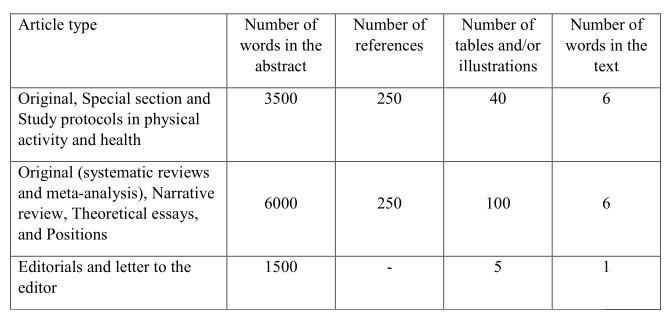
The body of the text should be structured according to each type of article (see table). Citations should be numbered and ordered sequentially in superscript Arabic numerals, following the Vancouver style. Abbreviations should be kept to a minimum, and when used, they should be identified after their first use.
References
Authors should adhere to the indicated word limit for each type of manuscript (see table), using references directly related to the manuscript's content. The organization of the reference list should follow the Vancouver style. For standardization, the use of reference management software utilizing the 'Elsevier Vancouver' style is recommended. It is necessary to provide the DOI of the material.
Some formatting examples are provided below:
Journal articles:
Hallal PC, Victora CG, Wells JCK, Lima RC. Physical inactivity: prevalence and associated variables in Brazilian adults. Med Sci Sports Exerc. 2003;35(11):1894-900. doi: https://doi.org/10.1249/01.MSS.0000093615.33774.0E.
Book
Nahas MV. Atividade física, saúde e qualidade de vida. 5ª ed. Londrina: Midiograf, 2003.
Book chapter
Zanella MT. Obesidade e fatores de risco cardiovascular. In: Mion Jr D, Nobre F (eds). Risco cardiovascular global: da teoria à prática. 2ª ed. São Paulo: Lemos Editorial Berenson GS. Obesity studies in Bogalusa. Am J Med Sci. 1995;310(Suppl); 2000. p. 109-25.
Thesis and dissertations
Brandão AA. Estudo longitudinal de fatores de risco cardiovascular em uma população de jovens [Doctoral thesis]. Rio de Janeiro: Universidade Federal do Rio de Janeiro; 2001.
Other documents:
Centers for Disease Control and Prevention and National Center for Health Statistics/CDC. CDC growth charts: United States; 2002. Available in: <http://www.cdc.gov. br/growthcharts> [2007 June].
IBGE. Síntese de indicadores sociais: uma análise das condições de vida da população brasileira: 2015. 35th ed. Rio de Janeiro: IBGE; 2015. Available in: <https://biblioteca.ibge.gov.br/visualizacao/livros/liv95011.pdf> [2018 May].
Tables and illustrations
Tables should be created in word processors (e.g., Word). They should be referenced in the text and included after the references. Each table should have a title and column headers. They should be sequentially numbered with Arabic numerals in the order they appear in the text. Footnotes should include the definition of abbreviations and the statistical tests used.
All figures (images, charts, photographs, and illustrations) must be referenced in the text and submitted at a size equal to or larger than the intended display size. They should be sequentially numbered with Arabic numerals in the order they appear in the text. If the figures have been previously published, the author/editor must provide written permission for reproduction, and the captions should include the publication source. When saved as digital files, the resolution should be of good graphic quality (maximum 21cm width, 300dpi). Accepted vector formats include: AI (Adobe Illustrator), PDF (Portable Document Format), WMF (Windows MetaFile), EPS (Encapsulated PostScript), or SVG (Scalable Vectorial Graphics).
Codes and Materials Underlying Articles
It is recommended that all data, codes, and materials underlying the article and used in the design and execution of the research be appropriately cited in the text and listed in the references section, preferably with a persistent identifier, such as a DOI.
Example of data reference:
Silva G. Breaks Cognition. Mendeley Data. 2024; V1. doi: https://doi.org/10.17632/ynxvnwks7z.1.
Data Availability
All articles resulting from original research should indicate data availability in the submission form, specifying whether the dataset is accessible and where it can be found.
RBAFS provides authors with the opportunity to deposit their research data in SciELO Data, a repository dedicated to the preservation, sharing, and dissemination of research data. Data deposition contributes to enhancing the transparency, reproducibility, and visibility of research, strengthening the principles of Open Science and promoting greater access to and collaboration in scientific production.
Mandatory documents for manuscript submission
- Cover letter
- Submission form
- Open Science compliance form
- Title page
- Manuscript body (including type of article, full title in Portuguese and English; abbreviated title; abstract; main text; references; tables and figures)
- Reporting checklist
- RBAFS submission checklist