Physical exercise and mental health in children with Autism Spectrum Disorder: an integrative review
DOI:
https://doi.org/10.12820/rbafs.31e0463Keywords:
Sport psychology, Mental health, Child development, Autism Spectrum Disorder, Physical activityAbstract
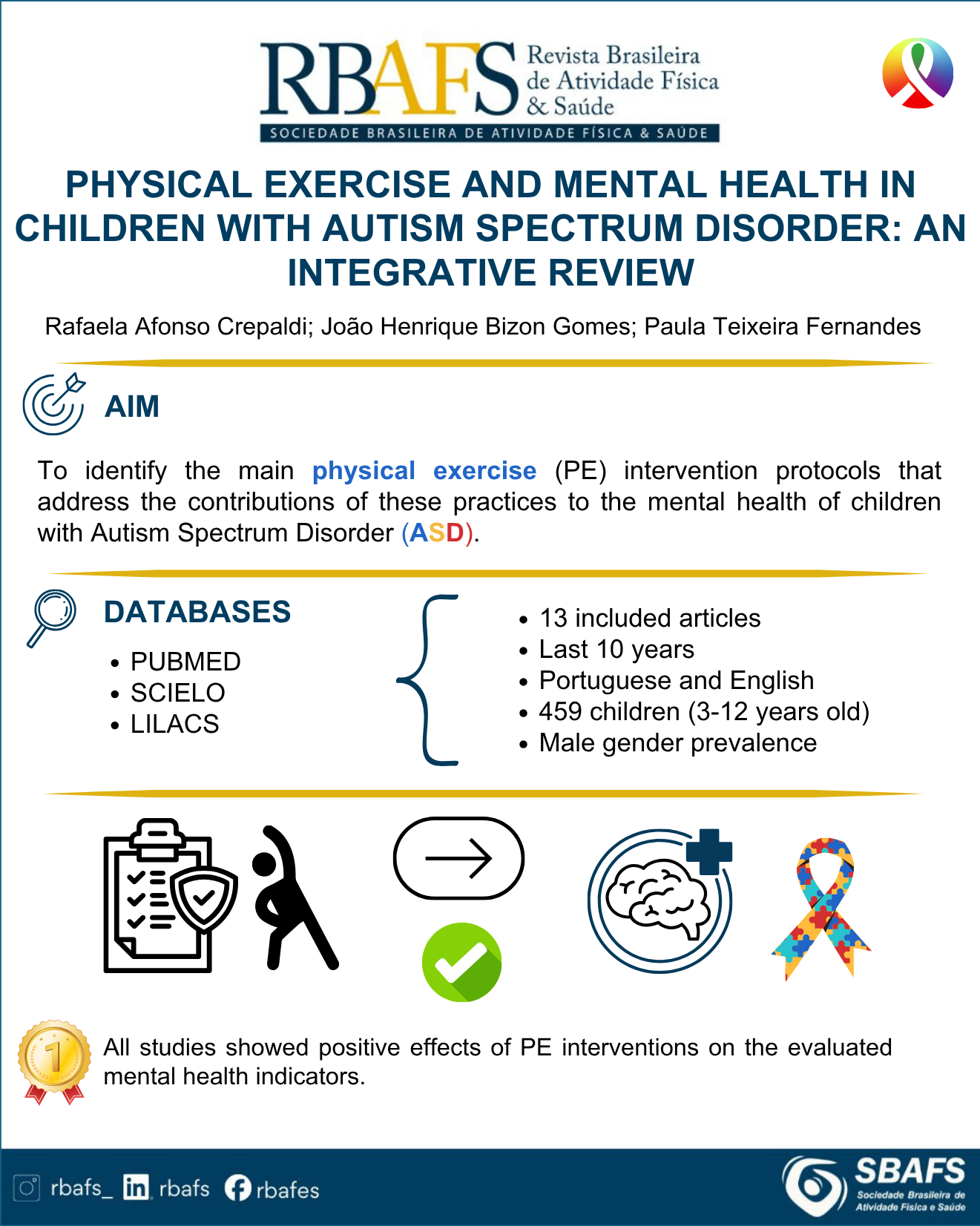
Introduction: The search for intervention strategies to promote the comprehensive development of children with Autism Spectrum Disorder (ASD) has been gaining increasing prominence. In this context, physical exercise (PE) has emerged as a promising resource, with growing evidence of its positive effects on motor, behavioral, and mental health outcomes. Aim: To identify the main physical exercise (PE) intervention protocols in recent studies that address the contributions of these practices to the mental health of this population. Methods: An integrative literature review was conducted in the following databases: LILACS, SciELO, and PubMed, covering the past ten years. Thirteen studies were selected, read in full, and qualitatively analyzed to identify convergences, divergences, trends, and existing research gaps. Results: All studies reported positive outcomes in mental health indicators. The intervention protocols ranged from 2 to 90 weeks in duration and varied across sports modalities and conventional PE sessions. The benefits of PE are enhanced when associated with cognitive, social, and affective components. The results demonstrated that isolated aerobic exercise does not produce the same cognitive and behavioral benefits as integrated global interventions. Conclusion: PE appears to be an essential strategy in the care of children with ASD. However, the analyzed studies did not assess mental health in a broad and multifactorial manner, highlighting the need for further research that considers the interplay among motor, social, cognitive, affective, and economic aspects that can limit the lives of children with ASD.
Downloads
References
1. American Psychiatric Association. Manual diagnóstico e estatístico de transtornos mentais: DSM-5-TR. 5ª ed. Porto Alegre: Artmed; 2022.
2. Vodakova E, Chatziioannou D, Jesina O, Kudlacek M. The effect of Halliwick method on aquatic skills of children with autism spectrum disorder. Int J Environ Res Public Health. 2022;19(23):16250-63.
3. Diniz NLF, Parlato-Oliveira E, Pimenta PGA, Araújo LA, Valadares ER. Autism and Down syndrome: early identification and diagnosis. Arq Neuropsiquiatr. 2022;80(6):620-30.
4. Lord C, Elsabbagh M, Baird G, Veenstra-Vanderweele J. Autism spectrum disorder. Lancet. 2018;392(10146):508-20.
5. Centers for Disease Control and Prevention (CDC). Data and statistics on autism spectrum disorder. United States: CDC; 2025. Disponível em: <https://www.cdc.gov/autism/data-research/index.html> [2025 Outubro].
6. Instituto Brasileiro de Geografia e Estatística (IBGE). Censo 2022 identifica 2,4 milhões de pessoas diagnosticadas com autismo no Brasil. Agência IBGE Notícias; 2025. Disponível em: https://agenciadenoticias.ibge.gov.br/agencia-noticias/2012-agencia-de-noticias/noticias/43464-censo-2022-identifica-2-4-milhoes-de-pessoas-diagnosticadas-com-autismo-no-brasil> [2025 outubro].
7. Ferreira JP, Toscano CVA, Rodrigues AM, Furtado GE, Barros MG, Wanderley RS, et al. Effects of a physical exercise program (PEP-Aut) on autistic children’s stereotyped behavior, metabolic and physical activity profiles, physical fitness, and health-related quality of life: A study protocol. Front Public Health. 2018;6:47-58.
8. Ji C, Yang J, Lin L, Chen S. Executive function improvement for children with autism spectrum disorder: A comparative study between virtual training and physical exercise methods. Children. 2022;9(4):507-18.
9. Tse ACY. Brief report: Impact of a physical exercise intervention on emotion regulation and behavioral functioning in children with autism spectrum disorder. J Autism Dev Disord. 2020;50(11):4191-8.
10. Ministério da Saúde. “Saúde mental no trabalho” é o tema do Dia Mundial da Saúde Mental 2017, comemorado em 10 de outubro [Internet]. Biblioteca Virtual em Saúde; 2017. Disponível em: <https://bvsms.saude.gov.br/saude-mental-no-trabalho-e- tema-do-dia-mundial-da-saude-mental-2017-comemorado-em-10-de-outubro/> [2025 outubro].
11. World Health Organization (WHO). Mental health action plan 2013-2020 [Internet]. Geneva: WHO; 2013. Disponível em: <https://www.who.int/publications/i/item/9789241506021> [2025 Outubro].
12. Ministério da Saúde. Guia de atividade física para a população brasileira [Internet]. Brasília: Ministério da Saúde; 2021 Disponível em: <http://bvsms.saude.gov.br/bvs/publicacoes/guia_atividade_fisica_populacao_brasileira.pdf> [2025 outubro].
13. Silva GC, Silva RA, Cavalcante Neto JL. Saúde mental e níveis de atividade física em crianças: uma revisão sistemática. Cad Bras Ter Ocup. 2017;25(3):607-15.
14. Souza MT, Silva MD, Carvalho R. Revisão integrativa: o que é e como fazer. Einstein (São Paulo). 2010;8:102-6.
15. Castaño PRL, Suárez DPM, González ER, Robledo-Castro C, Hederich-Martínez C, Cadena HPG, et al. Effects of physical exercise on gross motor skills in children with autism spectrum disorder. J Autism Dev Disord. 2024;54(8):2816-25.
16. Chen H, Liang Q, Wang B, Liu H, Dong G, Li K. Sports game intervention aids executive function enhancement in children with autism-An fNIRS study. Neurosci Lett. 2024;822:137647.
17. Jackson SLJ, Abel EA, Reimer S, McPartland JC. Brief report: a specialized fitness program for individuals with autism spectrum disorder benefits physical, behavioral, and emotional outcomes. J Autism Dev Disord. 2024;54(6):2402-10.
18. Orhan BE, Uzunçayir D, Canli U, Karaçam A, Ozdemir AS, Popa C, et al. Finding Stability - A Case Report on the Benefits of Adapted Kata Training for Children with Autism Spectrum Disorder. Children. 2024;11(5):523-37.
19. Tse ACY, Lee PH, Sit CHP, Poon ET, Sun BF, Pang CL, et al. Comparing the effectiveness of physical exercise intervention and melatonin supplement in improving sleep quality in children with ASD. J Autism Dev Disord. 2024;54(12):4456-64.
20. Yang Y, Chen D, Cai K, Zhu L, Shi Y, Dong X, et al. Effects of mini-basketball training program on social communication impairments and regional homogeneity of brain functions in preschool children with autism spectrum disorder. BMC Sports Sci Med Rehabil. 2024;16(1):92.
21. Silva JVT, Silva AW, Silva KMN, Keiner SA, Toscano CVA. Teleatendimento em exercício físico para população com transtorno do espectro autista: desafios e possibilidades. Rev Bras Educ Espec. 2023;29:e0151:77-92.
22. Tse ACY, Liu VHL, Lee PH, Anderson DL, Lakes KD. The relationships among executive functions, self-regulation, and physical exercise in children with autism spectrum disorder. Autism. 2023;28(2):327-41.
23. Tse ACY, Anderson DI, Liu VHL, Tsui SSL. Improving executive function of children with autism spectrum disorder through cycling skill acquisition. Med Sci Sports Exerc. 2021;53(7):1417-24.
24. Wang JG, Cai KL, Liu ZM, Herold F, Zou L, Zhu LN, et al. Effects of mini-basketball training program on executive functions and core symptoms among preschool children with autism spectrum disorders. Brain Sci. 2020;10(5):263.
25. Krüger GR, Garcias LM, Hax GP, Marques AC. O efeito de um programa de atividades rítmicas na interação social e na coordenação motora em crianças com transtorno do espectro autista. Rev Bras Ativ Fís Saúde. 2018;23:e0046:1-5.
26. Li L, Jia S, Wang P, Li S, Wang X, Zhu X. A network meta-analysis of the effect of physical exercise on core symptoms in patients with autism spectrum disorders. Front Neurol. 2024;15:1360434.
27. Wu Y, Ding L, Zhang Q, Dong Y, Tao C, Li Z, et al. The effect of physical exercise therapy on autism spectrum disorder: a systematic review and meta-analysis. Psychiatry Res. 2024;339:116074.
28. Jia S, Guo C, Li S, Zhou X, Wang X, Wang Q. The effect of physical exercise on disordered social communication in individuals with autism Spectrum disorder: a systematic review and meta-analysis of randomized controlled trials. Front Pediatr. 2023;11:1193648.
29. Diamond A. Effects of physical exercise on executive functions: going beyond simply moving to moving with thought. Ann Sports Med Res. 2015;2(1):1011.
30. Mandolesi L, Polverino A, Montuori S, Foti F, Ferraioli G, Sorrentino P, et al. Effects of physical exercise on cognitive functioning and wellbeing: biological and psychological benefits. Front Psychol. 2018;9:347071.
31. World Health Organization (WHO). World mental health report: transforming mental health for all. Geneva: WHO; 2022. Disponível em: <https://www.who.int/publications/i/item/9789240049338> [2025 outubro].
32. Flora ID, Silva BED, Silva Neto FP, Moreira DC, Soares BR, Sant’Ana PG. Influência do exercício físico no tratamento de transtornos mentais: uma revisão sistemática. Braz J Health Rev. 2024;7(9):e75649.
33. Tan BW, Pooley JA, Speelman CP. A meta-analytic review of the efficacy of physical exercise interventions on cognition in individuals with autism spectrum disorder and ADHD. J Autism Dev Disord. 2016;46(9):3126-43.
34. Liang X, Li R, Wong SHS, Sum RKW, Wang P, Yang B, et al. The effects of exercise interventions on executive functions in children and adolescents with autism spectrum disorder: a systematic review and meta-analysis. Sports Med. 2022;52(1):75-88.
35. Lourenço CCV, Esteves MDL, Corredeira RMN, Seabra AFT. Avaliação dos efeitos de programas de intervenção de atividade física em indivíduos com transtorno do espectro do autismo. Rev Bras Educ Espec. 2015;21(2):319-28.
36. Liang X, Haegele JA, Tse ACY, Li M, Zhang H, Zhao S, et al. The impact of the physical activity intervention on sleep in children and adolescents with autism spectrum disorder: A systematic review and meta-analysis. Sleep Med Rev. 2024;101913.
37. Li L, Jia S, Wang P, Li S, Wang X, Zhu X. A network meta-analysis of the effect of physical exercise on core symptoms in patients with autism spectrum disorders. Front Neurol. 2024;15:1360434.
38. Lima JL, Axt G, Teixeira DS, Monteiro D, Cid L, Yamamoto T, et al. Exergames for children and adolescents with autism spectrum disorder: an overview. Clin Pract Epidemiol Ment Health. 2020;16:1-6
Downloads
Published
How to Cite
Issue
Section
License
Copyright (c) 2026 Rafaela Afonso Crepaldi, João Henrique Bizon Gomes, Paula Teixeira Fernandes

This work is licensed under a Creative Commons Attribution 4.0 International License.
When submitting a manuscript to the Revista Brasileira de Atividade Física & Saúde, the authors retain the copyright to the article and authorize the Revista Brasileira de Atividade Física & Saúde to publish the manuscript under the Creative Commons Attribution 4.0 License and identify it as the original publication source.