Effects of epoch duration on estimated moderate and vigorous physical activity time among adults workers using the GT3X+ Accelerometer
DOI:
https://doi.org/10.12820/rbafs.31e0456Keywords:
Physical activity assessment, Accelerometry, MethodsAbstract
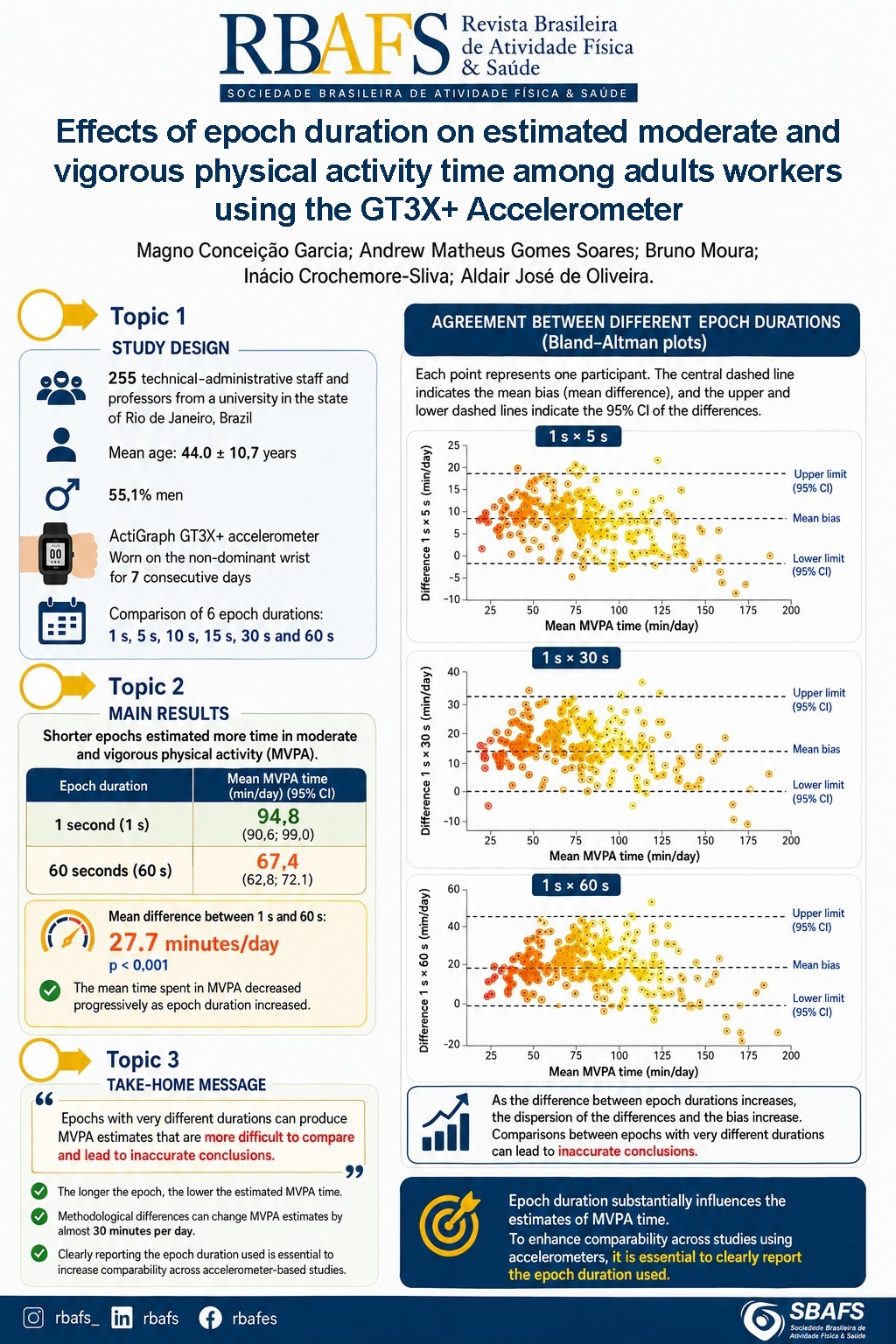
Introduction: Epoch length may influence physical activity estimates derived from accelerometers. Objective: To compare the effects of different epoch lengths on the average time spent in moderate-to-vigorous physical activity (MVPA) among adults using the GT3X+ accelerometer. Methods: This methodological study used data from the Longitudinal Study of Determinants of Physical Activity, a cohort of administrative staff and faculty members from a university in the state of Rio de Janeiro, Brazil.
Physical activity data were collected using an accelerometer (ActiGraph GT3X+) worn on the nondominant wrist for seven consecutive days. MVPA time was calculated using epoch lengths of 1s, 5s, 10s, 15s, 30s, and 60s. Analysis of variance was used to compare mean physical activity values across epoch lengths, followed by Bonferroni post hoc tests for pairwise comparisons. Bland–Altman plots were used to assess agreement. Accelerometer data processing and all statistical analyses were performed using R software. Results: A total of 255 participants were included (mean age: 44.0 ± 10.7 years; 55.3% men). Mean MVPA time was higher when calculated using shorter epochs compared with longer epochs (p < 0.001). MVPA estimated using a 1-second epoch was 94.8 minutes (95% CI: 90.6; 99.0), whereas the 60 second epoch yielded 67.4 minutes (95% CI: 62.8; 72.1), representing a significant mean difference of 27.7 minutes (p < 0.05). Conclusion: The observed differences indicate that substantially different epoch lengths may produce estimates that are difficult to compare and may lead to inaccurate conclusions. To improve comparability across studies using accelerometers, reporting the epoch length employed is essential.
Downloads
References
1. Thomas JJC, Daley AJ, Esliger DW, et al. Accelerometer-Measured Physical Activity Data Sets (Global Physical Activity Data Set Catalogue) That Include Markers of Cardiometabolic Health: Systematic Scoping Review. J Med Internet Res. 2023;25:e45599. DOI: https://doi.org/10.2196/45599
2. Fishman EI, Steeves JA, Zipunnikov V, et al. Association between Objectively Measured Physical Activity and Mortality in NHANES. Med Sci Sports Exerc. 2016;48(7):1303-11. DOI: https://doi.org/10.1249/MSS.0000000000000885
3. Knuth AG, Assunção MCF, Gonçalves H, et al. Descrição metodológica do uso de acelerometria para mensurar a prática de atividade física nas coortes de nascimentos de Pelotas, Rio Grande do Sul, Brasil, 1993 e 2004. Cad Saúde Pública. 2013;29:557-65. DOI: https://doi.org/10.1590/S0102-311X2013000300013
4. Wendt A, da Silva ICM, Gonçalves H, Assunção MCF, Menezes AMB, Wehrmeister FC. Sleep parameters measured by accelerometry: descriptive analyses from the 22-year follow-up of the Pelotas 1993 birth cohort. Sleep Med. 2020;67:83-90. DOI: https://doi.org/10.1016/j.sleep.2019.10.020
5. Migueles JH, Cadenas-Sanchez C, Ekelund U, et al. Accelerometer Data Collection and Processing Criteria to Assess Physical Activity and Other Outcomes: A Systematic Review and Practical Considerations. Sports Med. 2017;47(9):1821-45. DOI: https://doi.org/10.1007/s40279-017-0716-0
6. Sasaki J, Coutinho A, Santos C, et al. Orientações para utilização de acelerômetros no Brasil. Rev Bras Ativ Fís Saúde. 2017;22(2):110-26. DOI: https://doi.org/10.12820/rbafs.v.22n2p110-126
7. Altenburg TM, Wang X, Van Ekris E, et al. The consequences of using different epoch lengths on the classification of accelerometer based sedentary behaviour and physical activity. PLoS One. 2021;16(7 July 2021):1-14. DOI: https://doi.org/10.1371/journal.pone.0254721
8. de Almeida Mendes M, da Silva ICM, Ramires VV, Reichert FF, Martins RC, Tomasi E. Calibration of raw accelerometer data to measure physical activity: A systematic review. Gait Posture. 2018;61:98-110. DOI: https://doi.org/10.1016/j.gaitpost.2017.12.028
9. Farrahi V, Niemelä M, Kangas M, Korpelainen R, Jämsä T. Calibration and validation of accelerometer-based activity monitors: A systematic review of machine-learning approaches. Gait Posture. 2019;68:285-299. DOI: https://doi.org/10.1016/j.gaitpost.2018.12.003
10. Soares AMG, Moco BP, De Oliveira AJ. Comparison between data processing from GT3X+ accelerometer for vigorous moderate physical activity. J Phys Educ. 2022;33(1):e-3344.
11. Rowlands AV, Yates T, Davies M, Khunti K, Edwardson CL. Raw Accelerometer Data Analysis with GGIR R-package: Does Accelerometer Brand Matter? Med Sci Sports Exerc. 2016;48(10):1935. DOI: https://doi.org/10.1249/MSS.0000000000000978
12. Troiano RP, Berrigan D, Dodd KW, Mâsse LC, Tilert T, Mcdowell M. Physical Activity in the United States Measured by Accelerometer. Med Sci Sports Exerc. 2008;40(1):181-8. DOI: https://doi.org/10.1249/mss.0b013e31815a51b3
13. Aadland E, Nilsen AKO. Accelerometer epoch length influence associations for physical activity intensities with body mass index and locomotor skills in young children. J Sports Sci. 2022;40(14):1568-77. DOI: https://doi.org/10.1080/02640414.2022.2092979
14. Vale S, Santos R, Silva P, Soares-Miranda L, Mota J. Preschool Children Physical Activity Measurement: Importance of Epoch Length Choice. Pediatr Exerc Sci. 2009;21(4):413-20. DOI: https://doi.org/10.1123/pes.21.4.413
15. Chung WY, Purwar A, Sharma A. Frequency domain approach for activity classification using accelerometer. Annu Int Conf IEEE Eng Med Biol Soc. 2008:1120-3.
16. Gómez-García M, Torrado J, Bia D, Zócalo Y. Influence of Epoch Length and Recording Site on the Relationship Between Tri-Axial Accelerometry-Derived Physical Activity Levels and Structural, Functional, and Hemodynamic Properties of Central and Peripheral Arteries. Front Sports Act Living. 2022;4:1-21. DOI: https://doi.org/10.3389/fspor.2022.799659
17. Orme M, Wijndaele K, Sharp SJ, Westgate K, Ekelund U, Brage S. Combined influence of epoch length, cut-point and bout duration on accelerometry-derived physical activity. nt J Behav Nutr Phys Act. 2014;11(1):1-8. DOI: https://doi.org/10.1186/1479-5868-11-34
18. Ainsworth BE, Bassett J, Strath SJ, et al. Comparison of three methods for measuring the time spent in physical activity. Med Sci Sports Exerc. 2000;32(9 Suppl):S457-64. DOI: https://doi.org/10.1097/00005768-200009001-00004
19. Fabre Id N, Lhuisset N, Bernal C, Bois J. Effect of epoch length on intensity classification and on accuracy of measurement under controlled conditions on treadmill: Towards a better understanding of accelerometer measurement. PLoS One. Published online 2020. DOI: https://doi.org/10.1371/journal.pone.0227740
20. Skinner AM, Rowlands AV, Vlachopoulos D, Barker AR, Janz KF, Moore SA. The Influence of Accelerometer Epoch Length on Associations of Physical Activity Intensity and Volume with Bone Outcomes. J Sports Sci Med. 2023;22(1):117-32. DOI: https://doi.org/10.52082/jssm.2023.117
21. Haddadj R, Verdot C, Salanave B, Deschamps V, Vanhelst J. Impact of varying accelerometer epoch length on physical activity patterns in adults: Considerations for public health. PLoS One. 2024;19(12):e0316176. DOI: https://doi.org/10.1371/journal.pone.0316176
22. Trost SG, McIver KL, Pate RR. Conducting accelerometer-based activity assessments in field-based research. Med Sci Sports Exerc. 2005;37(11 Suppl):S531-43. DOI: https://doi.org/10.1249/01.mss.0000185657.86065.98
23. van Hees VT, Fang Z, Langford J, et al. Autocalibration of accelerometer data for free-living physical activity assessment using local gravity and temperature: an evaluation on four continents. J Appl Physiol. 2014;117(7):738-44. DOI: https://doi.org/10.1152/japplphysiol.00421.2014
24. Hildebrand M, Van Hees VT, Hansen BH, Ekelund U. Age Group Comparability of Raw Accelerometer Output from Wrist- and Hip-Worn Monitors. Med Sci Sports Exerc. 2014;46(9):1816. DOI: https://doi.org/10.1249/MSS.0000000000000289
25. Aadland E, Andersen LB, Anderssen SA, Resaland GK, Kvalheim OM. Accelerometer epoch setting is decisive for associations between physical activity and metabolic health in children. J Sports Sci. 2020;38(3):256-63. DOI: https://doi.org/10.1080/02640414.2019.1693320
26. Nilsson A, Ekelund U, Yngve A, Sjöström M. Assessing Physical Activity among Children with Accelerometers Using Different Time Sampling Intervals and Placements. Pediatric Exerc Sci. 2002;14(1):87-96. DOI: https://doi.org/10.1123/pes.14.1.87
27. Aibar A, Chanal J. Physical Education: The Effect of Epoch Lengths on Children’s Physical Activity in a Structured Context. PLoS One. 2015;10(4):e0121238. DOI: https://doi.org/10.1371/journal.pone.0121238
28. Sanders T, Cliff DP, Lonsdale C. Measuring Adolescent Boys’ Physical Activity: Bout Length and the Influence of Accelerometer Epoch Length. PLOS ONE. 2014;9(3):e92040. DOI: https://doi.org/10.1371/journal.pone.0092040
29. Ayabe M, Kumahara H, Morimura K, Tanaka H. Epoch length and the physical activity bout analysis: an accelerometry research issue. BMC research notes. 2013;6(1):20. DOI: https://doi.org/10.1186/1756-0500-6-20
30. Edwardson CL, Gorely T. Epoch length and its effect on physical activity intensity. Med Sci Sports Exerc. 2010;42(5):928-934. DOI: https://doi.org/10.1249/MSS.0b013e3181c301f5
31. Gabriel KP, McClain JJ, Schmid KK, et al. Issues in accelerometer methodology: the role of epoch length on estimates of physical activity and relationships with health outcomes in overweight, post-menopausal women. Int J Behav Nutr Phys Act. 2010;7:53. DOI: https://doi.org/10.1186/1479-5868-7-53
Downloads
Published
How to Cite
Issue
Section
License
Copyright (c) 2026 Magno Conceição Garcia, Andrew Matheus Gomes Soares, Bruno Moura, Inácio Crochemore-Silva, Aldair José de Oliveira

This work is licensed under a Creative Commons Attribution 4.0 International License.
When submitting a manuscript to the Revista Brasileira de Atividade Física & Saúde, the authors retain the copyright to the article and authorize the Revista Brasileira de Atividade Física & Saúde to publish the manuscript under the Creative Commons Attribution 4.0 License and identify it as the original publication source.