Impacts of physical activity on cognitive performance in middle-aged and older adults
DOI:
https://doi.org/10.12820/rbafs.31e0460Keywords:
Aged, Middle aged, Exercise, Cognition, COVID-19 pandemicAbstract
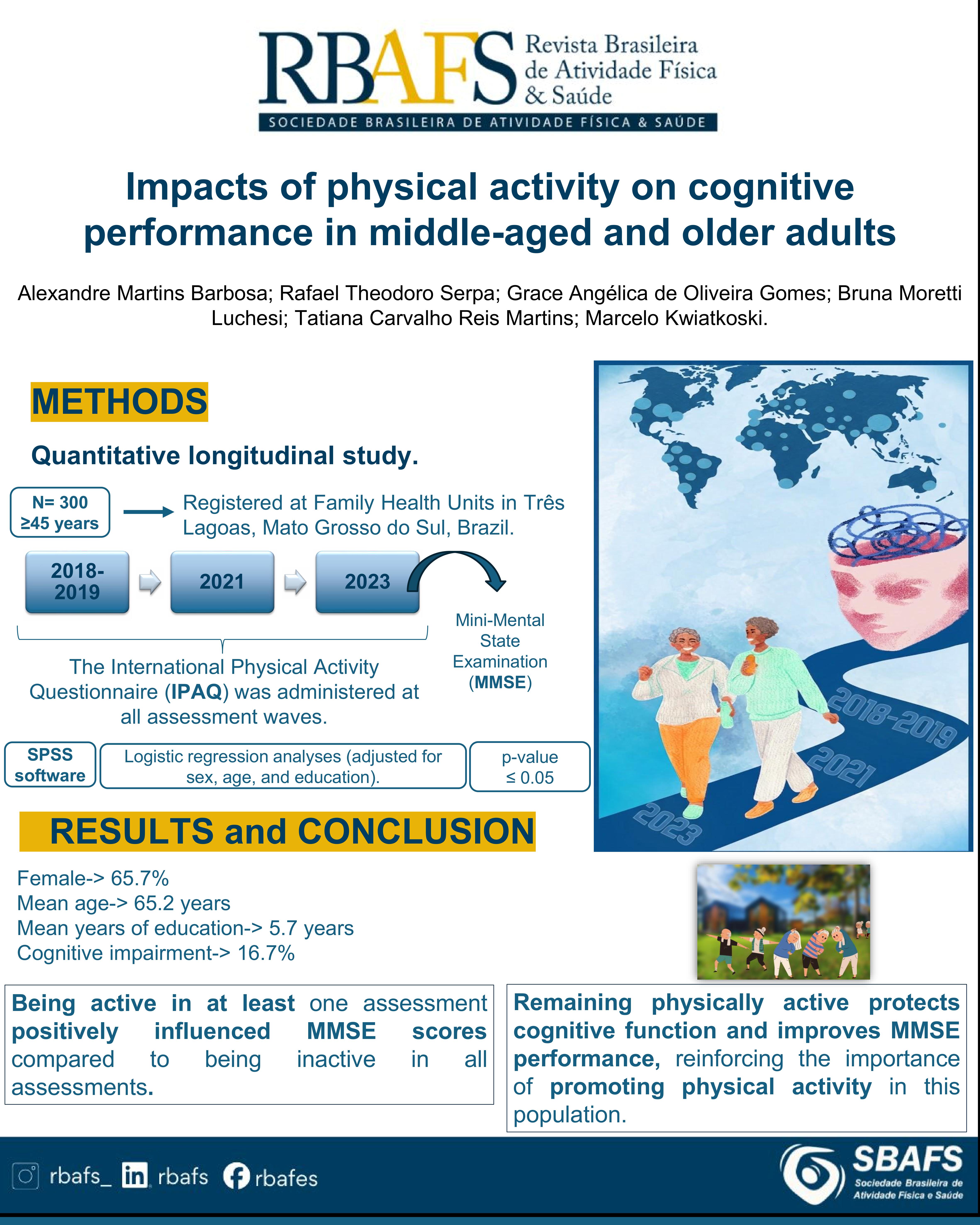
Introduction: Physical activity (PA) contributes to the prevention of cognitive impairment. Social isolation measures, such as those adopted during the COVID-19 pandemic, may negatively affect PA levels. Objective: To assess the longitudinal impacts of PA on cognitive performance in middle-aged and older adults. Methods: A longitudinal, quantitative study was conducted in 2018/2019 (T1), 2021 (T2), and 2023 (T3), involving 300 individuals aged 45 years and older, registered at Health Units in Três Lagoas, Mato Grosso do Sul, Brazil. The International Physical Activity Questionnaire, short version, was administered at all three assessments, and the Mini-Mental State Examination (MMSE) was administered at T3. Statistical analyses included logistic regression adjusted for sex, age, and education, as well as ANOVA. Results: At T3, most participants were female (65.7%), with a mean age of 65.2 years, 5.7 years of schooling, and 16.7% had cognitive impairment. Participants who were physically inactive at T1 (OR = 2.76; IC 95%: 1,34 – 5,72) and T2 (OR = 3.47; IC 95%: 1,31 - 9,21) had a significantly higher risk of cognitive impairment at T3. The greater the number of times a participant was classified as active across assessments (0–3), the lower the likelihood of cognitive impairment (OR = 0.52; IC 95%: 0,34 - 0,80). Being active in at least one assessment positively influenced MMSE scores compared to being inactive in all assessments. Conclusion: Physical inactivity increased the risk of cognitive impairment in middle-aged and older adults. Encouraging and promoting PA in this population is essential to minimize the impacts of aging on cognition.
Downloads
References
1. Kim BJ, Liu L, Cheung C, Ahn J. Effects of cognitive impairment and functional limitation on depressive symptoms among community-dwelling older Korean immigrants in the U.S. PloS One. 2018;13(3):e0193092.
2. Fogg C, Griffiths P, Meredith P, Bridges J. Hospital outcomes of older people with cognitive impairment: An integrative review. Int J Geriatr Psychiatry. 2018;33(9):1177–97.
3. Han FF, Wang HX, Wu JJ, Yao W, Hao CF, Pei JJ. Depressive symptoms and cognitive impairment: A 10-year follow-up study from the Survey of Health, Ageing and Retirement in Europe. Eur Psychiatry. 2021;64(1):e55.
4. Barros EMMAH de, Martelli Júnior H, Andrade RS de, Dias VO, Caldeira AP, Maia LC, et al. Comprometimento cognitivo e fatores associados em uma população de idosos. Cad Saúde Colet. 2023;31:e31040493.
5. Lázari MR de, Bertelli-Costa T, Scaramel IC, Adorno I, Vernin LRS, Neri AL. Prevalência e incidência de deficit cognitivo em pessoas idosas: associações com atividade física no lazer. Rev Bras Geriatr Gerontol. 2022;25(5):e220127.
6. Bloomberg M, Brocklebank L, Hamer M, Steptoe A. Joint associations of physical activity and sleep duration with cognitive ageing: longitudinal analysis of an English cohort study. Lancet Healthy Longev. 2023;4(7):e345–e353.
7. Galle SA, Deijen JB, Milders MV, De Greef MHG, Scherder EJA, van Duijn CM, et al. The effects of a moderate physical activity intervention on physical fitness and cognition in healthy elderly with low levels of physical activity: a randomized controlled trial. Alzheimer’s Res Ther. 2023;15(1):12.
8. Botero JP, Farah BQ, Correia MA, Lofrano-Prado MC, Cucato GG, Shumate G, Ritti-Dias RM, et al. Impact of the COVID-19 pandemic stay at home order and social isolation on physical activity levels and sedentary behavior in Brazilian adults. Einstein (Sao Paulo). 2021;19:eAE6156.
9. Runacres A, Mackintosh KA, Knight RL, Sheeran L, Thatcher R, Shelley J, et al. Impact of the COVID-19 Pandemic on Sedentary Time and Behaviour in Children and Adults: A Systematic Review and Meta-Analysis. Int J Environ Res Public Health. 2021;18(21):11286.
10. Silva DR, Werneck AO, Malta DC, Souza-Júnior PRB, Azevedo LO, Barros MBA, et al. Incidence of physical inactivity and excessive screen time during the first wave of the COVID-19 pandemic in Brazil: what are the most affected population groups? Ann Epidemiol. 2021;62:30–5.
11. Wilke J, Rahlf AL, Füzéki E, Groneberg DA, Hespanhol L, Mai P, et al. Physical Activity During Lockdowns Associated with the COVID-19 Pandemic: A Systematic Review and Multilevel Meta-analysis of 173 Studies with 320,636 Participants. Sports Med Open. 2022;8(1):125.
12. Brasil. Ministério da Saúde. Fundação Oswaldo Cruz. Recomendações para o planejamento de retorno às atividades escolares presenciais no contexto da pandemia de Covid-19. Brasília: Ministério da Saúde, 2021. Disponível em: <https://www.arca.fiocruz.br/bitstream/icict/48700/2/Recomendacao_retorno_atividades_escolares_2021-08-19.pdf> [2022 Junho].
13. Corbett A, Williams G, Creese B, Hampshire A, Hayman V, Palmer A, et al. Cognitive decline in older adults in the UK during and after the COVID-19 pandemic: a longitudinal analysis of PROTECT study data. The Lancet Healthy Longev. 2023;4(11):e591-e599.
14. Matsudo S, Araújo T, Matsudo V, Andrade D, Andrade E, Oliveira LC, et al. Questionário internacional de atividade física (IPAQ): estudo de validade e reprodutibilidade no Brasil. Rev Bras Ativ Fís Saúde. 2012;6(2):5-18.
15. Benedetti TRB, Antunes P de C, Rodriguez-Añez CR, Mazo GZ, Petroski ÉL. Reprodutibilidade e validade do Questionário Internacional de Atividade Física (IPAQ) em homens idosos. Rev Bras Med Esporte. 2007;13(1):11–6.
16. World Health Organization. WHO guidelines on physical activity and sedentary behaviour. 2020. Disponível em: <https://www.who.int/publications/i/item/9789240015128> [2023 Janeiro].
17. Bertolucci PHF, Brucki SMD, Campacci SR, Juliano Y. O Mini-Exame do Estado Mental em uma população geral: impacto da escolaridade. Arq Neuro-Psiquiatr. 1994;52(1):01–7.
18. Dong Y; Peng C. Principled missing data methods for researchers. SpringerPlus. 2013;2(1):222.
19. Graham JW. Missing Data Analysis: Making It Work in the Real World. Annu Rev Psychol. 2003;60(1):549–76.
20. Gomes GAO, Brown WJ, Codogno JS, Mielke GI. Twelve year trajectories of physical activity and health costs in mid-age Australian women. Int J of Behav Nutr Phys Act. 2020;17(1).
21. Kim HY. Statistical Notes for Clinical Researchers: Assessing Normal Distribution (2) Using Skewness and Kurtosis. Restor Dent Endod. 2013;38(1):52–4.
22. Yan S, Fu W, Wang C, Mao J, Liu B, Zou L, et al. Association between sedentary behavior and the risk of dementia: a systematic review and meta-analysis. Transl Psychiatry. 2020;10(1):112.
23. Dong B, Yue Y, Wang Z, Sun M, Wang Y. Association between physical activity, peak expiratory flow, and cognitive function in aging: a cross-sectional analysis. BMC Geriatr. 2024;24(1):460.
24. Amieva H, Retuerto N, Hernandez-Ruiz V, Meillon C, Dartigues JF, Pérès K. Longitudinal Study of Cognitive Decline before and after the COVID-19 Pandemic: Evidence from the PA-COVID Survey. Dement Geriatr Cogn Disord. 2022;51(1):56-62.
25. Feter N, Caputo EL, Smith EC, Doring IR, Cassuriaga J, Leite JS, et al. Association between physical activity and subjective memory decline triggered by the COVID-19 pandemic: Findings from the PAMPA cohort. Prev Med. 2021;145:106415.
26. Perez-Lasierra JL, Casajús JA, Casasnovas JA, Arbones-Mainar JM, Lobo A, Lobo E, et al. Can Physical Activity Reduce the Risk of Cognitive Decline in Apolipoprotein e4 Carriers? A Systematic Review. Int J Environ Res Public Health. 2021;18(14):7238. d
27. Chow LS, Gerszten RE, Taylor JM, Pedersen BK, van Praag H, Trappe S, et al. Exerkines in health, resilience and disease. Nat Rev Endocrinol. 2022;18(5):273–89.
28. Saheli M, Mandana Moshrefi, Masoumeh Baghalishahi, Amirhossein Mohkami, Yaser Firouzi, Suzuki K, et al. Cognitive Fitness: Harnessing the Strength of Exerkines for Aging and Metabolic Challenges. Sports. 2024;12(2):57.
29. Heo J, Noble EE, Call JA. The role of exerkines on brain mitochondria: a mini-review. J Appl Physiol. 2023;134(1):28–35.
30. Liu D, Pan Y, Wang J, Shen S, Zhao X. Relationship between different physical activity parameters and cognitive impairment in middle-aged and older adults: insights from a 4-year longitudinal study. BMC Psychol. 2025;13(1).
31. Yoneda T, Lewis NS, Knight JD, Rush J, Vendittelli R, Luca Kleineidam, et al. The Importance of Engaging in Physical Activity in Older Adulthood for Transitions Between Cognitive Status Categories and Death: A Coordinated Analysis of 14 Longitudinal Studies. J Gerontol A. 2020;76(9):1661–7.
32. Hamm JM, Parker K, Lachman ME, Mogle JA, Duggan KA, McGrath R. Increased frequency of light physical activity during midlife and old age buffers against cognitive declines. J Behav Med. 2024;47(5):622-34.
33. Stockwell S, Trott M, Tully M, Shin J, Barnett Y, Butler L, et al. Changes in physical activity and sedentary behaviours from before to during the COVID-19 pandemic lockdown: a systematic review. BMJ Open Sport Exerc Med. 2021;7(1).
34. Waterink L, Bakker ED, Leonie, Mangialasche F, Miia Kivipelto, Deckers K, et al. Changes in Brain-Health Related Modifiable Risk Factors in Older Adults After One Year of COVID-19-Restrictions. Front Psychiatry. 2022;13:877460.
35. Ekelund U, Tarp J, Steene-Johannessen J, Hansen BH, Jefferis B, Fagerland MW, et al. Dose-response associations between accelerometry measured physical activity and sedentary time and all cause mortality: systematic review and harmonised meta-analysis. BMJ. 2019;366(8211):l4570.
36. Katzmarzyk PT, Friedenreich C, Shiroma EJ, Lee I-Min. Physical inactivity and non-communicable disease burden in low-income, middle-income and high-income countries. Br J Sports Med. 2021;56(2):101-6.
37. Cunningham C, O’ Sullivan R, Caserotti P, Tully MA. Consequences of physical inactivity in older adults: A systematic review of reviews and meta‐analyses. Scand J Med Sci Sports. 2020;30(5):816–27.
Downloads
Published
How to Cite
Issue
Section
License
Copyright (c) 2026 Alexandre Martins Barbosa, Rafael Theodoro Serpa, Grace Angélica de Oliveira Gomes, Bruna Moretti Luchesi, Tatiana Carvalho Reis Martins, Marcelo Kwiatkoski

This work is licensed under a Creative Commons Attribution 4.0 International License.
When submitting a manuscript to the Revista Brasileira de Atividade Física & Saúde, the authors retain the copyright to the article and authorize the Revista Brasileira de Atividade Física & Saúde to publish the manuscript under the Creative Commons Attribution 4.0 License and identify it as the original publication source.