Transport-related physical activity in Brazil: an analysis of temporal trends using VIGITEL data
DOI:
https://doi.org/10.12820/rbafs.31e0459Keywords:
Active mobility, Active commuting, Urban areas, Socioeconomic factors, Public policiesAbstract
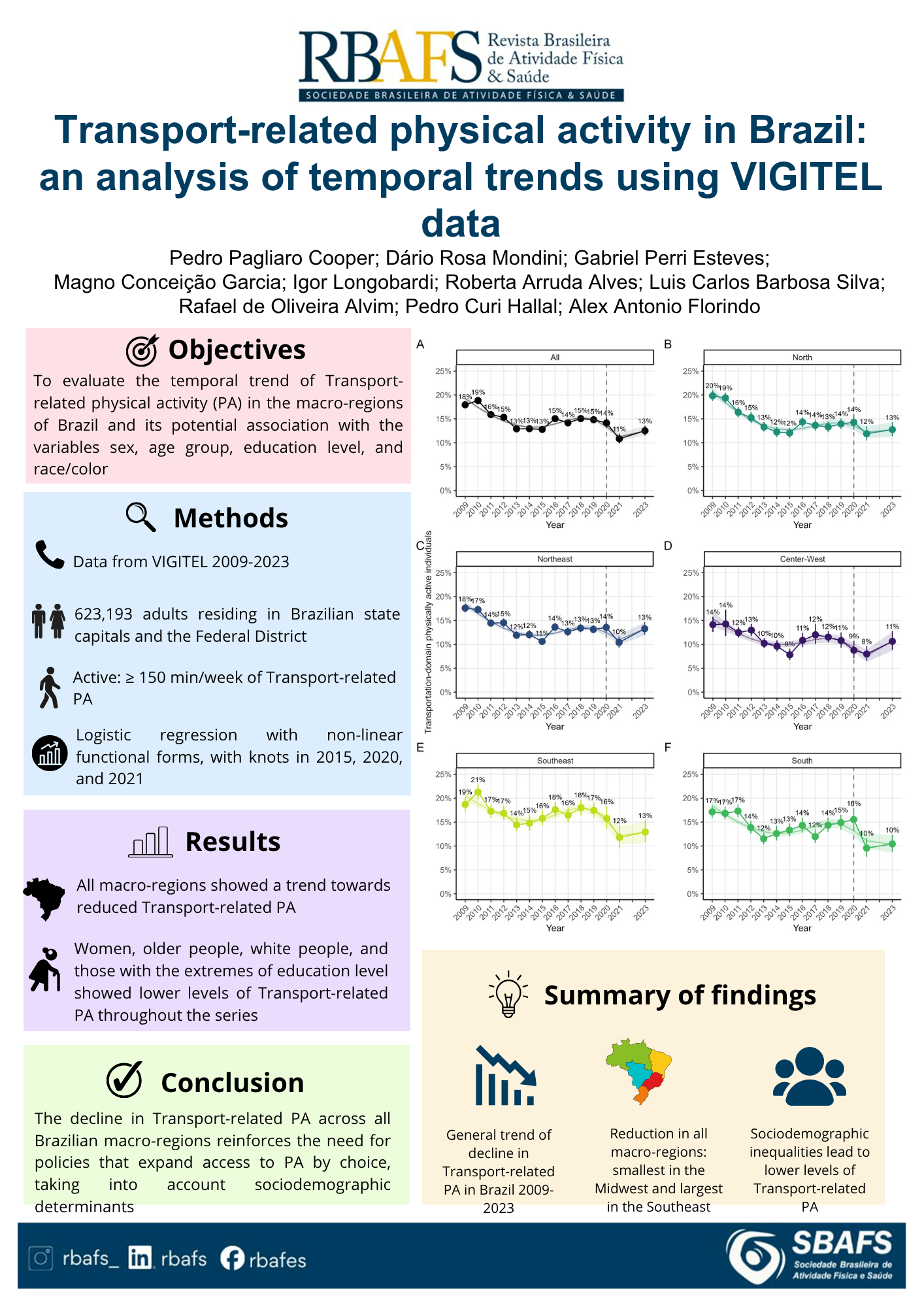
Introduction: Transport-related physical activity (TRPA) in urban areas can offer benefits for health, sustainability, and the right to the city, but studies investigating associated inequities are still lacking. Considering the inequalities among Brazilian macro-regions, it is necessary to understand how sociodemographic factors influence TRPA over time. Objectives: Evaluate the temporal trends of TRPA in Brazilian macro-regions and assess its potential association with sex, age, educational level, and race/ethnicity. Methods: Data from the VIGITEL telephone survey of 623.193 adults (≥18 years) living in Brazilian capitals and the Federal District between 2009 and 2023 were used. Individuals who achieved ≥150 minutes/week of TRPA were classified as physically active. To assess the variables of interest, logistic regression models with non-linear functional forms were applied, with nodes positioned in the years 2015, 2020, and 2021. Results: The proportion of individuals active in commuting decreased from 17.9% (95% CI: 17.2; 18.7) in 2009 to 12.5% (95% CI: 11.5; 13.6) in 2023. All macro-regions showed a downward trend, with the lowest prevalence in the Central-West and the highest in the Southeast. Women, the elderly, White individuals, and individuals with both higher (12 or more years) and lower (0-4 years) educational levels showed lower levels of TRPA throughout the series. Conclusion: Given the declining trend in TRPA, which is differently related to sociodemographic factors, the need for policies that expand its access as a choice, considering its determinants more comprehensively, is reinforced.
Downloads
References
1. Strain T, Flaxman S, Guthold R, Semenova E, Cowan M, Riley LM, et al. National, regional, and global trends in insufficient physical activity among adults from 2000 to 2022: a pooled analysis of 507 population-based surveys with 5·7 million participants. The Lancet Global Health. 2024;12(8):e1232-e1243.
2. World Health Organization. Global action plan on physical activity 2018–2030: more active people for a healthier world. 2018. Disponível em: <https://iris.who.int/items/4d3e290b-aa54-4d9b-8a8f-3baaa5e0d3df> [2025 outubro].
3. Hallal PC, Andersen LB, Bull FC, Guthold R, Haskell W, Ekelund U. Global physical activity levels: surveillance progress, pitfalls, and prospects. The Lancet. 2012;380(9838):247-57.
4. Salvo D, Jáuregui A, Adlakha D, Sarmiento OL, Reis RS. When Moving Is the Only Option: The Role of Necessity Versus Choice for Understanding and Promoting Physical Activity in Low- and Middle-Income Countries. Annu Rev Public Health. 2023;44:151-69.
5. Florindo AA, Goulardins GS, Andrade DR, Knebel MTG, Santos MP, Hallal PC, et al. Em defesa da caminhada e do uso de bicicleta como deslocamento no Brasil. Cad Saúde Pública. 2025;41:e00099324.
6. Crochemore-Silva I, Knuth AG, Mielke GI, Loch MR. Promoção de atividade física e as políticas públicas no combate às desigualdades: reflexões a partir da Lei dos Cuidados Inversos e Hipótese da Equidade Inversa. Cad Saúde Pública. 2020;36:e00155119.
7. Salvo D, Crochemore-Silva I, Wendt A, Tarp J, Shiroma EJ, Simpson RJ, et al. Physical activity for public health in the 21st century. Nat Med. 2026;32(4):1479-89.
8. Brasil, Ministério da Saúde. Vigitel Brasil 2021 - estimativas sobre frequência e distribuição sociodemográfica de fatores de risco e proteção para doenças crônicas — Ministério da Saúde. Disponível em: <https://www.gov.br/saude/pt-br/centrais-de-conteudo/publicacoes/svsa/vigitel/vigitel-brasil-2021-estimativas-sobre-frequencia-e-distribuicao-sociodemografica-de-fatores-de-risco-e-protecao-para-doencas-cronicas/view> [2025 fevereiro].
9. Bernal RTI, Iser BPM, Malta DC, Claro RM. Surveillance System for Risk and Protective Factors for Chronic Diseases by Telephone Survey (Vigitel): changes in weighting methodology. Epidemiol Serv Saúde. 2017;26:701-712.
10. Bastone A de C, Moreira B de S, Vasconcelos KS de S, Magalhães AS, Coelho DM, Silva JI da, et al. Time trends of physical activity for leisure and transportation in the Brazilian adult population: results from Vigitel, 2010-2019. Cad Saúde Pública. 2022;38:e00057222.
11. Herreros-Irarrázabal D, Guzmán-Habinger J, Mahecha Matsudo S, Kovalskys I, Gómez G, Rigotti A, et al. Association between Active Transportation and Public Transport with an Objectively Measured Meeting of Moderate-to-Vigorous Physical Activity and Daily Steps Guidelines in Adults by Sex from Eight Latin American Countries. Int J Environ Res Public Health. 2021;18(21):11553.
12. Pereira RHM, Warwar L, Parga J, Bazzo J, Braga CK, Herszenhut D, et al. Tendências e desigualdades da mobilidade urbana no Brasil I: o uso do transporte coletivo e individual. Instituto de Pesquisa Econômica Aplicada - IPEA. 2021:1-51.
13. Rissel C, Curac N, Greenaway M, Bauman A. Physical Activity Associated with Public Transport Use—A Review and Modelling of Potential Benefits. Int J Environ Res Public Health. 2012;9(7):2454-2478.
14. Confederação Nacional da Indústria. Mobilidade Urbana no Brasil: Marco Institucional e Propostas de Modernização. Mobilidade urbana no Brasil marco institucional e propostas de modernização [Internet]. 2023. Disponível em: <http://portaldaindustria.com.br/publicacoes/2023/5/mobilidade-urbana-no-brasil-marco-institucional-e-propostas-de-modernizacao/> [2025 outubro].
15. Ali PC, Jesus LAN de, Ramos LLA. Espaços livres de uso público no contexto da segurança urbana. Ambient constr. 2020;20:67-86.
16. Schymura LG. O papel da falta de sorte na “década perdida” de 2011 a 2020 | IBRE. February 8, 2022. Disponível em: <https://portalibre.fgv.br/revista-conjuntura-economica/carta-da-conjuntura/o-papel-da-falta-de-sorte-na-decada-perdida-de> [2026 abril].
17. Associação Nacional das Empresas de Transportes Urbanos. Anuário NTU: 2023-2024. Associação Nacional das Empresas de Transportes Urbanos; 2024:72. Disponível em: <https://ntu.org.br/novo/upload/Publicacao/Pub638573500081945042.pdf> [2026 abril].
18. Teixeira IP. Infraestrutura para o deslocamento ativo: uma análise territorial nos 5.570 municípios brasileiros. Rev Bras Ativ Fís Saúde. 2026;31:1-19.
19. Madeira MC, Siqueira FCV, Facchini LA, Silveira DS da, Tomasi E, Thumé E, et al. Atividade física no deslocamento em adultos e idosos do Brasil: prevalências e fatores associados. Cad Saúde Pública. 2013;29:165-174.
20. Florindo AA, Hallal PC, Moura EC de, Malta DC. Prática de atividades físicas e fatores associados em adultos, Brasil, 2006. Rev Saúde Pública. 2009;43:65-73.
21. Pereira R, Vieira J. Tendências e Desigualdades Da Mobilidade Urbana No Brasil III : O Uso Da Mobilidade Ativa. Julho de 2024. IPEA; 2024.
22. Agência IBGE Notícias. Pessoas pretas e pardas continuam com menor acesso a emprego, educação, segurança e saneamento | Agência de Notícias. Agência de Notícias - IBGE. November 11, 2022. Disponível em: <https://agenciadenoticias.ibge.gov.br/agencia-noticias/2012-agencia-de-noticias/noticias/35467-pessoas-pretas-e-pardas-continuam-com-menor-acesso-a-emprego-educacao-seguranca-e-saneamento> [2025 outubro].
23. Instituto Brasileiro de Geografia e Estatística (IBGE). Desigualdades Sociais Por Cor Ou Raça No Brasil. IBGE; 2022. Disponível em: <https://biblioteca.ibge.gov.br/visualizacao/livros/liv101972_informativo.pdf.> [2025 setembro].
24. Goel R, Goodman A, Aldred R, Nakamura R, Tatah L, Garcia LMT, et al. Cycling behaviour in 17 countries across 6 continents: levels of cycling, who cycles, for what purpose, and how far? Transp Rev. 2022; 42(1):58–81.
25. Machado A. Movimentas - Direito à Mobilidade: Discurso – Gênero. Letra Capital Editora Ltda; 2022:150. Disponível em: <https://www.letracapital.com.br/wp-content/uploads/2023/02/movimentas-digital.pdf?srsltid=AfmBOopsSLB8TqmbzBEo9PcVaMgEGy9Nw-6J0uVBhpeAQJVnTlvDk9up> [2025 outubro].
Downloads
Published
How to Cite
Issue
Section
License
Copyright (c) 2026 Pedro Pagliaro Cooper, Dário Rosa Mondini, Gabriel Perri Esteves, Magno Conceição Garcia, Igor Longobardi, Roberta Arruda Alves, Luis Carlos Barbosa Silva, Rafael de Oliveira Alvim, Pedro Curi Hallal, Alex Antonio Florindo

This work is licensed under a Creative Commons Attribution 4.0 International License.
When submitting a manuscript to the Revista Brasileira de Atividade Física & Saúde, the authors retain the copyright to the article and authorize the Revista Brasileira de Atividade Física & Saúde to publish the manuscript under the Creative Commons Attribution 4.0 License and identify it as the original publication source.