National overview of infrastructure for active commuting: a territorial analysis of Brazil’s 5,570 municipalities
DOI:
https://doi.org/10.12820/rbafs.31e0433Keywords:
Infrastructure, Walking, Cycling, Census, City planningAbstract
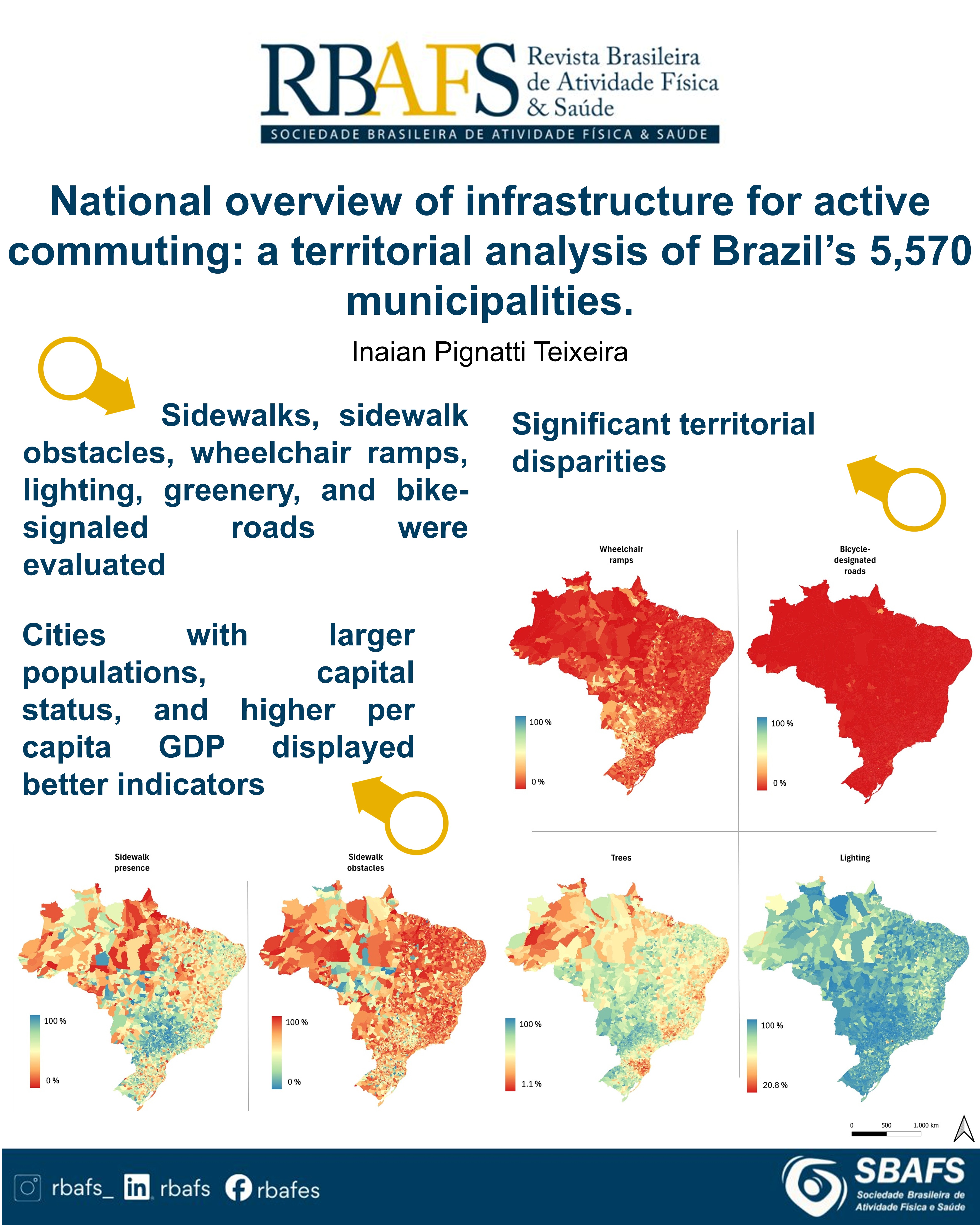
Objective: This study presents a territorial analysis of urban infrastructure aimed at active commuting-sidewalks, sidewalk obstacles, wheelchair ramps, lighting, trees, and bike-signaled roads -across Brazil’s 5,570 municipalities, based on data from the 2022 Urban Survey of Household Surroundings conducted by the Brazilian Institute of Geography and Statistics. Methods: Descriptive statistical analyses of these elements were performed for all municipalities, further stratified by municipality size, region of Brazil, population growth, per capita Gross Domestic Product (GDP), and urban hierarchy, as well as specifically for each of the 27 Brazilian capitals. Results: The results reveal significant territorial disparities. Cities with larger populations, capital status, and higher per capita GDP displayed better indicators such as the presence of wheelchair ramps, tree coverage, and sidewalks. Bike-signaled roads were consistently low across most Brazilian municipalities, while street lighting showed consistently high coverage nationwide. Conclusion: These findings also support the planning of cities that are more equitable, resilient, and sustainable. These results, disaggregated for all 5,570 municipalities and aggregated for comparison groups, provide valuable input for the development and revision of master plans, urban mobility strategies, and initiatives focused on territorial equity, aligning with the targets of Sustainable Development Goal 11 and the principles of the Brazilian City Statute.
Downloads
References
1. Nabiyeva GN, Wheeler SM, London JK, Brazil N. Implementation of SDG 11: initial good practices. Sustainability. 2023;15(20):14810. doi: https://doi.org/10.3390/su152014810 DOI: https://doi.org/10.3390/su152014810
2. Elsey H, Thomson D, Lin R, Maharjan U, Agarwal S, Newell J. Addressing inequities in urban health: do decision-makers have the data they need? J Urban Health. 2016;93:526–37. doi: https://doi.org/10.1007/s11524-016-0046-9 DOI: https://doi.org/10.1007/s11524-016-0046-9
3. Organização Mundial da Saúde (OMS). Global action plan on physical activity 2018–2030: more active people for a healthier world. World Health Organization. 2018. Disponível em: <https://apps.who.int/iris/handle/10665/272722> [2025 julho].
4. Jáuregui A, Lambert EV, Panter J, Moore C, Salvo D. Scaling up urban infrastructure for physical activity in the COVID-19 pandemic and beyond. Lancet. 2021;398(10298):370–2. doi: https://doi.org/10.1016/S0140-6736(21)01599-3 DOI: https://doi.org/10.1016/S0140-6736(21)01599-3
5. Papageorgiou GN, Tsappi E. Development of an active transportation framework model. Sustainability. 2024;16(17):7546. doi: https://doi.org/10.3390/su16177546 DOI: https://doi.org/10.3390/su16177546
6. Edwards P, Tsouros AD. A healthy city is an active city: a physical activity planning guide. Copenhagen: WHO Regional Office for Europe; 2012. Disponível em: <https://iris.who.int/handle/10665/341088> [2025 julho].
7. Jacobs J, Alston L, Needham C, Backholer K, Strugnell C, Allender S, et al. Variation in the physical activity environment according to area-level socio-economic position—a systematic review. Obes Rev. 2019;20:686–700. doi: https://doi.org/10.1111/obr.12818 DOI: https://doi.org/10.1111/obr.12818
8. Duhl LJ, Sanchez AK. Healthy cities and the city planning process. Copenhagen: WHO Regional Office for Europe; 1999.
9. Corburn J. Toward the healthy city: people, places, and the politics of urban planning. Cambridge: MIT Press; 2009. DOI: https://doi.org/10.7551/mitpress/7583.001.0001
10. Florindo AA, Goulardins GS, Andrade DR, Knebel MTG, Santos MP, Hallal PC, et al. Em defesa da caminhada e do uso de bicicleta como deslocamento no Brasil. Cad Saúde Pública. 2025;41(2):e00099324. doi: https://doi.org/10.1590/0102-311XPT099324 DOI: https://doi.org/10.1590/0102-311xpt099324
11. Salvo D, Jáuregui A, Adlakha D, Sarmiento OL, Reis RS. When Moving Is the Only Option: The Role of Necessity Versus Choice for Understanding and Promoting Physical Activity in Low- and Middle-Income Countries. Annu Rev Public Health. 2023;44:151-69. doi: 10.1146/annurev-publhealth-071321-042211 DOI: https://doi.org/10.1146/annurev-publhealth-071321-042211
12. Jia B, Chen Y, Wu J. Bibliometric analysis of healthy urban planning. Int J Environ Res Public Health. 2021;18(18):9444. doi: https://doi.org/10.3390/ijerph18189444 DOI: https://doi.org/10.3390/ijerph18189444
13. World Resources Institute. Invest in walking and cycling for sustainable, safe cities. Washington, DC: WRI; 2022. Disponível em: <https://www.wri.org> [2025 julho].
14. Instituto de Políticas de Transporte e Desenvolvimento. MobiliDADOS. Disponível em: <https://mobilidados.org.br> [2025 julho].
15. Teixeira IP, Barbosa JPAS, Barrozo LV, Hino AAF, Nakamura PM, Andrade DR, et al. Built environments for physical activity: a longitudinal descriptive analysis of São Paulo city, Brazil. Cities Health. 2023;7:137–47. doi: https://doi.org/10.1080/23748834.2022.2127173 DOI: https://doi.org/10.1080/23748834.2022.2127173
16. Pereira RHM, Braga CK, Serra B, Nadalin, VG. Desigualdades socioespaciais de acesso a oportunidades nas cidades brasileiras. 2019. Disponível em: <https://repositorio.ipea.gov.br/bitstream/11058/9586/1/td_2535.pdf> [2025 julho].
17. Madeira MC, Siqueira FCV, Facchini LA, Silveira DS, Tomasi E, Thumé E, et al. Atividade física no deslocamento em adultos e idosos do Brasil: prevalências e fatores associados. Cad Saúde Pública. 2013;29:165–74. doi: https://doi.org/10.1590/S0102-311X2013000100019 DOI: https://doi.org/10.1590/S0102-311X2013000100019
18. Nações Unidas. Transforming our world: the 2030 agenda for sustainable development. New York: UN; 2015.
19. SpringerLink. SDG-11: sustainable cities and communities. Cham: SpringerLink; 2024. Disponível em: <https://link.springer.com/collections/jhhcjfdifg> [2025 julho].
20. Favarão Leão AL, Gierbolini-Rivera RD, Franco Silva M, Shaw C, O’Connor A, Salvo D, et al. Spatial indicators of inequity in urban health research: a scoping review. Discov Public Health. 2025;22:27. doi: https://doi.org/10.1186/s12982-025-00421-z DOI: https://doi.org/10.1186/s12982-025-00421-z
21. IBGE. Pesquisa urbanística do entorno dos domicílios. Rio de Janeiro: IBGE; 2022.
22. Câmara JA. Plano diretor. In: Ferraz S, Dallari AA, editors. Estatuto da Cidade (Comentários à Lei federal 10.257/2001). 4th ed. São Paulo: Malheiros; 2010. p. 318–34.
23. IBGE. Pesquisa urbanística do entorno dos domicílios. Disponível em: <https://biblioteca.ibge.gov.br/visualizacao/livros/liv102168.pdf> [2025 agosto].
24. IBGE. Treinamento da Pesquisa Urbanística do Entorno dos Domicílios. n.d. Disponível em: <https://censo2022.ibge.gov.br/treinamento-entorno/capa.php> [2025 julho]
25. Leite DS, Alves WF. Iluminação pública: sua relevância para a segurança e qualidade de vida do cidadão. Rev. Contemp. 2023;3(7): 8223-47. doi: https://doi.org/10.56083/RCV3N7-046 DOI: https://doi.org/10.56083/RCV3N7-046
26. Teixeira IP, Rodrigues da Silva AN, Schwanen T, Manzato GG, Dörrzapf L, et al. Does cycling infrastructure reduce stress biomarkers in commuting cyclists? A comparison of five European cities. J. Transp. Geogr. 2020;88:102830. doi: https://doi.org/10.1016/j.jtrangeo.2020.102830 DOI: https://doi.org/10.1016/j.jtrangeo.2020.102830
27. Rocha CA, Marques EV, Mendonça KV de, Zanella ME, Cavalcante RM. Percepção ambiental dos usuários de locais utilizados para a prática de atividade física e lazer na cidade de Fortaleza (CE). Rev Bras Educ Ambient. 2023;18(7):42–54. doi: https://doi.org/10.34024/revbea.2023.v18.15445 DOI: https://doi.org/10.34024/revbea.2023.v18.15445
28. Carvalho JP. A árvore no espaço urbano. Rev Agrotecnologia - Agrotec. 2013;9. Disponível em: <https://www.researchgate.net/publication/344954916_A_Arvore_no_Espaco_Urbano>. [2025 julho].
Downloads
Published
How to Cite
Issue
Section
License
Copyright (c) 2026 Inaian Pignatti Teixeira

This work is licensed under a Creative Commons Attribution 4.0 International License.
When submitting a manuscript to the Revista Brasileira de Atividade Física & Saúde, the authors retain the copyright to the article and authorize the Revista Brasileira de Atividade Física & Saúde to publish the manuscript under the Creative Commons Attribution 4.0 License and identify it as the original publication source.