The importance of the moderate-to-vigorous physical activity and sedentary behavior combined pattern on the association between body mass index and motor competence in children
DOI:
https://doi.org/10.12820/rbafs.30e0411Keywords:
Psychomotor performance, Child, Adiposity, Motor activityAbstract
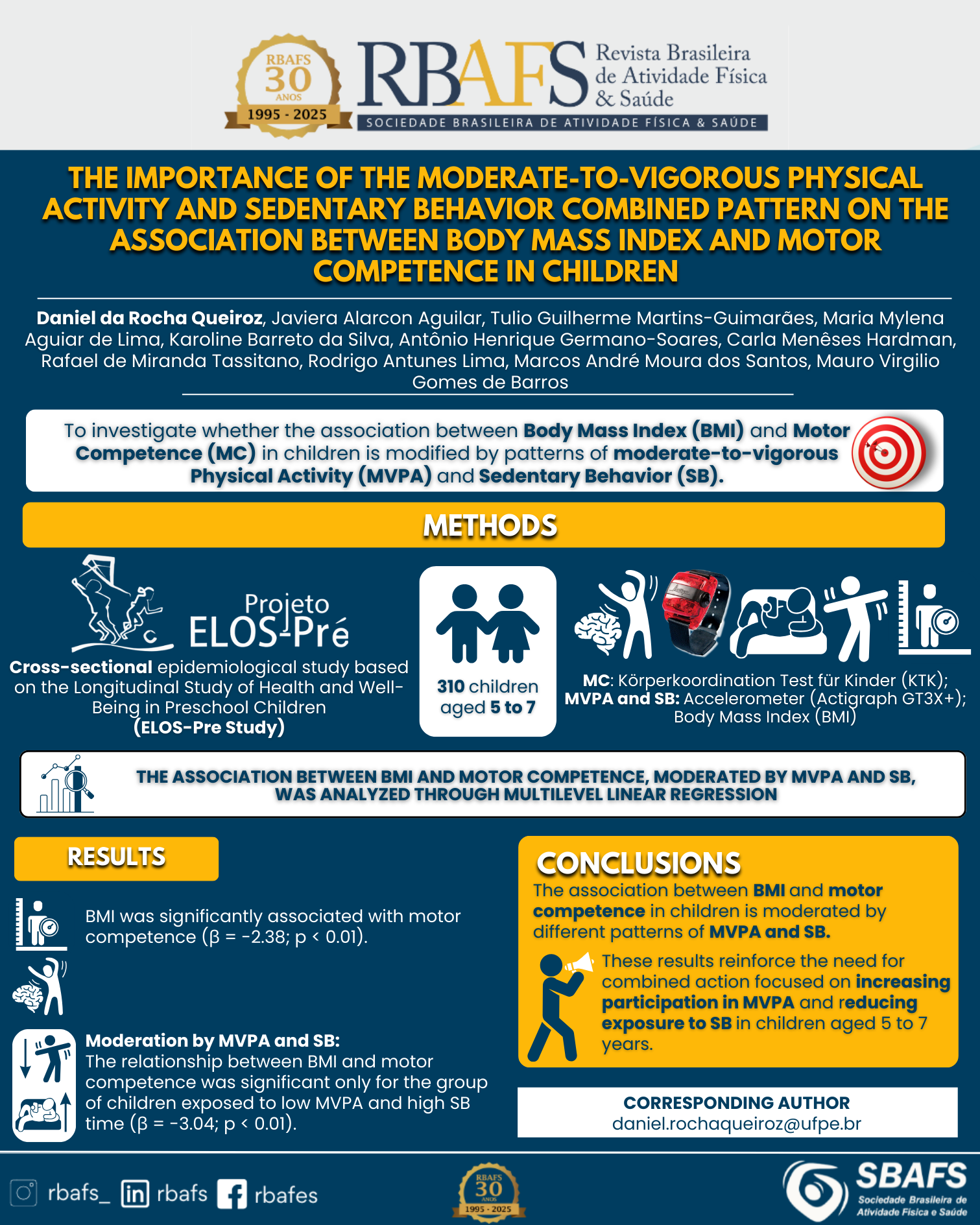
Objective: To investigate whether the association between body mass index and motor competence in children is modified by patterns of moderate-to-vigorous physical activity and sedentary behavior (SB). Methods: This is a cross-sectional study based on the data from 310 children (5-7 years old) who participated in the Longitudinal Study of Health and Well-Being in Preschool Children (ELOS-Pre Study) in Recife, Brazil. Motor competence was assessed using the Körperkoordination Test für Kinder (KTK). The duration and moderate-to-vigorous physical activity and time spent in SB were measured directly by accelerometer. A multilevel linear regression was performed to verify the association between body mass index and motor competence, moderated by moderate-to-vigorous physical activity and sedentary behavior patterns. Results: Body mass index was significantly related to motor competence (β = -2.38, p < 0.01). After considering moderate-to-vigorous physical activity and sedentary behavior patterns, the relationship between body mass index and motor competence was only significant for the group of children exposed to a low pattern of moderate-to-vigorous physical activity and high time spent in sedentary behavior (β = -3.04, p < 0.01). Conclusions: The association between body mass index and motor competence in children is moderated by different patterns of moderate-to-vigorous physical activity and sedentary behavior.
Downloads
References
1. Cattuzzo MT, Dos Santos Henrique R, Re AH, de Oliveira IS, Melo BM, de Sousa Moura M, et al. Motor competence and health related physical fitness in youth: A systematic review. J Sci Med Sport. 2016;19(2):123-9. DOI: https://doi.org/10.1016/j.jsams.2014.12.004
2. Utesch T, Bardid F, Büsch D, Strauss B. The relationship between motor competence and physical fitness from early childhood to early adulthood: A meta-analysis. Sports Med. 2019;49(4):541-51. DOI: https://doi.org/10.1007/s40279-019-01068-y
3. Robinson LE, Stodden DF, Barnett LM, Lopes VP, Logan SW, Rodrigues LP, et al. Motor competence and its effect on positive developmental trajectories of health. Sports Med. 2015;45(9):1273-84. DOI: https://doi.org/10.1007/s40279-015-0351-6
4. Stodden DF, Goodway JD, Langendorfer SJ, Roberton MA, Rudisill ME, Garcia C, et al. A developmental perspective on the role of motor skill competence in physical activity: An emergent relationship. Quest. 2008;60(2):290-306. DOI: https://doi.org/10.1080/00336297.2008.10483582
5. Barnett LM, Webster EK, Hulteen RM, De Meester A, Valentini NC, Lenoir M, et al. Through the looking glass: A systematic review of longitudinal evidence, providing new insight for motor competence and health. Sports Med. 2022;52(4):875-920. DOI: https://doi.org/10.1007/s40279-021-01516-8
6. Barros WMA, da Silva KG, Silva RKP, Souza A, da Silva ABJ, Silva MRM, et al. Effects of overweight/obesity on motor performance in children: A systematic review. Front Endocrinol (Lausanne). 2021;12:759165. DOI: https://doi.org/10.3389/fendo.2021.759165
7. Martins C, Romo-Perez V, Webster EK, Duncan M, Lemos LF, Staiano AE, et al. Motor competence and body mass index in the preschool years: A pooled cross-sectional analysis of 5545 children from eight countries. Sports Med. 2024;54(2):505-16. DOI: https://doi.org/10.1007/s40279-023-01929-7
8. Chowdhury SD, Wrotniak BH, Ghosh T. Association between body mass index and motor competence in Santal children of Purulia district, India. J Mot Behav. 2017;49(3):349-54. DOI: https://doi.org/10.1080/00222895.2016.1219308
9. D'Hondt E, Deforche B, Vaeyens R, Vandorpe B, Vandendriessche J, Pion J, et al. Gross motor coordination in relation to weight status and age in 5- to 12-year-old boys and girls: a cross-sectional study. Int J Pediatr Obes. 2011;6(2-2):e556-64. DOI: https://doi.org/10.3109/17477166.2010.500388
10. Lopes VP, Malina RM, Maia JAR, Rodrigues LP. Body mass index and motor coordination: Non-linear relationships in children 6-10 years. Child Care Health Dev. 2018;44(3):443-51. DOI: https://doi.org/10.1111/cch.12557
11. Lopes VP, Stodden DF, Bianchi MM, Maia JA, Rodrigues LP. Correlation between BMI and motor coordination in children. J Sci Med Sport. 2012;15(1):38-43. DOI: https://doi.org/10.1016/j.jsams.2011.07.005
12. Luz LGO, Coelho ESMJ, Duarte JP, Valente-Dos-Santos J, Machado-Rodrigues A, Seabra A, et al. Multivariate relationships among morphology, fitness and motor coordination in prepubertal girls. J Sports Sci Med. 2018;17(2):197-204.
13. Queiroz DDR, Aguilar JA, Martins Guimarães TG, Hardman CM, Lima RA, Duncan MJ, et al. Association between body mass index, physical activity and motor competence in children: moderation analysis by different environmental contexts. Ann Hum Biol. 2020;47(5):417-24. DOI: https://doi.org/10.1080/03014460.2020.1779815
14. D'Hondt E, Deforche B, Gentier I, Verstuyf J, Vaeyens R, De Bourdeaudhuij I, et al. A longitudinal study of gross motor coordination and weight status in children. Obesity (Silver Spring). 2014;22(6):1505-11. DOI: https://doi.org/10.1002/oby.20723
15. Lima RA, Bugge A, Ersbøll AK, Stodden DF, Andersen LB. The longitudinal relationship between motor competence and measures of fatness and fitness from childhood into adolescence. J Pediatr (Rio J). 2019;95(4):482-8. DOI: https://doi.org/10.1016/j.jped.2018.02.010
16. Lima RA, Bugge A, Pfeiffer KA, Andersen LB. Tracking of gross motor coordination from childhood into adolescence. Res Q Exerc Sport. 2017;88(1):52-9. DOI: https://doi.org/10.1080/02701367.2016.1264566
17. Lima RA, Soares FC, Queiroz DR, Aguilar JA, Bezerra J, Barros MVG. The importance of body weight status on motor competence development: From preschool to middle childhood. Scand J Med Sci Sports. 2021;31 Suppl 1(Suppl 1):15-22. DOI: https://doi.org/10.1111/sms.13787
18. Van Kann DHH, Adank AM, van Dijk ML, Remmers T, Vos SB. Disentangling physical activity and sedentary behavior patterns in children with low motor competence. Int J Environ Res Public Health. 2019;16(20):3804. DOI: https://doi.org/10.3390/ijerph16203804
19. Adank MA, Van Kann DHH, Hoeboer JJAA, Vries SI, Kremers SPJ, Vos SB. Investigating motor competence in association with sedentary behavior and physical activity in 7- to 11-year-old children. Int J Environ Res Public Health. 2018;15(11):2470. DOI: https://doi.org/10.3390/ijerph15112470
20. Herman KM, Chaput JP, Sabiston CM, Mathieu ME, Tremblay A, Paradis G. Combined physical activity/sedentary behaviour associations with indices of adiposity in 8- to 10-year-old children. J Phys Act Health. 2015;12(1):20-9. DOI: https://doi.org/10.1123/jpah.2013-0019
21. Kiphard EJ, Schilling F. Körperkoordinationstest für kinder: KTK. Beltz; 1974.
22. Cools W, Martelaer KD, Samaey C, Andries C. Movement skill assessment of typically developing preschool children: a review of seven movement skill assessment tools. J Sports Sci Med. 2009;8(2):154-68.
23. Vandorpe B, Vandendriessche JB, Vaeyens R, Pion J, Lefevre J, Philippaerts RM, et al. The value of a non-sport-specific motor test battery in predicting performance in young female gymnasts. J Sports Sci. 2012;30(5):497-505. DOI: https://doi.org/10.1080/02640414.2012.654399
24. Reilly JJ, Penpraze V, Hislop J, Davies G, Grant S, Paton JY. Objective measurement of physical activity and sedentary behaviour: review with new data. Arch Dis Child. 2008;93(7):614-9. DOI: https://doi.org/10.1136/adc.2007.133272
25. Trost SG, Loprinzi PD, Moore R, Pfeiffer KA. Comparison of accelerometer cut points for predicting activity intensity in youth. Med Sci Sports Exerc. 2011;43(7):1360-8. DOI: https://doi.org/10.1249/MSS.0b013e318206476e
26. Lima RA, Barros SSH, Cardoso Júnior CG, Silva G, Farias Júnior JC, Andersen LB, et al. Influência do número de dias e de horas válidas de uso do acelerômetro na estimativa do nível de atividade física em pré-escolares de Recife, Pernambuco, Brasil. Rev Bras Cineantropom Desempenho Hum. 2014;16:171-81. DOI: https://doi.org/10.5007/1980-0037.2014v16n2p171
27. Evenson KR, Catellier DJ, Gill K, Ondrak KS, McMurray RG. Calibration of two objective measures of physical activity for children. J Sports Sci. 2008;26(14):1557-65. DOI: https://doi.org/10.1080/02640410802334196
28. Souza MC, Chaves RN, Lopes VP, Malina RM, Garganta R, Seabra A, et al. Motor coordination, activity, and fitness at 6 years of age relative to activity and fitness at 10 years of age. J Phys Act Health. 2014;11(6):1239-47. DOI: https://doi.org/10.1123/jpah.2012-0137
29. Estevan I, Clark C, Molina-García J, Menescardi C, Barton V, Queralt A. Longitudinal association of movement behaviour and motor competence in childhood: A structural equation model, compositional, and isotemporal substitution analysis. J Sci Med Sport. 2022;25(8):661-6. DOI: https://doi.org/10.1016/j.jsams.2022.05.010
30. Campbell SDI, Brosnan BJ, Chu AKY, Skeaff CM, Rehrer NJ, Perry TL, et al. Sedentary behavior and body weight and composition in adults: A systematic review and meta-analysis of prospective studies. Sports Med. 2018;48(3):585-95. DOI: https://doi.org/10.1007/s40279-017-0828-6
31. Farooq A, Basterfield L, Adamson AJ, Pearce MS, Hughes AR, Janssen X, et al. Moderate-to-vigorous intensity physical activity and sedentary behaviour across childhood and adolescence, and their combined relationship with obesity risk: A multi-trajectory analysis. Int J Environ Res Public Health. 2021;18(14):7421. DOI: https://doi.org/10.3390/ijerph18147421
32. Gallant F, Thibault V, Hebert J, Gunnell KE, Bélanger M. One size does not fit all: Identifying clusters of physical activity, screen time, and sleep behaviour co-development from childhood to adolescence. Int J Behav Nutr Phys Act. 2020;17(1):58. DOI: https://doi.org/10.1186/s12966-020-00964-1
33. Tremblay MS, Chaput JP, Adamo KB, Aubert S, Barnes JD, Choquette L, et al. Canadian 24-hour movement guidelines for the early years (0-4 years): An integration of physical activity, sedentary behaviour, and sleep. BMC Public Health. 2017;17(Suppl 5):874. DOI: https://doi.org/10.1186/s12889-017-4859-6
34. Van Hecke L, Loyen A, Verloigne M, van der Ploeg HP, Lakerveld J, Brug J, et al. Variation in population levels of physical activity in European children and adolescents according to cross-European studies: A systematic literature review within DEDIPAC. Int J Behav Nutr Phys Act. 2016;13:70. DOI: https://doi.org/10.1186/s12966-016-0396-4
35. De Meester A, Stodden D, Goodway J, True L, Brian A, Ferkel R, et al. Identifying a motor proficiency barrier for meeting physical activity guidelines in children. J Sci Med Sport. 2018;21(1):58-62. DOI: https://doi.org/10.1016/j.jsams.2017.05.007
Downloads
Published
How to Cite
Issue
Section
License
Copyright (c) 2025 Daniel da Rocha Queiroz, Javiera Alarcon Aguilar, Túlio Guilherme Martins-Guimarães, Maria Mylena Aguiar de Lima, Karoline Barreto da Silva Rocha, Antônio Henrique Germano-Soares, Carla Menêses Hardman, Rafael de Miranda Tassitano, Rodrigo Antunes Lima, Marcos André Moura dos Santos, Mauro Virgílio Gomes de Barros

This work is licensed under a Creative Commons Attribution 4.0 International License.
When submitting a manuscript to the Revista Brasileira de Atividade Física & Saúde, the authors retain the copyright to the article and authorize the Revista Brasileira de Atividade Física & Saúde to publish the manuscript under the Creative Commons Attribution 4.0 License and identify it as the original publication source.