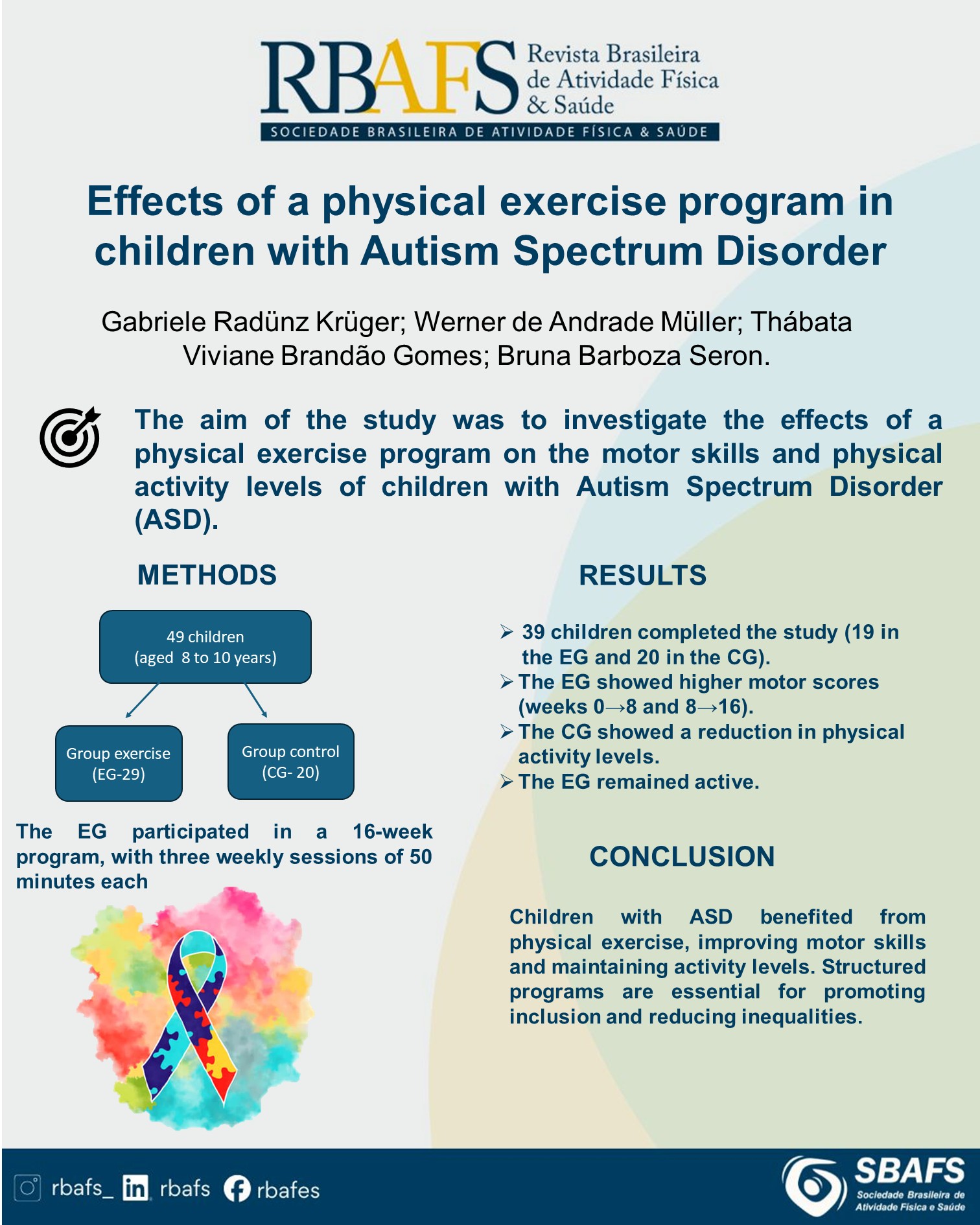
Effects of a physical exercise program in children with Autism Spectrum Disorder
DOI:
https://doi.org/10.12820/rbafs.31e0440Keywords:
Autism Spectrum Disorder, Test of Gross Motor Development-2, Accelerometry, Circuit-based exercise, Equity, InclusionAbstract
Objective: The study investigate study was to investigate the effects of a physical exercise program on the motor skills and physical activity levels of children with Autism Spectrum Disorder (ASD). Methods: Forty-nine children, aged 8 to 10 years, were randomly assigned to an exercise group (EG; n = 29) and a control group (CG; n = 20). The EG participated in a 16-week program, with three weekly sessions of 50 minutes each, consisting of both aerobic and strength exercises. Motor skills were measured by the Test of Gross Motor Development-2. Physical activity was assessed by accelerometry before the intervention, after 8 weeks, and after 16 weeks. Data analysis was conducted using Generalized Estimating Equations and Bonferroni post-hoc tests (α = 0.05). Results: 39 children completed the intervention. The results showed that the EG had higher scores related to motor skills compared to the CG after the intervention. Additionally, significant improvements in motor skills were observed in the EG from week 0 to week 8 and from week 8 to week 16, with no changes over time in the CG. The CG reduced physical activity levels from week 0 to week 8, and the EG remained stable. Conclusion: Children with ASD benefited from the physical exercise program, showing improvements in motor skills and maintenance of physical activity levels. Exercise programs should be used to promote inclusion in physical exercise promotion, mitigating disparities in access to physical activity and its associated benefits.
Downloads
References
1. American Psychiatric Association. Diagnostic and statistical manual of mental disorders (DSM-5). 5th ed. Arlington: APA; 2013. DOI: https://doi.org/10.1176/appi.books.9780890425596
2. Fulceri F, Grossi E, Contaldo A, Narzisi A, Apicella F, Parrini I, et al. Motor skills as moderators of core symptoms in autism spectrum disorders: Preliminary data from an exploratory analysis with artificial neural networks. Front Psychol. 2019;9:1-12. doi: https://doi.org/10.3389/fpsyg.2018.02683 DOI: https://doi.org/10.3389/fpsyg.2018.02683
3. Krüger GR, Garcias LM, Hax GP, Marques AC. O efeito de um programa de atividades rítmicas na interação social e na coordenação motora em crianças com transtorno do espectro autista. Rev Bras Ativ Fís Saúde. 2019;23:1-5. doi: https://doi.org/10.12820/rbafs.23e0046 DOI: https://doi.org/10.12820/Rbafs.23e0046
4. Xing Y, Wu X. Effects of Motor Skills and Physical Activity Interventions on Motor Development in Children with Autism Spectrum Disorder: A Systematic Review. Healthcare (Basel, Switzerland). 2025;13(5):489. doi: https://doi.org/10.3390/healthcare13050489 DOI: https://doi.org/10.3390/healthcare13050489
5. Ketcheson L, Hauck J, Ulrich D. The effects of an early motor skill intervention on motor skills, levels of physical activity, and socialization in young children with autism spectrum disorder: A pilot study. Autism. 2016;26. doi: https://doi.org/10.1177/1362361316650611 DOI: https://doi.org/10.1177/1362361316650611
6. Healy S, Haegele JA, Grenier M, Garcia JM. Physical activity, screen-time behavior, and obesity among 13-year-olds in Ireland with and without autism spectrum disorder. J Autism Dev Disord. 2017;47(1):49-57. doi: https://doi.org/10.1007/s10803-016-2920-4 DOI: https://doi.org/10.1007/s10803-016-2920-4
7. Najafabadi MG, Sheikh M, Poushaneh K, Hemayattalab R, Bakhtiar S, Ghorbani MH. The effect of SPARK on social and motor skills of children with autism. Pediatr Neonatol. 2018;59(5):481-7. doi: https://doi.org/10.1002/aur.2659 DOI: https://doi.org/10.1016/j.pedneo.2017.12.005
8. Pan CY, Tsai CL, Hsieh KW, Chu CH, Li YL, Huang ST. Objectively measured physical activity and health-related physical fitness in secondary school-aged male students with autism spectrum disorders. Phys Ther. 2016;96(4):511-20. doi: https://doi.org/10.2522/ptj.20140353 DOI: https://doi.org/10.2522/ptj.20140353
9. Lourenço CCV, Vilas-Boas AA, Boemer MR. A eficácia de um programa de treino de trampolins na proficiência motora de crianças com transtorno do espectro do autismo. Rev Bras Educ Espec. 2016;22(1):39-48. doi: https://doi.org/10.1590/S1413-65382216000100004 DOI: https://doi.org/10.1590/S1413-65382216000100004
10. Li R, Liang X, Zhou Y, Ren Z. A Systematic Review and Meta-Analysis of Moderate-to-Vigorous Physical Activity Levels in Children and Adolescents With and Without ASD in Inclusive Schools. Front Pediatr. 2021;9:726942. doi: https://doi.org/10.3389/fped.2021.726942 DOI: https://doi.org/10.3389/fped.2021.726942
11. Memari AH, Ziaee V, ShayestehFar M, Ghanouni P, Mansournia MA, AkbarFahimi N. Children with autism spectrum disorder and patterns of participation in daily physical and play activities. Neurol Res Int. 2015;2015:531906. doi: https://doi.org/10.1155/2015/531906 DOI: https://doi.org/10.1155/2015/531906
12. Stanish HI, Curtin C, Must A, Phillips S, Maslin M, Bandini LG. Physical activity levels, frequency, and type among adolescents with and without autism spectrum disorder. J Autism Dev Disord. 2017;47(3):785-94. doi: https://doi.org/10.1007/s10803-016-3001-4 DOI: https://doi.org/10.1007/s10803-016-3001-4
13. Bremer E, Balogh R, Lloyd M. Effectiveness of a fundamental motor skill intervention for 4-year-old children with autism spectrum disorder: A pilot study. Autism. 2015;19(8):980-91. doi: https://doi.org/10.1177/1362361314557548 DOI: https://doi.org/10.1177/1362361314557548
14. Bhat AN. Motor Impairment Increases in Children With Autism Spectrum Disorder as a Function of Social Communication, Cognitive and Functional Impairment, Repetitive Behavior Severity, and Comorbid Diagnoses: A SPARK Study Report. Autism research: official journal of the International Society for Autism Research. 2021;14(1):202–19. doi: https://doi.org/10.1002/aur.2453 DOI: https://doi.org/10.1002/aur.2453
15. Abadi MRH, Zheng Y, Wharton T, Dell CA, Vatanparast H, Johnston J. Children with Autism Spectrum Disorder Spent 30 Min Less Daily Time in Moderate-to-Vigorous Physical Activity than Typically Developing Peers: a Meta-Analysis of Cross-sectional Data. Rev J Autism Dev Disord. 2023;10:144–57. doi: https://doi.org/10.1007/s40489-021-00262-x DOI: https://doi.org/10.1007/s40489-021-00262-x
16. Schopler E, Reichler RJ, Renner BR. The childhood autism rating scale (CARS). Los Angeles: Western Psychological Services; 1988.
17. Pereira A, Riesgo RS, Wagner MB. Childhood autism: translation and validation of the Childhood Autism Rating Scale for use in Brazil. J Pediatr (Rio J). 2008;84(6):487-94. doi: https://doi.org/10.2223/JPED.1828 DOI: https://doi.org/10.1590/S0021-75572008000700004
18. Ruggeri A, Dancel A, Johnson R, Sargent B. The effect of motor and physical activity intervention on motor outcomes of children with autism spectrum disorder: A systematic review. Autism. 2020;24(3):544-68. doi: https://doi.org/10.1177/1362361319885215 DOI: https://doi.org/10.1177/1362361319885215
19. Cain KL, Sallis JF, Conway TL, Van Dyck D, Calhoon L. Use of accelerometers in youth physical activity studies: a review of methods. J Phys Act Health. 2013;10(3):437–50. doi: https://doi.org/10.1123/jpah.10.3.437 DOI: https://doi.org/10.1123/jpah.10.3.437
20. World Health Organization. WHO guidelines on physical activity and sedentary behaviour. Geneva: WHO; 2020 Available from: <https://www.who.int/publications/i/item/9789240015128> [2025 July].
21. Evenson KR, Catellier DJ, Gill K, Ondrak KS, McMurray RG. Calibration of two objective measures of physical activity for children. J Sports Sci. 2008;26(14):1557-65. doi: https://doi.org/10.1080/02640410802334196 DOI: https://doi.org/10.1080/02640410802334196
22. Cohen J. Statistical power analysis for the behavioral sciences. 2nd ed. Hillsdale, NJ: Lawrence Erlbaum Associates; 1988.
23. Krüger GR. Atividade física e barreiras em crianças com autismo de Pelotas [dissertação de mestrado]. Pelotas: Universidade Federal de Pelotas; 2015.
24. Must A, Phillips SM, Curtin C, Bandini LG. Motor intervention and assessment instruments in autism spectrum disorders. J Phys Act Health. 2015;12(4):52934. doi: https://doi.org/10.1590/1980-0037.2019v21e60515 DOI: https://doi.org/10.1123/jpah.2013-0271
25. Ferreira JP, Toscano CVA, Rodrigues AM, Furtado GE, Barros MG, Wanderley RS, et al. Effects of a physical exercise program (PEP-Aut) on autistic children’s stereotyped behavior, metabolic and physical activity profiles, physical fitness, and health-related quality of life: A study protocol. Front Public Health. 2018;6:47. doi: https://doi.org/10.3389/fpubh.2018.00047 DOI: https://doi.org/10.3389/fpubh.2018.00047
26. Soares AM, Neto JLC. Evaluation of motor behavior in children with autism spectrum disorder: A systematic review. Rev Bras Educ Espec. 2015;21:445-58. doi: https://doi.org/10.1590/S1413-65382115000300010 DOI: https://doi.org/10.1590/S1413-65382115000300010
27. Kruger G, Silveira JR, Marques AC. Habilidades motoras de crianças com transtorno do espectro autista. Rev Bras Cineantropom Desempenho Hum. 2019;21:e60515. doi: https://doi.org/10.1590/1980-0037.2019v21e60515 DOI: https://doi.org/10.1590/1980-0037.2019v21e60515
28. Monteiro CE, Da Silva E, Sodré R, Costa F, Trindade AS, Bunn P, et al. The effect of physical activity on motor skills of children with autism spectrum disorder: A meta-analysis. Int J Environ Res Public Health. 2022;19(21):14081. doi: https://doi.org/10.3390/ijerph192114081 DOI: https://doi.org/10.3390/ijerph192114081
29. Benson S, Piper BJ, Krueger L, Helms K, Waterbury H, Lynch J. Differences in sleep patterns, sleepiness, and physical activity levels between young adults with autism spectrum disorder and typically developing controls. Dev Neurorehabil. 2019;22(3):164-73. doi: https://doi.org/10.1080/17518423.2018.1501777 DOI: https://doi.org/10.1080/17518423.2018.1501777
30. Zhao M, Chen S. The effects of structured physical activity program on social interaction and communication for children with autism. Biomed Res Int. 2018;2018:1-13. doi: https://doi.org/10.1155/2018/1825046 DOI: https://doi.org/10.1155/2018/1825046
31. Wachob D, Lorenzi DG. Brief report: Influence of physical activity on sleep quality in children with autism. J Autism Dev Disord. 2015;45(8):2641-6. doi: https://doi.org/10.1007/s10803-015-2424-7 DOI: https://doi.org/10.1007/s10803-015-2424-7
32. Bahrami F, Movahedi A, Marandi SM, Abedi A. Kata techniques training consistently decreases stereotypy in children with autism spectrum disorder. Res Dev Disabil. 2012;33(4):1183-93. doi: https://doi.org/10.1016/j.ridd.2012.01.018 DOI: https://doi.org/10.1016/j.ridd.2012.01.018
33. Tyler K, MacDonald M. Physical activity and physical fitness of school-aged children and youth with autism spectrum disorders. J Autism Dev Disord. 2014;44(12):3121-6. doi: https://doi.org/10.1155/2014/312163 DOI: https://doi.org/10.1155/2014/312163
34. McCoy SM, Jakicic JM, Gibbs BB. Comparison of obesity, physical activity, and sedentary behaviors among adolescents with and without autism spectrum disorder. J Autism Dev Disord. 2016;46(7):2317-26. doi: https://doi.org/10.1007/s10803-016-2762-0 DOI: https://doi.org/10.1007/s10803-016-2762-0
35. Jones RA, Downing K, Rinehart NJ, Barnett LM, May T, McGillivray JA, et al. Physical activity, sedentary behavior and their correlates in children with autism spectrum disorder: A systematic review. PLoS One. 2017;12(2):e0172482. doi: https://doi.org/10.1371/journal.pone.0172482 DOI: https://doi.org/10.1371/journal.pone.0172482
Downloads
Published
How to Cite
Issue
Section
License
Copyright (c) 2026 Gabriele Radünz Krüger, Werner de Andrade Müller, Thábata Viviane Brandão Gomes, Bruna Barboza Seron

This work is licensed under a Creative Commons Attribution 4.0 International License.
When submitting a manuscript to the Revista Brasileira de Atividade Física & Saúde, the authors retain the copyright to the article and authorize the Revista Brasileira de Atividade Física & Saúde to publish the manuscript under the Creative Commons Attribution 4.0 License and identify it as the original publication source.