Treinamento intervalado de alta intensidade sob hipóxia para pessoas com diabetes tipo 2: protocolo de estudo
DOI:
https://doi.org/10.12820/rbafs.31e0458Palavras-chave:
Treinamento intervalado de alta intensidade, Hipóxia, Diabetes mellitus tipo 2, Hemoglobina glicada, Aptidão físicaResumo
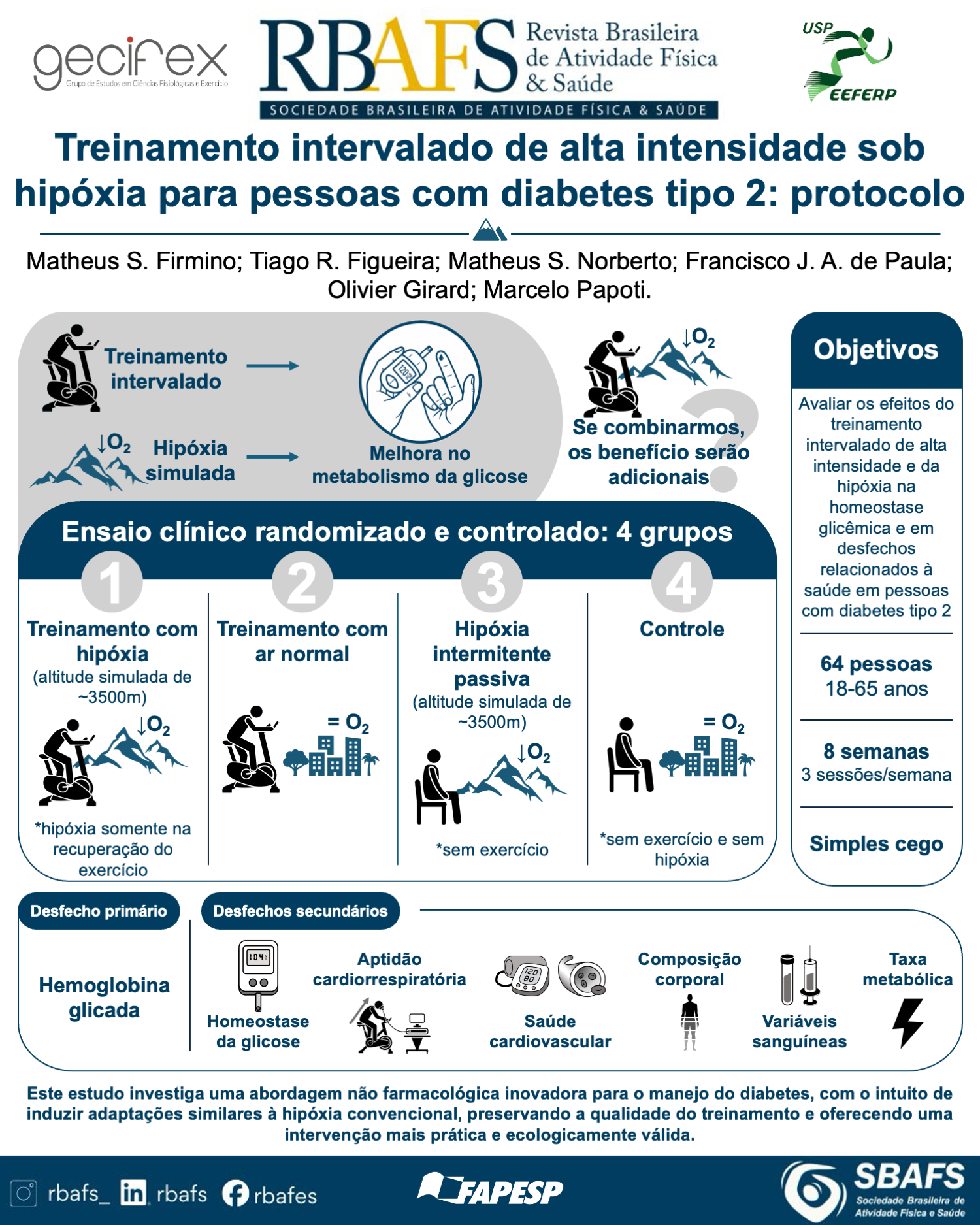
Introdução: O treinamento intervalado de alta intensidade (HIIT) pode melhorar a sensibilidade à insulina, o controle glicêmico e a composição corporal em indivíduos com diabetes mellitus tipo 2 (DM2). A hipóxia intermitente (redução da disponibilidade de oxigênio), quando combinada ao HIIT, parece melhorar o controle glicêmico através de vias moleculares convergentes independentes da insulina. Objetivo: Avaliar se oito semanas de hipóxia intermitente e HIIT, isolados ou combinados, melhoram a homeostase glicêmica e desfechos relacionados à saúde em indivíduos com DM2. Métodos: Este ensaio clínico randomizado, controlado e simples-cego recrutará 64 indivíduos (18–65 anos) com DM2, randomizados em 4 grupos: 1) HIIT com hipóxia durante a recuperação dos esforços (fração inspirada de oxigênio, FiO₂ = 0,135); 2) HIIT em normóxia (FiO₂ = 0,209); 3) hipóxia intermitente passiva (FiO₂ = 0,135); ou 4) controle. As intervenções terão duração de 8 semanas (3 sessões semanais). O HIIT será realizado em cicloergômetro, em intensidades correspondentes à frequência cardíaca do ponto de compensação respiratória e à potência pico. O desfecho primário inclui a hemoglobina glicada, as medidas secundárias incluem homeostase glicêmica, aptidão cardiorrespiratória, saúde cardiovascular, composição corporal e desfechos hematológicos, metabólicos e comportamentais. A análise estatística será conduzida por meio de modelos lineares generalizados mistos (α = 0,05). Discussão: Este estudo investiga uma abordagem não farmacológica inovadora para o manejo do DM2, aplicando hipóxia exclusivamente durante os períodos de recuperação do HIIT. Essa estratégia busca induzir adaptações fisiológicas comparáveis às da hipóxia intermitente convencional, preservando a qualidade do treinamento e oferecendo uma intervenção mais prática e ecologicamente válida.
Downloads
Referências
1. Stumvoll M, Goldstein BJ, van Haeften TW. Type 2 diabetes: principles of pathogenesis and therapy. The Lancet. 2005;365(9467):1333–46.
2. Sampath Kumar A, Maiya AG, Shastry BA, Vaishali K, Ravishankar N, Hazari A, et al. Exercise and insulin resistance in type 2 diabetes mellitus: A systematic review and meta-analysis. Ann Phys Rehabil Med. 2019;62(2):98–103.
3. Jiménez-Maldonado A, García-Suárez PC, Rentería I, Moncada-Jiménez J, Plaisance EP. Impact of high-intensity interval training and sprint interval training on peripheral markers of glycemic control in metabolic syndrome and type 2 diabetes. Biochim Biophys Acta Mol Basis Dis. 2020;1866(8):165820
4. Khalafi M, Symonds ME. The impact of high-intensity interval training on inflammatory markers in metabolic disorders: A meta-analysis. Scand J Med Sci Sports. 2020;30(11):2020–36.
5. Gripp F, Nava RC, Cassilhas RC, Esteves EA, Magalhães COD, Dias-Peixoto MF, et al. HIIT is superior than MICT on cardiometabolic health during training and detraining. Eur J Appl Physiol. 2021;121(1):159–72.
6. Arrieta-Leandro MC, Moncada-Jiménez J, Morales-Scholz MG, Hernández-Elizondo J. The effect of chronic high-intensity interval training programs on glycaemic control, aerobic resistance, and body composition in type 2 diabetic patients: a meta-analysis. J Endocrinol Invest. 2023;46(12):2423–43.
7. Jelleyman C, Yates T, O’Donovan G, Gray LJ, King JA, Khunti K, et al. The effects of high-intensity interval training on glucose regulation and insulin resistance: A meta-analysis. Obes Rev. 2015;16(11):942–61.
8. Liu J xin, Zhu L, Li P jun, Li N, Xu Y bing. Effectiveness of high-intensity interval training on glycemic control and cardiorespiratory fitness in patients with type 2 diabetes: a systematic review and meta-analysis. Aging Clin Exp Res. 2019;31(5):575–93.
9. De Nardi AT, Tolves T, Lenzi TL, Signori LU, Silva AMV da. High-intensity interval training versus continuous training on physiological and metabolic variables in prediabetes and type 2 diabetes: A meta-analysis. Diabetes Res Clin Pract. 2018;137:149–59.
10. Garcia SP, Cureau FV, Iorra F de Q, Bottino LG, Laura LE, Leivas G, et al. Effects of exercise training and physical activity advice on HbA1c in people with type 2 diabetes: A network meta-analysis of randomized controlled trials. Diabetes Res Clin Pract. 2025;221:112027.
11. Lopez-Pascual A, Bes-Rastrollo M, Sayón-Orea C, Perez-Cornago A, Díaz-Gutiérrez J, Pons JJ, et al. Living at a geographically higher elevation is associated with lower risk of metabolic syndrome: Prospective analysis of the SUN cohort. Front Physiol. 2017;7(658):1–9.
12. Ortiz-Prado E, Espinosa PS, Borrero A, Cordovez SP, Vasconez JE, Barreto-Grimales A, et al. Stroke-Related Mortality at Different Altitudes: A 17-Year Nationwide Population-Based Analysis From Ecuador. Front Physiol. 2021;12: 733928.
13. Navarrete-Opazo A, Mitchell GS. Therapeutic potential of intermittent hypoxia: a matter of dose. Am J Physiol Regul Integr Comp Physiol. 2014;307:118197.
14. Marlatt KL, Greenway FL, Kyle Schwab J, Ravussin E. Two weeks of moderate hypoxia improves glucose tolerance in individuals with type 2 diabetes. Int J Obes. 2019;44(3):744–7.
15. Shepherd AI, James TJ, Gould AAM, Mayes H, Neal R, Shute J, et al. Impact of nocturnal hypoxia on glycaemic control, appetite, gut microbiota and inflammation in adults with type 2 diabetes mellitus: A single-blind crossover trial Handling Editors. J Physiol. 2024;602(21):5835-5854.
16. D’Hulst G, Sylow L, Hespel P, Deldicque L. Acute systemic insulin intolerance does not alter the response of the Akt/GSK-3 pathway to environmental hypoxia in human skeletal muscle. Eur J Appl Physiol. 2015;115(6):1219–31.
17. Soo J, Raman A, Lawler NG, Goods PSR, Deldicque L, Girard O, et al. The role of exercise and hypoxia on glucose transport and regulation. Eur J Appl Physiol. 2023;123(6):1147–65.
18. Lavalle S, Masiello E, Iannella G, Magliulo G, Pace A, Lechien JR, et al. Unraveling the Complexities of Oxidative Stress and Inflammation Biomarkers in Obstructive Sleep Apnea Syndrome: A Comprehensive Review. Life (Basel). 2024;14(4):425.
19. Soo J, Girard O, Ihsan M, Fairchild T. The Use of the SpO2 to FiO2 Ratio to Individualize the Hypoxic Dose in Sport Science, Exercise, and Health Settings. Front Physiol. 2020;11:570472.
20. Serebrovska T V., Portnychenko AG, Drevytska TI, Portnichenko VI, Xi L, Egorov E, et al. Intermittent hypoxia training in prediabetes patients: Beneficial effects on glucose homeostasis, hypoxia tolerance and gene expression. Exp Biol Med. 2017;242(15):1542–52.
21. Schreuder THA, Nyakayiru J, Houben J, Thijssen DHJ, Hopman MTE. Impact of hypoxic versus normoxic training on physical fitness and vasculature in diabetes. High Alt Med Biol. 2014;15(3):349–55.
22. van Meijel RLJ, Vogel MAA, Jocken JWE, Vliex LMM, Smeets JSJ, Hoebers N, et al. Mild intermittent hypoxia exposure induces metabolic and molecular adaptations in men with obesity. Mol Metab. 2021;53:101287.
23. Kindlovits R, Pereira AMDS, Sousa AC, Viana JL, Teixeira VH. Effects of Acute and Chronic Exercise in Hypoxia on Cardiovascular and glycemic Parameters in Patients with Type 2 Diabetes: A Systematic Review. High Alt Med Biol. 2022;23(4):301–12.
24. Mackenzie R, Maxwell N, Castle P, Elliott B, Brickley G, Watt P. Intermittent exercise with and without hypoxia improves insulin sensitivity in individuals with type 2 diabetes. J Clin Endocrinol Metab. 2012;97(4).
25. Kindlovits R, Sousa AC, Viana JL, Milheiro J, Oliveira BMPM, Marques F, et al. Eight Weeks of Intermittent Exercise in Hypoxia, with or without a Low-Carbohydrate Diet, Improves Bone Mass and Functional and Physiological Capacity in Older Adults with Type 2 Diabetes. Nutrients. 2024;16(11).
26. Ladage D, Braunroth C, Lenzen E, Berghöfer S, Graf C, Bloch W, et al. Influence of intermittent hypoxia interval training on exercise-dependent erythrocyte nos activation and blood pressure in diabetic patients. Can J Physiol Pharmacol. 2012;90(12):1591–8.
27. Ghaith A, Chacaroun S, Borowik A, Chatel L, Doutreleau S, Wuyam B, et al. Hypoxic high-intensity interval training in individuals with overweight and obesity. Am J Physiol Regul Integr Comp Physiol. 2022;323(5):R700–9.
28. Camacho-Cardenosa A, Camacho-Cardenosa M, Brazo-Sayavera J, Burtscher M, Timón R, Olcina G. Effects of high-intensity interval training under normobaric hypoxia on cardiometabolic risk markers in overweight/obese women. High Alt Med Biol. 2018;19(4):356–66.
29. Wehrlin JP, Hallén J. Linear decrease in VO2max and performance with increasing altitude in endurance athletes. Eur J Appl Physiol. 2006;96(4):404–12.
30. Papoti M, Manchado-Gobatto FB, Gobatto CA. Inter-effort recovery hypoxia: a new paradigm in sport science? BMJ Open Sport Exerc Med. 2023;9(3):e001520.
31. Foresti YF, Carvalho CD De, Ribeiro FA, Andreossi JC, Luches-Pereira G, Bertucci DR, et al. Acute physiological responses to “Recovery Intermittent Hypoxia” in HIIT. Rev Bras Med Esporte. 2024;30:e2021_0499.
32. Dellavechia de Carvalho C, Marcolino Putti G, Figueiredo Foresti Y, Alves Ribeiro F, Causin Andreossi J, Ferraz de Campos G, et al. Recovery in normobaric hypoxia as an additional stimulus for high-intensity intermittent training. Sci Sports. 2023;38(2):189–96.
33. Norberto MS, Torini JVG, Firmino MS, Papoti M. Validation of Air Storage System for Hypoxia Exposure During Exercise. High Alt Med Biol. 2024; 25(2):122-8.
34. Radtke T, Crook S, Kaltsakas G, Louvaris Z, Berton D, Urquhart DS, et al. ERS statement on standardisation of cardiopulmonary exercise testing in chronic lung diseases. European Respiratory Review. 2019;28(154).
35. Keir DA, Iannetta D, Mattioni Maturana F, Kowalchuk JM, Murias JM. Identification of Non-Invasive Exercise Thresholds: Methods, Strategies, and an Online App. Sports Med. 2022;52(2):237–55.
36. Sanchis-Gomar F, Martinez-Bello VE, Domenech E, Nascimento AL, Pallardo F V., Gomez-Cabrera MC, et al. Effect of intermittent hypoxia on hematological parameters after recombinant human erythropoietin administration. Eur J Appl Physiol. 2009;107(4):429–36.
37. Simental-Mendía LE, Rodríguez-Morán M, Guerrero-Romero F. The product of fasting glucose and triglycerides as surrogate for identifying insulin resistance in apparently healthy subjects. Metab Syndr Relat Disord. 2008;6(4):299–304.
38. Millet GP, Debevec T, Brocherie F, Girard O, Pialoux V. Commentaries on Viewpoint: Human skeletal muscle wasting in hypoxia: a matter of hypoxic dose? J Appl Physiol. 2017;122(2):409.
39. Borresen J, Lambert MI. The Quantification of Training Load, the Training Response and the Effect on Performance. Sports Med. 2009;39(9):779–95.
40. Putti GM, Costa GP, Norberto MS, Carvalho CD de, Bertuzzi RC de M, Papoti M. Use of Inter-Effort Recovery Hypoxia as a New Approach to Improve Anaerobic Capacity and Time to Exhaustion. High Alt Med Biol. 2024;25(1):68–76.
Downloads
Publicado
Como Citar
Edição
Seção
Licença
Copyright (c) 2026 Matheus Simionato Firmino, Tiago Rezende Figueira, Matheus Silva Norberto, Francisco José Albuquerque de Paula, Olivier Girard, Marcelo Papoti

Este trabalho está licenciado sob uma licença Creative Commons Attribution 4.0 International License.
Ao submeter um manuscrito à Revista Brasileira de Atividade Física & Saúde, os autores mantêm a titularidade dos direitos autorais sobre o artigo, e autorizam a Revista Brasileira de Atividade Física & Saúde a publicar esse manuscrito sob a Licença Creative Commons Atribuição 4.0 e identificá-la como veículo de sua publicação original.