“Seja Ativo”: contradições na parceria entre Federação Internacional de Futebol e Organização Mundial da Saúde
DOI:
https://doi.org/10.12820/rbafs.31e0438Palavras-chave:
Educação em saúde, Organização Mundial da Saúde, Conflito de interesses, FutebolResumo
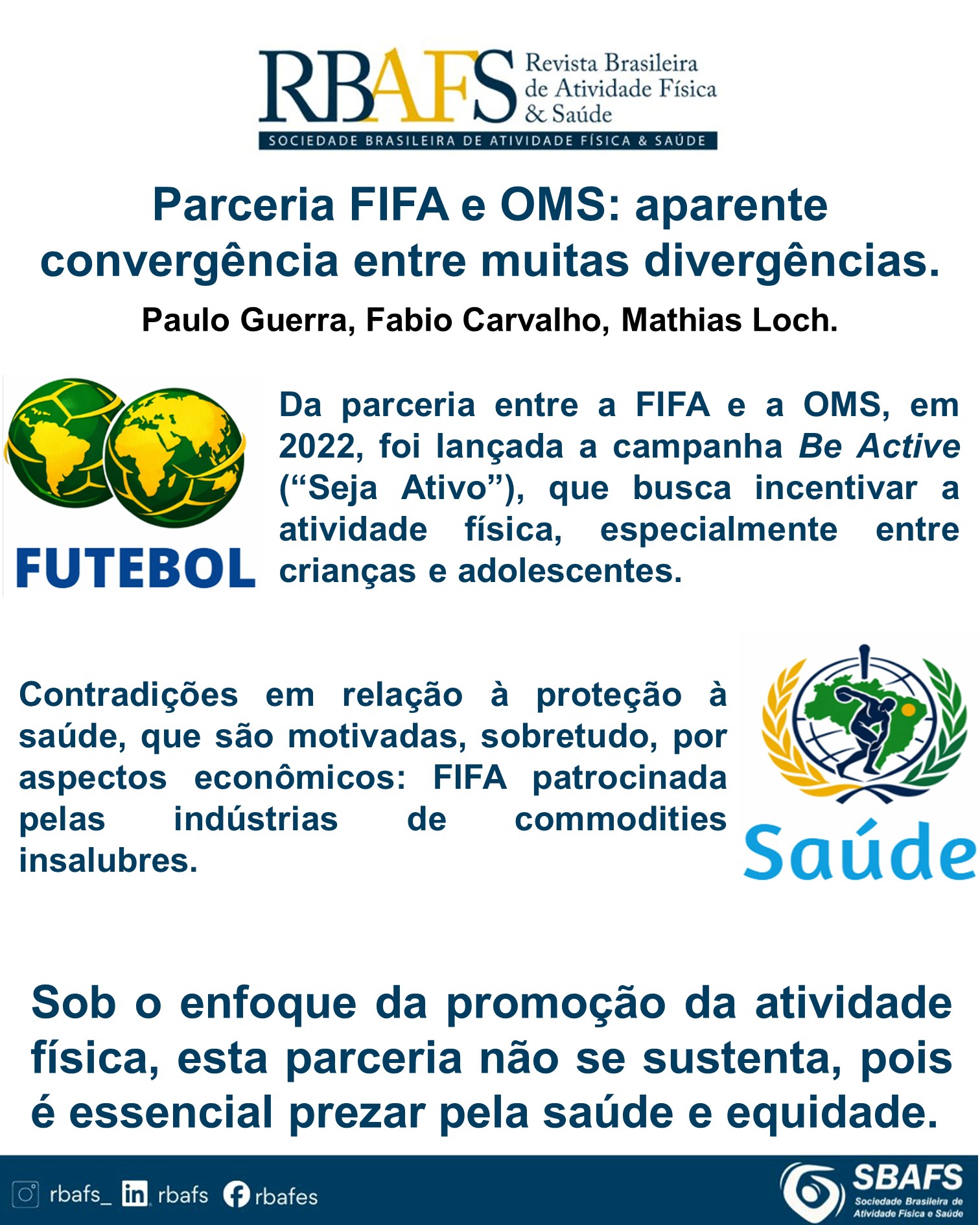
Da parceria entre a Federação Internacional de Futebol (FIFA) e a Organização Mundial da Saúde (OMS), em 2022, foi lançada a campanha Be Active (“Seja Ativo”), que busca incentivar a prática de atividades físicas, especialmente entre crianças e adolescentes. Mesmo que as instituições de grande porte tenham papel importante na disseminação de ações em saúde, o presente texto traz reflexões sobre as contradições quanto aos seus compromissos com a proteção à saúde, que são motivadas, sobretudo, por aspectos econômicos. A principal delas está no contraste entre as relações históricas entre a FIFA e as indústrias de commodities insalubres, que patrocinam seus megaeventos há mais de 50 anos e os esforços da OMS em recomendar a formulação de políticas mais assertivas para proteger crianças e adolescentes dos impactos do marketing alimentar, bem como seu apoio ao debate sobre os determinantes comerciais da saúde. O texto também traz reflexões sobre questões de outros domínios, como o étnico-racial e o político. Por fim, a partir destes pontos de contradição quanto aos compromissos da FIFA e da OMS em relação a proteção à saúde, que são permeadas, sobretudo, por prerrogativas econômicas, cabe indicar, sob o enfoque da promoção da atividade física, e, por consequência, da saúde, que esta parceria não se sustenta, recomendando-se que a OMS se afaste de entidades que, em suas práticas, não prezam pela saúde e equidade.
Downloads
Referências
1. Fédération Internationale de Football Association. Be Active. Available from: <https://inside.fifa.com/campaigns/bringthe-moves> [2025 June].
2. Boykoff J. Toward a Theory of Sportswashing: MegaEvents, Soft Power, and Political Conflict. Sociol Sport J. 2022;39:342–51. doi: https://doi.org/10.1123/ssj.2022-0095 DOI: https://doi.org/10.1123/ssj.2022-0095
3. Gilmore AB, Fabbri A, Baum F, Bertscher A, Bondy K, Chang HJ, et al. Defining and conceptualising the commercial determinants of health. Lancet. 2023;401(10383):1194-1213. doi: https://doi.org/10.1016/S0140-6736(23)00013-2 DOI: https://doi.org/10.1016/S0140-6736(23)00013-2
4. World Health Organization. WHO recommends stronger policies to protect children from the harmful impact of food marketing. Available from: <https://www.who.int/news/item/03-07-2023-who-recommends-stronger-policiesto-protect-children-from-the-harmful-impact-of-foodmarketing> [2025 June].
5. Institute for Health Metrics and Evaluation (IHME). Global Burden of Disease 2021: Findings from the GBD 2021 Study. Seattle, WA: IHME, 2024.
6. Valenciano-Mendoza E, Mora-Maltas B, Mestre-Bach G, Munguía L, Richard J, Derevensky JL, Potenza MN, et al. Clinical Correlates of Sports Betting: A Systematic Review. J Gambl Stud. 2023;39:579-624. doi: https://doi.org/10.1007/s10899-023-10196-0 DOI: https://doi.org/10.1007/s10899-023-10196-0
7. Van Tulleken C, Monteiro CA. Football can’t ignore its sugar problem. BMJ. 2025;389:r1200. doi: https://doi.org/10.1136/bmj.r1200. DOI: https://doi.org/10.1136/bmj.r1200
8. Deutsche Welle. FIFA’s controversial business model. Available from:<https://www.dw.com/en/fifas-controversialbusiness-model/a-18479441> [2025 June].
9. Câmara dos Deputados. Fim do patrocínio de refrigerantes inviabilizaria eventos esportivos no País, diz COB. Available from: <https://www.camara.leg.br/noticias/516993-fimdo-patrocinio-de-refrigerantes-inviabilizaria-eventosesportivos-no-pais-diz-cob/> [2025 June].
10. Fédération Internationale de Football Association. No Discrimination. Available from: <https://inside.fifa.com/campaigns/no-discrimination> [2025 June].
11. The New York Times. The Athletic. FIFA drops antiracism, anti-discrimination messages for Club World Cup. Available from: <https://www.nytimes.com/athletic/6430673/2025/06/16/fifa-club-world-cup-racismdiscrimination-message/> [2025 June].
12. World Health Organization. There is no place for discrimination, racism and inequality in healthcare. Available from: <https://www.who.int/multi-media/details/there-isno-place-for-discrimination--racism-and-inequality-inhealthcare> [2025 June].
13. Boudreaux CJ, Karahan G, Coats, M. Bend it like FIFA: corruption on and off the pitch, Manag Finance. 2016;42:866–78. doi: https://doi.org/10.1108/MF-01-2016-0012 DOI: https://doi.org/10.1108/MF-01-2016-0012
14. Kristiansen M, Sheikh A. The Health of Low-Income Migrant Workers in Gulf Cooperation Council Countries. Health Hum Rights J. 2014. Disponível em: <https://www.hhrjournal.org/2014/07/22/the-health-of-low-income-migrant-workers-in-gulf-cooperation-council-countries/> [2025 junho].
15. Almeida C, Campos RP. Multilateralismo, ordem mundial Covid-19: questões atuais e desafios futuros para a OMS. Saúde debate [Internet]. 2020;44(spe4):13–39. doi: https://doi.org/10.1590/0103-11042020E401 DOI: https://doi.org/10.1590/SciELOPreprints.1115
Downloads
Publicado
Como Citar
Edição
Seção
Licença
Copyright (c) 2026 Paulo Henrique Guerra, Fabio Fortunato Brasil de Carvalho, Mathias Roberto Loch

Este trabalho está licenciado sob uma licença Creative Commons Attribution 4.0 International License.
Ao submeter um manuscrito à Revista Brasileira de Atividade Física & Saúde, os autores mantêm a titularidade dos direitos autorais sobre o artigo, e autorizam a Revista Brasileira de Atividade Física & Saúde a publicar esse manuscrito sob a Licença Creative Commons Atribuição 4.0 e identificá-la como veículo de sua publicação original.