Associação entre sintomas de ansiedade e preferência de intensidade de exercício: um estudo transversal
DOI:
https://doi.org/10.12820/rbafs.30e0415Palavras-chave:
Saúde mental, Níveis de atividade física, Transtorno de ansiedade, Transtornos de ansiedade generalizada, Estudo transversalResumo
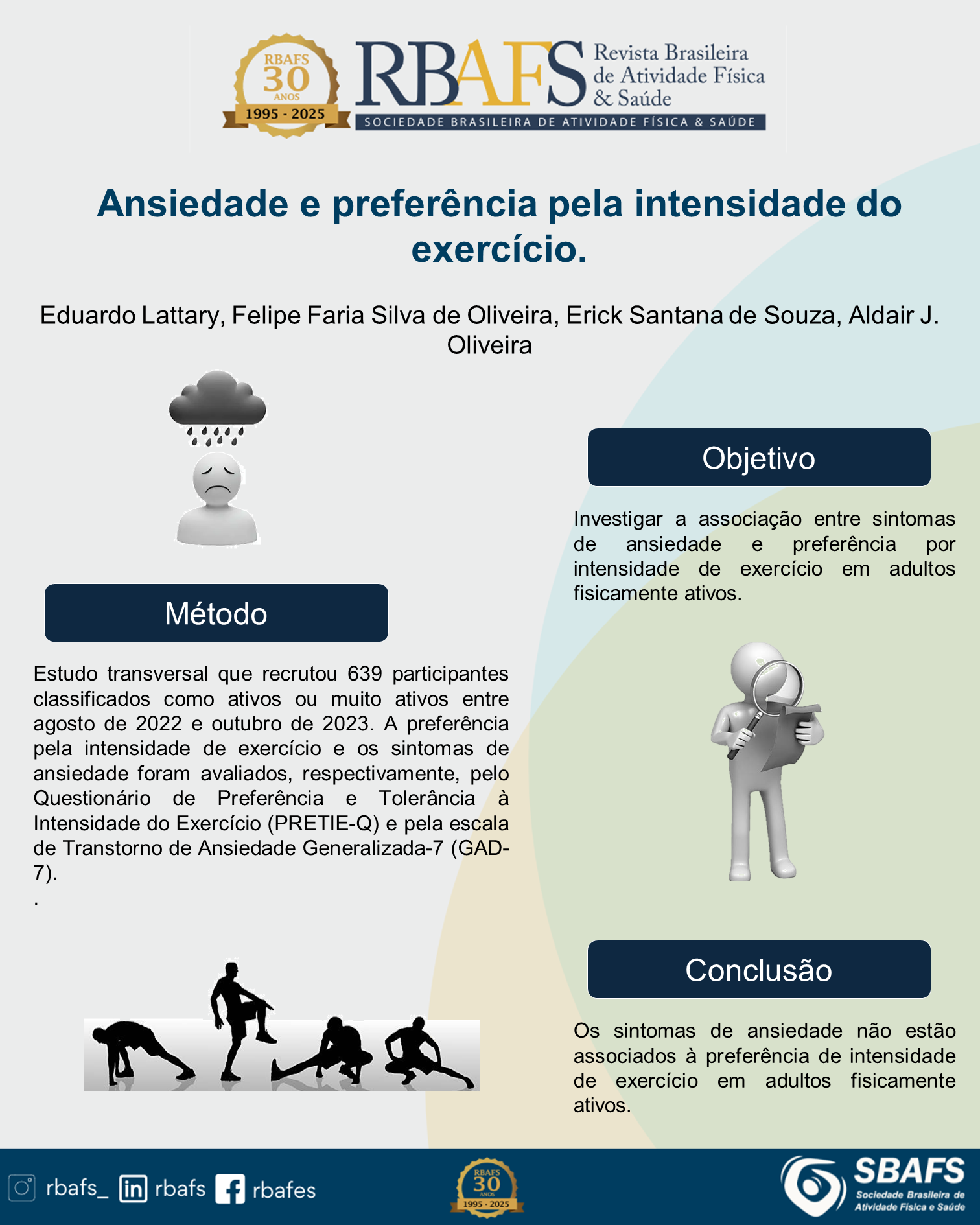
Introdução: A literatura aponta para benefícios da prática regular de exercícios físicos no tratamento da ansiedade, entretanto a preferência pela intensidade foi pouco explorada. Objetivo: Investigar a associação entre sintomas de ansiedade e preferência por intensidade de exercício em adultos fisicamente ativos. Métodos: Estudo transversal que recrutou 639 participantes classificados como ativos ou muito ativos entre agosto de 2022 e outubro de 2023. A preferência pela intensidade de exercício e os sintomas de ansiedade foram avaliados, respectivamente, pelo Questionário de Preferência e Tolerância à Intensidade do Exercício (PRETIE-Q) e e pela escala de Transtorno de Ansiedade Generalizada-7 (GAD-7). As associações foram analisadas utilizando modelos de regressão logística bruta e ajustada. Resultados: Dos 108 participantes sintomáticos, 39 eram homens (36,1%; 44,1 ± 10,6 anos; 1,75 ± 0,07 m; 86,2 ± 14,1 kg; GAD = 11,9 ± 3,4) e 69 eram mulheres (63,9%; 42,5 ± 8,8 anos; 1,63 ± 0,06 m; 68,9 ± 13,4 kg; GAD = 13,0 ± 3,7). Entre os 531 participantes não sintomáticos, 324 eram homens (61,1%; 47,3 ± 11,1 anos; 1,75 ± 0,06 m; 85,2 ± 14,9 kg; GAD = 2,7 ± 2,4) e 207 eram mulheres (38,9%; 44,9 ± 9,6 anos; 1,63 ± 0,06 m; 67,9 ± 12,3 kg; GAD = 3,5 ± 2,3). Nenhuma associação foi observada entre sintomas de ansiedade e preferência por intensidade de exercício, tanto no modelo bruto (p = 0,44) quanto no ajustado (p = 0,79). Conclusão: Os sintomas de ansiedade não apresentaram associação com a preferência pela intensidade do exercício em adultos fisicamente ativos.
Downloads
Referências
1. Association AP. Diagnostic and statistical manual of mental disorders. 4th ed. Washington: American Psychiatric Association; 1994.
2. Szuhany KL, Simon NM. Anxiety Disorders: A Review. JAMA. 2022;328(24):2431-45. DOI: https://doi.org/10.1001/jama.2022.22744
3. Hoffman DL, Dukes EM, Wittchen HU. Human and economic burden of generalized anxiety disorder. Depress Anxiety. 2008;25(1):72-90. DOI: https://doi.org/10.1002/da.20257
4. Bereza BG, Machado M, Einarson TR. Systematic review and quality assessment of economic evaluations and quality-of-life studies related to generalized anxiety disorder. Clin Ther. 2009;31(6):1279-308. DOI: https://doi.org/10.1016/j.clinthera.2009.06.004
5. Byrne GJ. Interventions for generalized anxiety disorder. Curr Opin Psychiatry. 2023;36(2):134-9. DOI: https://doi.org/10.1097/YCO.0000000000000840
6. DeGeorge KC, Grover M, Streeter GS. Generalized Anxiety Disorder and Panic Disorder in Adults. Am Fam Physician. 2022;106(2):157-64.
7. Stonerock GL, Hoffman BM, Smith PJ, Blumenthal JA. Exercise as Treatment for Anxiety: Systematic Review and Analysis. Ann Behav Med. 2015;49(4):542-56. DOI: https://doi.org/10.1007/s12160-014-9685-9
8. Crombie KM, O'Connor PJ. Exercise and Anxiety. Curr Top Behav Neurosci. 2024;67:199-222. DOI: https://doi.org/10.1007/7854_2024_498
9. McKeon G, Curtis J, Rosenbaum S. Promoting physical activity for mental health: an updated evidence review and practical guide. Curr Opin Psychiatry. 2022;35(4):270-6. DOI: https://doi.org/10.1097/YCO.0000000000000796
10. McDowell CP, Dishman RK, Vancampfort D, Hallgren M, Stubbs B, MacDonncha C, et al. Physical activity and generalized anxiety disorder: results from The Irish Longitudinal Study on Ageing (TILDA). Int J Epidemiol. 2018;47(5):1443-53. DOI: https://doi.org/10.1093/ije/dyy141
11. Herring MP, Gordon BR, Murphy J, Lyons M, Lindheimer JB. The Interplay Between Expected Psychological Responses to Exercise and Physical Activity in Analogue Generalized Anxiety Disorder: a Cross-sectional Study. Int J Behav Med. 2023;30(2):221-33. DOI: https://doi.org/10.1007/s12529-022-10081-x
12. Ekkekakis P, Hall EE, Petruzzello SJJJoS, Psychology E. Some like it vigorous: Measuring individual differences in the preference for and tolerance of exercise intensity. 2005;27(3):350-74. DOI: https://doi.org/10.1123/jsep.27.3.350
13. Silva M, Lattari E, Monteiro W, Oliveira AJ, Cordeiro R, Farinatti P, et al. The affect-intensity relationship in aerobic exercise: an analysis based on a systematic review. Int J Sport Exerc Psychol. 2024; 23(5):872–89. DOI: https://doi.org/10.1080/1612197X.2024.2356825
14. Ekkekakis P. Let them roam free? Physiological and psychological evidence for the potential of self-selected exercise intensity in public health. Sports Med. 2009;39(10):857-88. DOI: https://doi.org/10.2165/11315210-000000000-00000
15. Williams DM, Dunsiger S, Jennings EG, Marcus BHJAoBM. Does affective valence during and immediately following a 10-min walk predict concurrent and future physical activity? Ann Behav Med. 2012;44(1):43-51. DOI: https://doi.org/10.1007/s12160-012-9362-9
16. Vandenbroucke JP, von Elm E, Altman DG, Gotzsche PC, Mulrow CD, Pocock SJ, et al. Strengthening the Reporting of Observational Studies in Epidemiology (STROBE): explanation and elaboration. Ann Intern Med. 2007;147(8):W163-94. DOI: https://doi.org/10.7326/0003-4819-147-8-200710160-00010-w1
17. Oliveira AJ, Lopes CS, Maranhao Neto GA, Sousa GM, Paravidino V, Rostila M, et al. Psychosocial and environmental determinants of physical activity in a Brazilian public university employees - ELDAF: A prospective cohort study protocol. PLoS One. 2022;17(2):e0263385. DOI: https://doi.org/10.1371/journal.pone.0263385
18. Matsudo S, Araújo T, Marsudo V, Andrade D, Andrade E, Braggion GJRbafs. Questinário internacional de atividade física (IPAQ): estudo de validade e reprodutibilidade no Brasil. 2001:05-18.
19. Swinson RP. The GAD-7 scale was accurate for diagnosing generalised anxiety disorder. Evid Based Med. 2006;11(6):184. DOI: https://doi.org/10.1136/ebm.11.6.184
20. Kroenke K, Spitzer RL, Williams JB, Monahan PO, Lowe B. Anxiety disorders in primary care: prevalence, impairment, comorbidity, and detection. Ann Intern Med. 2007;146(5):317-25. DOI: https://doi.org/10.7326/0003-4819-146-5-200703060-00004
21. Smirmaul BPC, Ekkekakis P, Teixeira IP, Nakamura PM, Kokubun EJRBdC, Humano D. Questionário de Preferência e Tolerância da Intensidade de Exercício: versão em português do Brasil. Rev Bras Cineantropom Desempenho Hum. 2015;17:550-64. DOI: https://doi.org/10.5007/1980-0037.2015v17n5p550
22. Ekkekakis P, Parfitt G, Petruzzello SJ. The pleasure and displeasure people feel when they exercise at different intensities: decennial update and progress towards a tripartite rationale for exercise intensity prescription. Sports Med. 2011;41(8):641-71. DOI: https://doi.org/10.2165/11590680-000000000-00000
23. Box AG, Petruzzello SJ. High-Intensity Interval Exercise: Methodological Considerations for Behavior Promotion From an Affective Perspective. Front Psychol. 2021;12:563785. DOI: https://doi.org/10.3389/fpsyg.2021.563785
24. Stonerock GL, Gupta RP, Blumenthal JA. Is exercise a viable therapy for anxiety? Systematic review of recent literature and critical analysis. Prog Cardiovasc Dis. 2024;83:97-115. DOI: https://doi.org/10.1016/j.pcad.2023.05.006
25. Saeed SA, Cunningham K, Bloch RM. Depression and Anxiety Disorders: Benefits of Exercise, Yoga, and Meditation. Am Fam Physician. 2019;99(10):620-7.
26. Kandola A, Stubbs B. Exercise and Anxiety. Adv Exp Med Biol. 2020;1228:345-52. DOI: https://doi.org/10.1007/978-981-15-1792-1_23
27. Jayakody K, Gunadasa S, Hosker C. Exercise for anxiety disorders: systematic review. Br J Sports Med. 2014;48(3):187-96. DOI: https://doi.org/10.1136/bjsports-2012-091287
28. Belem da Silva CT, Schuch F, Costa M, Hirakata V, Manfro GG. Somatic, but not cognitive, symptoms of anxiety predict lower levels of physical activity in panic disorder patients. J Affect Disord. 2014;164:63-8. DOI: https://doi.org/10.1016/j.jad.2014.04.007
29. Bastos V, Andrade AJ, Rodrigues F, Monteiro D, Cid L, Teixeira DS. Set to fail: Affective dynamics in a resistance training program designed to reach muscle concentric failure. Scand J Med Sci Sports. 2022;32(12):1710-23. DOI: https://doi.org/10.1111/sms.14222
Downloads
Publicado
Como Citar
Edição
Seção
Licença
Copyright (c) 2025 Eduardo Lattari, Felipe Faria Silva de Oliveira, Erick Santana de Souza, Aldair José de Oliveira

Este trabalho está licenciado sob uma licença Creative Commons Attribution 4.0 International License.
Ao submeter um manuscrito à Revista Brasileira de Atividade Física & Saúde, os autores mantêm a titularidade dos direitos autorais sobre o artigo, e autorizam a Revista Brasileira de Atividade Física & Saúde a publicar esse manuscrito sob a Licença Creative Commons Atribuição 4.0 e identificá-la como veículo de sua publicação original.