Demographic and clinical factors are associated with performance on the 6-minute walk test and the 2-minute step test in Parkinson’s disease
DOI:
https://doi.org/10.12820/rbafs.31e0464Palabras clave:
Walking, Exercise test, Parkinson disease, ComorbidityResumen
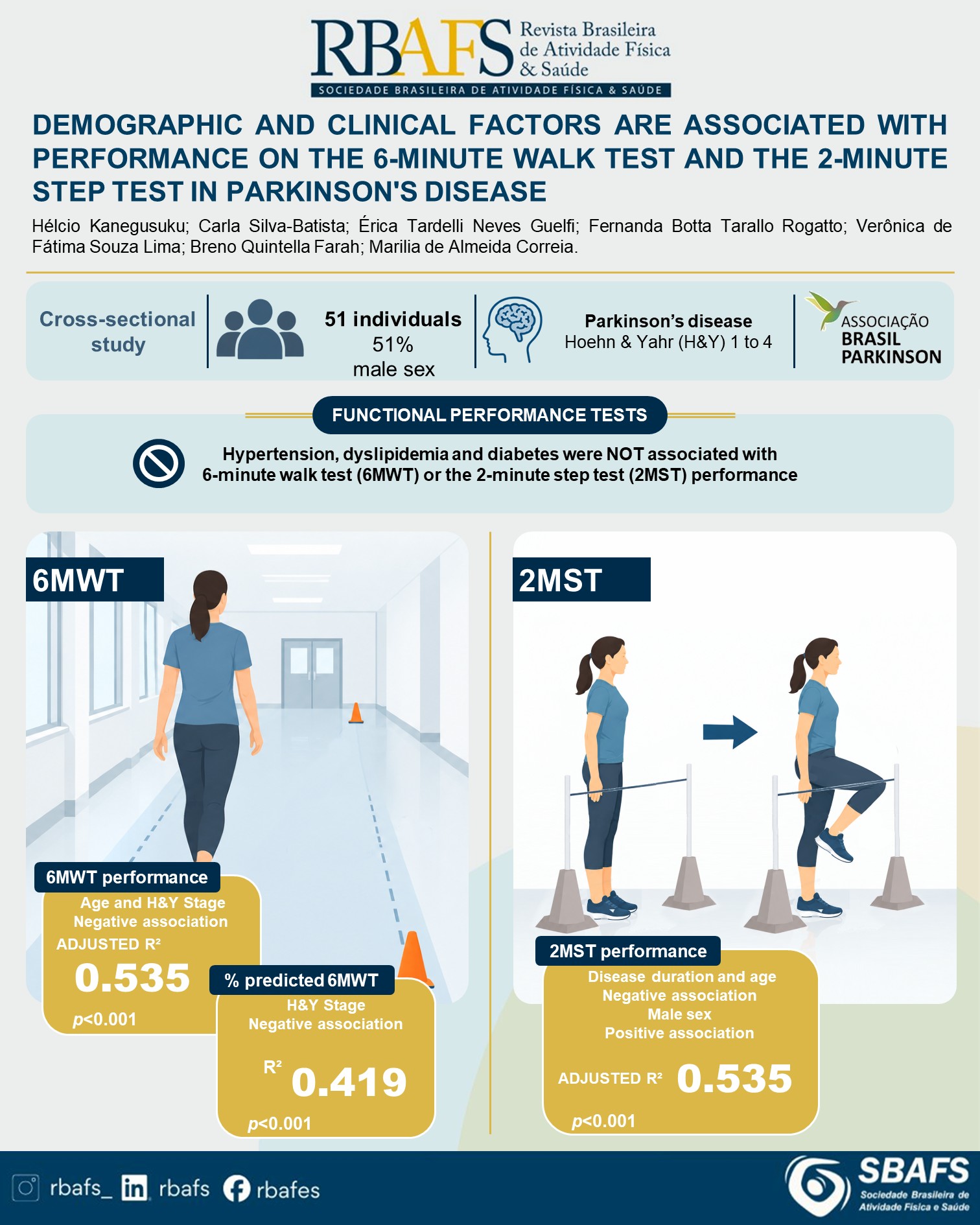
Introduction: It is still unclear whether comorbidities such as hypertension, diabetes mellitus, and dyslipidemia impact performance on the 6-minute walk test (6MWT) in Parkinson’s disease (PD). Moreover, the factors associated with performance on the 2-minute step test (2MST) in PD remain unclear. Objective: This study aimed to analyze whether demographic factors, clinical characteristics related to PD, and comorbid conditions are associated factors with performance on the 6MWT and the 2MST in PD. Methods: This cross-sectional study was conducted at Associação Brasil Parkinson. 51 individuals (Hoehn & Yahr [H&Y] stages 1-4) performed the 2MST or the 6MWT twice on the same day (“on” state). An interval of at least 5 days was adopted between the assessments (2MST or 6MWT). The number of steps achieved on the 2MST, the 6MWT distance, the percentage of predicted 6MWT in healthy subjects, and the associated factors such as demographic characteristics, body mass index, H&Y stage, the Unified Parkinson’s disease Rating Scale part III score, comorbidities, history of falls, and medication information were obtained. Results: The multiple linear regression analysis showed that the H&Y stage and age were negatively associated with 6MWT performance (adjusted R2 = 0.535, p < 0.001), while only the H&Y stage was negatively associated with the percentage of predicted 6MWT (R2 = 0.419, p < 0.001). Disease duration and age were negatively associated with 2MST performance, whereas male sex was positively associated with 2MST performance (adjusted R2= 0.283, p < 0.001). Conclusion: Advanced age and higher PD severity were associated with worse 6MWT performance, while advanced age and longer disease duration were associated with worse 2MST performance, whereas male sex was associated with better 2MST performance.
Descargas
Citas
1. Ben-Shlomo Y, Darweesh S, Llibre-Guerra J, Marras C, San Luciano M, Tanner C. The epidemiology of Parkinson’s disease. The Lancet. 2024;403(10423):283-29. DOI: https://doi.org/10.1016/S0140-6736(23)01419-8
2. Rodríguez-Violante M, Camacho-Ordoñez A, Cervantes-Arriaga A, González-Latapí P, Velázquez-Osuna S. Factors associated with the quality of life of subjects with Parkinson’s disease and burden on their caregivers. Neurología. 2015;30(5):257-63. DOI: https://doi.org/10.1016/j.nrleng.2014.01.002
3. Kanegusuku H, Ritti-Dias RM, Barbosa PYI, das Neves Guelfi ET, Okamoto E, Miranda CS, et al. Influence of motor impairment on exercise capacity and quality of life in patients with Parkinson disease. J Exerc Rehabil. 2021;17(4):241-6. DOI: https://doi.org/10.12965/jer.2142290.145
4. Scalzo PL, Flores CR, Marques JR, Robini SC, Teixeira AL. Impact of changes in balance and walking capacity on the quality of life in patients with Parkinson’s disease. Arq Neuropsiquiatr. 2012;70(2):119-24. DOI: https://doi.org/10.1590/S0004-282X2012000200009
5. Ellis T, Cavanaugh JT, Earhart GM, Ford MP, Foreman KB, Dibble LE. Which measures of physical function and motor impairment best predict quality of life in Parkinson’s disease? Parkinsonism Relat Disord. 2011;17(9):693-7. DOI: https://doi.org/10.1016/j.parkreldis.2011.07.004
6. Canning CG, Ada L, Johnson JJ, McWhirter S. Walking capacity in mild to moderate Parkinson’s disease. Arch Phys Med Rehabil. 2006;87(3):371-5. DOI: https://doi.org/10.1016/j.apmr.2005.11.021
7. Radi B, Ambari AM, Dwiputra B, Intan RE, Triangto K, Santoso A, et al. Determinants and prediction equations of six-minute walk test distance immediately after cardiac surgery. Front Cardiovasc Med. 2021;8:685673. DOI: https://doi.org/10.3389/fcvm.2021.685673
8. Üğüt BO, Kalkan AC, Kahraman T, Dönmez Çolakoğlu B, Çakmur R, Genç A. Determinants of 6-minute walk test in people with Parkinson’s disease. Ir J Med Sci. 2023;192(1):359-67. DOI: https://doi.org/10.1007/s11845-022-02954-7
9. Farah BQ, Ritti-Dias RM, Cucato GG, Chehuen Mda R, Barbosa JP, Zeratti AE, et al. Effects of Clustered comorbid conditions on walking capacity in patients with peripheral artery disease. Ann Vasc Surg. 2014;28(2):279-83. DOI: https://doi.org/10.1016/j.avsg.2013.01.020
10. Srithawong A, Poncumhak P, Manoy P, Kumfu S, Promsrisuk T, Prasertsri P, et al. The optimal cutoff score of the 2-min step test and its association with physical fitness in type 2 diabetes mellitus. J Exerc Rehabil. 2022;18(3):214-21. DOI: https://doi.org/10.12965/jer.2244232.116
11. Carthy ER. Autonomic dysfunction in essential hypertension: A systematic review. Ann Med Surg. 2014;3(1):2–7. DOI: https://doi.org/10.1016/j.amsu.2013.11.002
12. Dimitropoulos G. Cardiac autonomic neuropathy in patients with diabetes mellitus. World J Diabetes. 2014;5(1):17-39. DOI: https://doi.org/10.4239/wjd.v5.i1.17
13. Yalamudi K. Study of comparison between autonomic dysfunction and dyslipidemia in healthy postmenopausal women. J Midlife Health. 2017;8(3):103-9. DOI: https://doi.org/10.4103/jmh.JMH_67_15
14. Sabino-Carvalho JL, Fisher JP, Vianna LC. Autonomic function in patients with Parkinson’s disease: From rest to exercise. Front Physiol. 2021;12:626640. DOI: https://doi.org/10.3389/fphys.2021.626640
15. Braghieri HA, Kanegusuku H, Corso SD, Cucato GG, Monteiro F, Wolosker N, et al. Validity and reliability of 2-min step test in patients with symptomatic peripheral artery disease. J Vasc Nurs. 2021;39(2):33-8. DOI: https://doi.org/10.1016/j.jvn.2021.02.004
16. Chan WLS, Pin TW. Reliability, validity and minimal detectable change of 2-min walk test and 10-m walk test in frail older adults receiving day care and residential care. Aging Clin Exp Res. 2020;32(4):597-604. DOI: https://doi.org/10.1007/s40520-019-01255-x
17. Rikli RE, Jones CJ. Development and validation of criterion-referenced clinically relevant fitness standards for maintaining physical independence in later years. Gerontologist. 2013;53(2):255-67. DOI: https://doi.org/10.1093/geront/gns071
18. Santos MGMC, Benazzi FAF, Uhdre AL, Dibai-Filho AV. Test-retest and inter-rater reliability and construct validity of the 2-minute step test in individuals with Parkinson’s disease. J Bodyw Mov Ther. 2024;40:2033–41. DOI: https://doi.org/10.1016/j.jbmt.2024.10.059
19. da Silva Junior DH, Kanegusuku H, Lima VFS, Neves Guelfi ÉT, Rogatto FBT, Fecchio RY, et al. Validity, reliability and agreement of the two-minute step test in Parkinson`s disease. 2025; 66(Pt B):103661. DOI: https://doi.org/10.1016/j.gerinurse.2025.103661
20. von Elm E, Altman DG, Egger M, Pocock SJ, Gøtzsche PC, Vandenbroucke JP, et al. The Strengthening the Reporting of Observational Studies in Epidemiology (STROBE) Statement: guidelines for reporting observational studies. Bull World Health Organ. 2007;85(11):867-72. DOI: https://doi.org/10.2471/BLT.07.045120
21. Goetz CG, Poewe W, Rascol O, Sampaio C, Stebbins GT, Counsell C, et al. Movement Disorder Society Task Force report on the Hoehn and Yahr staging scale: Status and recommendations The Movement Disorder Society Task Force on rating scales for Parkinson’s disease. Mov Disord. 2004;19(9):1020-8. DOI: https://doi.org/10.1002/mds.20213
22. ATS Committee on Proficiency Standards for Clinical Pulmonary Function Laboratories. ATS statement: guidelines for the six-minute walk test. Am J Respir Crit Care Med. 2002;166(1):111-7. DOI: https://doi.org/10.1164/ajrccm.166.1.at1102
23. Britto RR, Probst VS, de Andrade AF, Samora GA, Hernandes NA, Marinho PE, et al. Reference equations for the six-minute walk distance based on a Brazilian multicenter study. Braz J Phys Ther. 2013;17(6):556-63. DOI: https://doi.org/10.1590/S1413-35552012005000122
24. Goetz CG, Tilley BC, Shaftman SR, Stebbins GT, Fahn S, Martinez-Martin P, et al. Movement Disorder Society‐sponsored revision of the Unified Parkinson’s Disease Rating Scale (MDS‐UPDRS): Scale presentation and clinimetric testing results. Mov Disord. 2008;23(15):2129-70. DOI: https://doi.org/10.1002/mds.22340
25. Kobayashi E, Himuro N, Takahashi M. Clinical utility of the 6-min walk test for patients with moderate Parkinson’s disease. Int J Rehabil Res. 2017;40(1):66-70. DOI: https://doi.org/10.1097/MRR.0000000000000205
26. Schapira AH, Jenner P. Etiology and pathogenesis of Parkinson’s disease. Mov Disord. 2011;26(6):1049-55. DOI: https://doi.org/10.1002/mds.23732
27. Falvo MJ, Earhart GM. Six-minute walk distance in persons with Parkinson disease: a hierarchical regression model. Arch Phys Med Rehabil. 2009;90(6):1004-8. DOI: https://doi.org/10.1016/j.apmr.2008.12.018
28. de Lima TA, Ferreira-Moraes R, Alves WMGDC, Alves TGG, Pimentel CP, Sousa EC, et al. Resistance training reduces depressive symptoms in elderly people with Parkinson disease: A controlled randomized study. Scand J Med Sci Sports. 2019;29(12):1957-67. DOI: https://doi.org/10.1111/sms.13528
29. Combs-Miller SA, Moore ES. Predictors of outcomes in exercisers with Parkinson disease: A two-year longitudinal cohort study. NeuroRehabilitation. 2019;44(3):425-32. DOI: https://doi.org/10.3233/NRE-182641
30. Yokote A, Hayashi Y, Yanamoto S, Fujioka S, Higa K, Tsuboi Y. Leg muscle strength correlates with gait performance in advanced Parkinson disease. Intern Med. 2022;61(5):633-8. DOI: https://doi.org/10.2169/internalmedicine.7646-21
31. Vetrano DL, Pisciotta MS, Brandi V, Lo Monaco MR, Laudisio A, Onder G, et al. Impact of disease duration and cardiovascular dysautonomia on hypertension in Parkinson’s disease. J Clin Hypertens. 2017;19(4):418–23. DOI: https://doi.org/10.1111/jch.12938
32. Konitsiotis S, Bostantjopoulou S, Chondrogiorgi M, Katsarou Z, Tagaris G, Mavromatis I, et al. Clinical characteristics of Parkinson’s disease patients in Greece: A multicenter, nation-wide, cross-sectional study. J Neurol Sci. 2014;343(1–2):36–40. DOI: https://doi.org/10.1016/j.jns.2014.05.003
33. Barone P, Antonini A, Colosimo C, Marconi R, Morgante L, Avarello TP, et al. The PRIAMO study: A multicenter assessment of nonmotor symptoms and their impact on quality of life in Parkinson’s disease. Mov Disord. 2009;24(11):1641–9. DOI: https://doi.org/10.1002/mds.22643
34. Blin O, Desnuelle C, Rascol O, Borg M, Paul HP Saint, Azulay JP, et al. Mitochondrial respiratory failure in skeletal muscle from patients with Parkinson’s disease and multiple system atrophy. J Neurol Sci. 1994;125(1):95–101. DOI: https://doi.org/10.1016/0022-510X(94)90248-8
35. Lateef OM, Fakorede S, Harris C, Lateef AM, Ajayi AF. Mitochondria at the crossroads of aging and cardiovascular disease. Life Sci. 2026;385:124127. DOI: https://doi.org/10.1016/j.lfs.2025.124127
36. Kelley DE, He J, Menshikova E V, Ritov VB. Dysfunction of mitochondria in human skeletal muscle in type 2 diabetes. Diabetes. 2002;51(10):2944–50. DOI: https://doi.org/10.2337/diabetes.51.10.2944
Descargas
Publicado
Cómo citar
Número
Sección
Licencia
Derechos de autor 2026 Helcio Kanegusuku, Carla Silva-Batista, Érica Tardelli Neves Guelfi, Fernanda Botta Tarallo Rogatto, Verônica de Fátima Souza Lima, Breno Quitella Farah, Marilia de Almeida Correia

Esta obra está bajo una licencia internacional Creative Commons Atribución 4.0.
Al enviar un manuscrito a la Revista Brasileira de Atividade Física & Saúde, los autores mantienen la titularidad de los derechos de autor sobre el artículo y autorizan a la Revista Brasileira de Atividade Física & Saúde a publicar este manuscrito bajo la Licencia Creative Commons Atribución 4.0 e identificarla como el vehículo de su publicación original.