Covid-19 pandemic, fitness and health outcomes in older adults with hypertension: a longitudinal study
DOI:
https://doi.org/10.12820/rbafs.31e0442Palabras clave:
COVID-19, Echocardiography, Cardiopulmonary exercise test, Sedentary behavior, Physical activityResumen
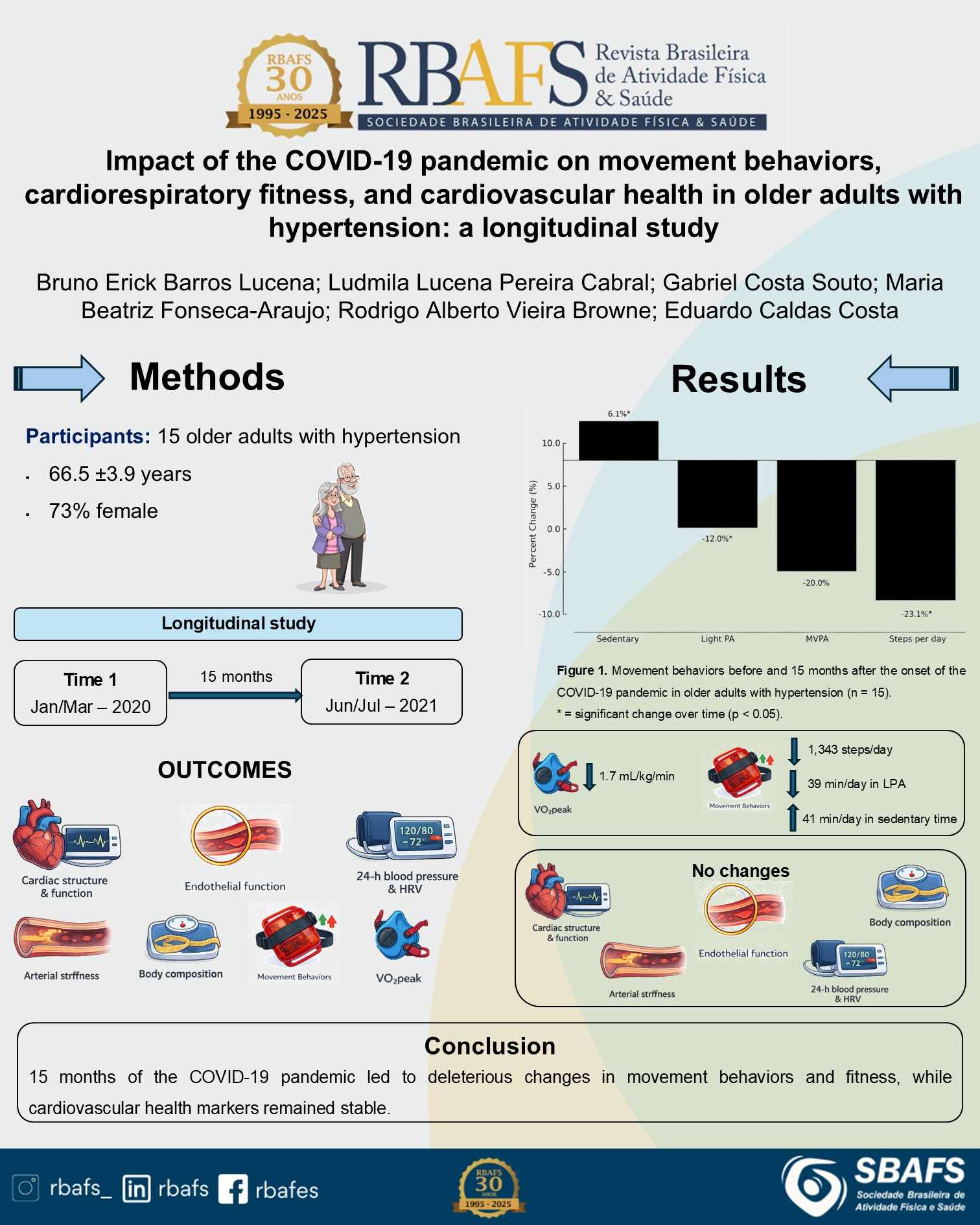
Objective: This study examined changes in cardiovascular health-related outcomes, movement behaviors, and body composition in older adults with hypertension 15 months after the onset of the covid-19 pandemic. Methods: Fifteen older adults were included in this longitudinal study with a 15-month follow-up. Assessments included cardiac structure and function, vascular health markers (arterial stiffness, endothelial function, and carotid intima-media thickness), 24-hour blood pressure and heart rate variability, cardiorespiratory fitness, accelerometer-based physical activity (PA) and sedentary behavior (SB), and body composition. Generalized linear mixed models were used for data analysis. Results: After 15 months, participants showed a significant increase in SB (β = 41 min/ day; p = 0.007), a reduction in light-intensity PA (β = ‒39 min/day; p = 0.008), a decrease in step count (β = ‒1,343 steps/day; p = 0.002), and a reduction in peak oxygen uptake (β = ‒1.7 mL/kg/min; p = 0.034). A small but significant decrease was also observed in left ventricular posterior wall thickness (β = ‒0.5 mm; p = 0.046). No significant changes were found in other outcomes (p > 0.05). Conclusion: Deleterious changes in movement behaviors and cardiorespiratory fitness were observed 15 months after the onset of the covid-19 pandemic in older adults with hypertension, despite the absence of significant changes in a broader range of cardiovascular health-related outcomes.
Descargas
Citas
1. Roth GA, Abate D, Abate KH, Abay SM, Abbafati C, Abbasi N, et al. Global, regional, and national age-sex-specific mortality for 282 causes of death in 195 countries and territories, 1980–2017: a systematic analysis for the Global Burden of Disease Study 2017. Lancet. 2018;392(10159):1736–88. DOI: https://doi.org/10.1016/S0140-6736(18)32203-7
2. Mills KT, Stefanescu A, He J. The global epidemiology of hypertension. Nat Rev Nephrol. 2020;16(4):223–37. DOI: https://doi.org/10.1038/s41581-019-0244-2
3. Yamada Y, Uchida T, Ogino M, Ikenoue T, Shiose T, Fukuma S. Changes in older people’s activities during the coronavirus disease 2019 pandemic in Japan. J Am Med Dir Assoc. 2020;21(10):1387–8.e1. DOI: https://doi.org/10.1016/j.jamda.2020.07.039
4. Browne RAV, Macêdo GAD, Cabral LLP, Oliveira GTA, Vivas A, Fontes EB, et al. Initial impact of the COVID-19 pandemic on physical activity and sedentary behavior in hypertensive older adults: an accelerometer-based analysis. Exp Gerontol. 2020;142:111121. DOI: https://doi.org/10.1016/j.exger.2020.111121
5. Browne RAV, Cabral LLP, Freire YA, Macêdo GAD, Oliveira GTA, Vivas A, et al. Housing type is associated with objectively measured changes in movement behavior during the COVID-19 pandemic in older adults with hypertension: an exploratory study. Arch Gerontol Geriatr. 2021;94:104354. DOI: https://doi.org/10.1016/j.archger.2021.104354
6. Park SK, Park S, Jee YS. Effects of physical inactivity behavior during COVID-19 pandemic on physical fitness, body composition, inflammatory cytokine, and immunocytes in older adults: a retrospective and prospective study. Physiol Behav. 2024;284:114640. DOI: https://doi.org/10.1016/j.physbeh.2024.114640
7. Ross R, Blair SN, Arena R, Church TS, Després J-P, Franklin BA, et al. Importance of assessing cardiorespiratory fitness in clinical practice: a case for fitness as a clinical vital sign. Circulation. 2016;134(24):e653–e699. DOI: https://doi.org/10.1161/CIR.0000000000000461
8. Beydoun HA, Beydoun MA, Gautam RS, Alemu BT, Weiss J, Hossain S, et al. COVID-19 pandemic impact on trajectories in cardiometabolic health, physical activity, and functioning among adults from the 2006–2020 Health and Retirement Study. J Gerontol A Biol Sci Med Sci. 2022;77(7):1371–9. DOI: https://doi.org/10.1093/gerona/glac028
9. Freiberg A, Schubert M, Romero Starke K, Hegewald J, Seidler A. A rapid review on the influence of COVID-19 lockdown and quarantine measures on modifiable cardiovascular risk factors in the general population. Int J Environ Res Public Health. 2021;18(16):8567. DOI: https://doi.org/10.3390/ijerph18168567
10. Dalton-Alves F, Araújo MBF, Lucena BE, Souto GC, Lopes DSD, Lucena MIS, et al. Effects of high-intensity interval and moderate-intensity continuous training on ambulatory blood pressure and cardiovascular outcomes in older adults with hypertension (HEXA Study): study protocol for a randomised trial. BMJ Open. 2024;14(12):e084736. DOI: https://doi.org/10.1136/bmjopen-2024-084736
11. Lang RM, Badano LP, Mor-Avi V, Afilalo J, Armstrong A, Ernande L, et al. Recommendations for cardiac chamber quantification by echocardiography in adults: an update from the American Society of Echocardiography and the European Association of Cardiovascular Imaging. J Am Soc Echocardiogr. 2015;28(1):1–39.e14. DOI: https://doi.org/10.1016/j.echo.2014.10.003
12. Malachias MVB, Souza WKSB, Plavnik FL, Rodrigues CIS, Brandão AA, Neves MFT, et al. 7th Brazilian guideline of arterial hypertension: presentation. Arq Bras Cardiol. 2016;107(3):1–83.
13. Nobre F, Mion D Jr, Gomes MAN, Malachias MVB, Amodeo C. V guidelines for ambulatory blood pressure monitoring (ABPM) and III guidelines for home blood pressure monitoring (HBPM). J Bras Nefrol. 2011;33(3):365–88.
14. Marek Malik, J. Thomas Bigger, A. John Camm, Robert E. Kleiger, Alberto Malliani, Arthur J. Moss. Heart rate variability: standards of measurement, physiological interpretation and clinical use. Eur Heart J. 1996;17(3):354–81. DOI: https://doi.org/10.1093/oxfordjournals.eurheartj.a014868
15. Reference Values for Arterial Stiffness Collaboration. Determinants of pulse wave velocity in healthy people and in the presence of cardiovascular risk factors: establishing normal and reference values. Eur Heart J. 2010;31(19):2338–50. DOI: https://doi.org/10.1093/eurheartj/ehq165
16. Papaioannou TG, Karageorgopoulou TD, Sergentanis TN, Protogerou AD, Psaltopoulou T, Sharman JE, et al. Accuracy of commercial devices and methods for noninvasive estimation of aortic systolic blood pressure: a systematic review and meta-analysis of invasive validation studies. J Hypertens. 2016;34(7):1237–48. DOI: https://doi.org/10.1097/HJH.0000000000000921
17. Weber T, Wassertheurer S, Rammer M, Maurer E, Hametner B, Mayer CC, et al. Validation of a brachial cuff-based method for estimating central systolic blood pressure. Hypertension. 2011;58(5):825–32. DOI: https://doi.org/10.1161/HYPERTENSIONAHA.111.176313
18. Harris RA, Nishiyama SK, Wray DW, Richardson RS. Ultrasound assessment of flow-mediated dilation. Hypertension. 2010;55(5):1075–85. DOI: https://doi.org/10.1161/HYPERTENSIONAHA.110.150821
19. Fletcher GF, Ades PA, Kligfield P, Arena R, Balady GJ, Bittner VA, et al. Exercise standards for testing and training: a scientific statement from the American Heart Association. Circulation. 2013;128(8):873–934. DOI: https://doi.org/10.1161/CIR.0b013e31829b5b44
20. Trost SG, McIver KL, Pate RR. Conducting accelerometer-based activity assessments in field-based research. Med Sci Sports Exerc. 2005;37(Suppl):S531–S543. DOI: https://doi.org/10.1249/01.mss.0000185657.86065.98
21. Choi L, Liu Z, Matthews CE, Buchowski MS. Validation of accelerometer wear and nonwear time classification algorithm. Med Sci Sports Exerc. 2011;43(2):357–64. DOI: https://doi.org/10.1249/MSS.0b013e3181ed61a3
22. Freedson PS, Melanson E, Sirard J. Calibration of the Computer Science and Applications, Inc. accelerometer. Med Sci Sports Exerc. 1998;30(5):777–81. DOI: https://doi.org/10.1097/00005768-199805000-00021
23. Alves CPL, Câmara M, Macêdo GAD, Freire YA, de Melo Silva R, Paulo-Pereira R, et al. Agreement between upper and lower limb measures to identify older adults with low skeletal muscle strength, muscle mass and muscle quality. PLoS One. 2022;17(1):e0262732. DOI: https://doi.org/10.1371/journal.pone.0262732
24. Massarotto RJ, Campbell AJ, Kreiter E, Claydon VE, Cote AT. Effects of detraining on left ventricular mass in endurance-trained individuals: a systematic review and meta-analysis. Eur J Prev Cardiol. 2024;31(4):415–24. DOI: https://doi.org/10.1093/eurjpc/zwad327
25. Howden EJ, Sarma S, Lawley JS, Opondo M, Cornwell WK, Stoller D, et al. Reversing the cardiac effects of sedentary aging in middle age: a randomized controlled trial. Circulation. 2018;137(15):1549–1560. DOI: https://doi.org/10.1161/CIRCULATIONAHA.117.030617
26. Toba A, Ishikawa J, Harada K. Ambulatory blood pressure is associated with left ventricular geometry after 10 years in hypertensive patients with continuous antihypertensive treatment. Hypertens Res. 2025;48(1):212–22. DOI: https://doi.org/10.1038/s41440-024-01905-2
27. Laurent S, Boutouyrie P. Arterial stiffness and hypertension in the elderly. Front Cardiovasc Med. 2020;7. DOI: https://doi.org/10.3389/fcvm.2020.544302
28. Seals DR, Jablonski KL, Donato AJ. Aging and vascular endothelial function in humans. Clin Sci (Lond). 2011;120(9):357–375. DOI: https://doi.org/10.1042/CS20100476
29. Tanaka H, Palta P, Folsom AR, Meyer ML, Matsushita K, Evenson KR, et al. Habitual physical activity and central artery stiffening in older adults. J Hypertens. 2018;36(9):1889–94. DOI: https://doi.org/10.1097/HJH.0000000000001782
30. Cabral LLP, Freire YA, Browne RAV, Macêdo GAD, Câmara M, Schwade D, et al. Associations of steps per day and peak cadence with arterial stiffness in older adults. Exp Gerontol. 2022;157:111628. 8 DOI: https://doi.org/10.1016/j.exger.2021.111628
31. Liang C, Song Z, Yao XZ, Xiao Q, Fu H, Tang L, et al. Exercise interventions for the effect of endothelial function in hypertensive patients: a systematic review and meta-analysis. J Clin Hypertens (Greenwich). 2024;26(6):599–614. DOI: https://doi.org/10.1111/jch.14818
32. Cameron AC, Lang NN, Touyz RM. Drug treatment of hypertension: focus on vascular health. Drugs. 2016;76(16):1529–50. DOI: https://doi.org/10.1007/s40265-016-0642-8
33. Silva IVG, de Figueiredo RC, Rios DRA. Effect of different classes of antihypertensive drugs on endothelial function and inflammation. Int J Mol Sci. 2019;20(14):3458. DOI: https://doi.org/10.3390/ijms20143458
34. Whelton PK, Carey RM, Aronow WS, Casey DE Jr, Collins KJ, Dennison Himmelfarb C, et al. 2017 ACC/AHA/AAPA/ABC/ACPM/AGS/APhA/ASH/ASPC/NMA/PCNA guideline for the prevention, detection, evaluation, and management of high blood pressure in adults. Hypertension. 2018;71(6):1269–1324. DOI: https://doi.org/10.1161/HYP.0000000000000066
35. Feitosa FGAM, Feitosa ADM, Paiva AMG, Mota-Gomes MA, Barroso WS, Miranda RD, et al. Impact of the COVID-19 pandemic on blood pressure control: a nationwide home blood pressure monitoring study. Hypertens Res. 2022;45(2):364–368. DOI: https://doi.org/10.1038/s41440-021-00784-1
36. Eckberg DL, Kuusela TA. Human vagal baroreflex sensitivity fluctuates widely and rhythmically at very low frequencies. J Physiol. 2005;567(3):1011–19. DOI: https://doi.org/10.1113/jphysiol.2005.091090
37. Thayer JF, Yamamoto SS, Brosschot JF. The relationship of autonomic imbalance, heart rate variability and cardiovascular disease risk factors. Int J Cardiol. 2010;141(2):122–31. DOI: https://doi.org/10.1016/j.ijcard.2009.09.543
38. Shah B, Kunal S, Bansal A, Jain J, Poundrik S, Shetty MK, et al. Heart rate variability as a marker of cardiovascular dysautonomia in post-COVID-19 syndrome using artificial intelligence. Indian Pacing Electrophysiol J. 2022;22(2):70–6. DOI: https://doi.org/10.1016/j.ipej.2022.01.004
39. Lu D, Zhang W, Tan S. Assessing the impact of 24-hour activity behaviors on cardiorespiratory fitness in older adults: a component analysis approach. Front Public Health. 2024;12. DOI: https://doi.org/10.3389/fpubh.2024.1478533
Descargas
Publicado
Cómo citar
Número
Sección
Licencia
Derechos de autor 2026 Bruno Erick Barros Lucena, Ludmila Lucena Pereira Cabral, Gabriel Costa Souto, Maria Beatriz da Fonseca-Araújo, Rodrigo Alberto Vieira Browne, Eduardo Caldas Costa

Esta obra está bajo una licencia internacional Creative Commons Atribución 4.0.
Al enviar un manuscrito a la Revista Brasileira de Atividade Física & Saúde, los autores mantienen la titularidad de los derechos de autor sobre el artículo y autorizan a la Revista Brasileira de Atividade Física & Saúde a publicar este manuscrito bajo la Licencia Creative Commons Atribución 4.0 e identificarla como el vehículo de su publicación original.