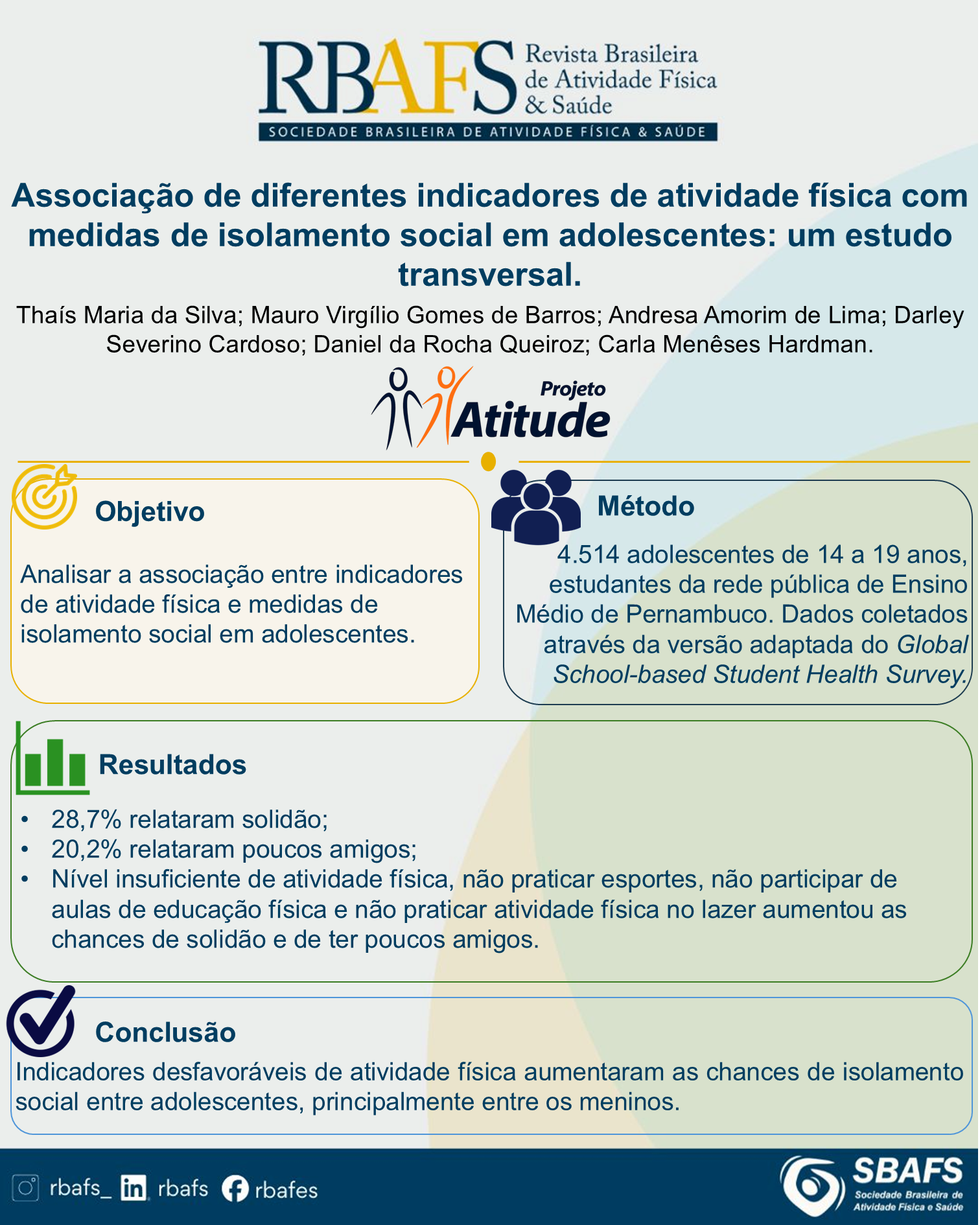
Associação de diferentes indicadores de atividade física com medidas de isolamento social em adolescentes: um estudo transversal
DOI:
https://doi.org/10.12820/rbafs.31e0455Palabras clave:
Aislamiento socialResumen
Introdução: O isolamento social (IS) emerge como fator prejudicial à saúde mental, sendo escassas evidências da relação entre atividade física (AF) e IS entre adolescentes. Objetivo: Analisar a associação de indicadores de AF com medidas de IS em adolescentes. Métodos: Estudo transversal (2022) com adolescentes da rede pública do Ensino Médio de Pernambuco. Utilizou-se a versão adaptada do Global School-based Student Health Survey para obtenção dos dados. As variáveis dependentes foram sentimento de solidão e ter poucos amigos. As independentes foram nível de AF total, prática esportiva, Atividade física no lazer (AFL) e participação nas aulas de Educação Física (EF). Para a análise estatística, utilizou-se a regressão logística binária (OR; IC 95%). Resultados: Participaram 4.514 adolescentes, dos quais 28,7% relataram sentir-se sozinhos e 20,2% ter poucos amigos. Observaram-se associações positivas dos indicadores de AF com o IS. Nível insuficiente de AF (solidão: OR = 1,50 [IC95%: 1,32 - 1,72]; poucos amigos: OR = 1,26 [IC 95%: 1,07 - 1,50]); ausência de prática esportiva (solidão: OR = 2,05 [IC95%: 1,71 - 2,45]; poucos amigos: OR = 1,52 [IC95%: 1,21 - 1,91]); ausência de AFL (solidão: OR = 1,45 [IC95%: 1,25 - 1,69]; poucos amigos: OR = 1,39 [IC 95%: 1,17 - 1,64]); não participar de EF (solidão: OR = 1,59 [IC 95%: 1,35 – 1,86]; poucos amigos: OR = 1,32 [IC 95%: 1,17 - 1,61]), diferindo por sexo. Conclusão: Nível de AF insuficiente, não praticar esportes, não participar de EF e não realizar AFL aumentaram as chances de IS em adolescentes.
Descargas
Citas
1. Keller T, Perry M, Spencer R. Reducing social isolation through formal youth mentoring: Opportunities and potential pitfalls. Clin Soc Work J. 2020;48(1):35–45.
2. Wong EL, Qiu H, Cheung AW, Leung HH, Chen FY, Yeoh E. Association of social isolation with health status among community-dwelling Chinese older adults living with homecare services: a cross-sectional survey in Hong Kong. Front. Public Health. 2023;11:1-8.
3. Almeida ILL, Rego JF, Teixeira ACG, Moreira MR. Social isolation and its impact on child and adolescent development: a systematic review. Rev. Paul. Pediatr. 2021;40:e2020385.
4. Zhu S, Kong X, Han F, Tian H, Sun S, Sun Y, et al. Association between social isolation and depression: Evidence from longitudinal and Mendelian randomization analyses. J Affect Disord. 2024;350:182–7.
5. Matias TS, Alves JF, Nienov JTA, Lopes MVV, Vasconcellos DIC. Clustering of physical activity, sedentary behavior, and diet associated with social isolation among brazilian adolescents. BMC Public Health. 2023;23(1):1–6.
6. Khan A, Khan S, Burton N. Insufficient physical activity and high sedentary behaviour are associated with loneliness in adolescents with overweight/obesity: Evidence from 23 low- and middle-income countries. Pediatr Obes. 2021;17(2):1–4.
7. Antunes JT, Machado ÍE, Malta DC. Loneliness and associated factors among Brazilian adolescents: results of national adolescent school-based health survey 2015. J Pediatr. 2022;98(1):92–8.
8. Santos SJ, Hardman CM, Barros SSH, Santos CFBF, Barros MVG. Association between physical activity, participation in Physical Education classes, and social isolation in adolescents. J Pediatr. 2015;91(6):543–50.
9. Pinto AA, Asante KO, Barbosa RMSP, Nahas MV, Dias DT, Pelegrini A. Association between loneliness, physical activity, and participation in physical education among adolescents in Amazonas, Brazil. J Health Psychol. 2019;26(5):650–8.
10. dos Santos AE, Araujo RHO, Nascimento VMS, Couto JO, Silva RJS. Associations between specific physical activity domains and social isolation in 102,072 Brazilian adolescents: Data from the 2015 National School–Based Health Survey. J Health Psychol. 2020;26(13):1–10.
11. da Solidade VT, do Nascimento VMS, Oliveira DPM, Ribas MCS, Sampaio RAC, Silva RJS. School physical activity and mental health in school-aged brazilian adolescents: A systematic review. Rev Bras de Cineantropom Desempenho Hum. 2021;23:1–13.
12. Araújo RHO, Werneck AO, Christofaro DGD, Silva DRP. Participation in physical education classes and social isolation among adolescents: A harmonized analysis with 266,156 participants from 69 countries. Ment. Health Phys. Act. 2024;26: 100583.
13. Luiz RR, Magnanini MMF. A lógica da determinação do tamanho da amostra em investigações epidemiológicas. Cad Saúde Colet. 2000;8(2):9-28.
14. Li Z, Li J, Kong J, Li Z, Wang R, Jiang F. Adolescent mental health interventions: a narrative review of the positive effects of physical activity and implementation strategies. Front Psychol. 2024;15:1433698.
15. Wanka F, Vogel M, Grafe N, Aßmann M, Kiess W, Poulain T. Leisure activities of adolescents—associations with demographic characteristics, well-being and parental leisure engagement. Pediatr Res. 2025;98:559-67.
16. Werneck AO, Collings PJ, Barboza LL, Stubbs B, Silva DR. Associations of sedentary behaviors and physical activity with social isolation in 100,839 school students: The Brazilian Scholar Health Survey. Gen Hosp Psychiatry. 2019;59:7–13.
17. Santino N, Arbour-Nicitopoulos KP, Sharma R, Graham JD, Bassett-Gunter RL. Physical activity and loneliness among adolescents with disabilities: Examining the quality of physical activity experiences as a possible moderator. Disabil Health J. 2021;14:1-6.
18. Centers for Disease Control and Prevention (US). Behavioral risk factor surveillance system user's guide. Atlanta: U.S. Department of Health and Human Services, Centers for Disease Control and Prevention; 1998.
19. Oleckno WA. Epidemiology: Concepts and Methods. Long Grove, IL: Waveland Press; 2008.
20. Haugen T, Säfvenbom R, Ommundsen Y. Sport participation and loneliness in adolescents: The mediating role of perceived social competence. Curr. Psychol. 2013;32(2):203–16.
21. Brière FN, Yale-Soulière G, Gonzalez-Sicilia D, Harbec M, Morizot J, Janosz M, et al. Prospective associations between sport participation and psychological adjustment in adolescents. J Epidemiol Community Health. 2018;72:575-81.
22. Rangul V, Sund ER, Ingul JM, Rimehaug T, Pape K, Kvaløy K. Exploring the link between physical activity, sports participation, and loneliness in adolescents before and into the COVID-19 pandemic: The HUNT Study, Norway. Int J Environ Res Public Health. 2024;21:1-13.
23. Hopkins CS, Hopkins C, Kanny S, Watson A. A systematic review of factors associated with sport participation among adolescent females. Int J Environ Res Public Health. 2022;19(6):3353.
24. White RL, Parker PD, Lubans DR, MacMillan F, Olson R, Astell-Burt T, et al. Domain specific physical activity and affective wellbeing among adolescents: An observational study of the moderating roles of autonomous and controlled motivation. Int J Behav Nutr Phys Act. 2018;15(87):1–13.
25. Dziedzic B, Sarwa P, Kobos E, Sienkiewicz Z, Idzik A, Wysokinski M, et al. Loneliness and depression among Polish high-school students. Int J Environ Res Public Health. 2021;18(4):1-11.
26. Igami K, Hosozawa M, Ikeda A, Bann D, Shimizu T, Iso H. Adolescent loneliness in 70 countries across Africa, America, and Asia: A comparison of prevalence and correlates. J Adolesc Health. 2023;72 72(6):906-13.
Parlikar N, Kvaløy K, Strand LB, Espnes GA, Moksnes UK. Loneliness in the Norwegian adolescent population: prevalence trends and relations to mental and self-rated health. BMC Psychiatry. 2023;23(895):1-14.
27. Carvalho PD, Barros MVG, Santos CM, Melo EN, Oliveira NKR, Lima RA. The prevalence of and factors associated with negative mental health indicators in adolescents attending high school in the Brazilian State of Pernambuco. Rev Bras Saúde Mater Infan. 2011;11(3):227–38.
28. Tubić T, Modrić T, Sekulić D, Bianco A, Radjo I, Drid P. Loneliness in sports active and non-active school-age children: Can sport protect children against loneliness? Front Psychiatry. 2023;13:1063714.
29. Rudolph KD, Dodson JF. Gender differences in friendship values: Intensification at adolescence. J Early Adolesc. 2022;42(4):586–607.
Descargas
Publicado
Cómo citar
Número
Sección
Licencia
Derechos de autor 2026 Thaís Maria da Silva, Mauro Virgílio Gomes de Barros, Andresa Amorim de Lima, Darley Severino Cardoso, Daniel da Rocha Queiroz, Carla Menêses Hardman

Esta obra está bajo una licencia internacional Creative Commons Atribución 4.0.
Al enviar un manuscrito a la Revista Brasileira de Atividade Física & Saúde, los autores mantienen la titularidad de los derechos de autor sobre el artículo y autorizan a la Revista Brasileira de Atividade Física & Saúde a publicar este manuscrito bajo la Licencia Creative Commons Atribución 4.0 e identificarla como el vehículo de su publicación original.