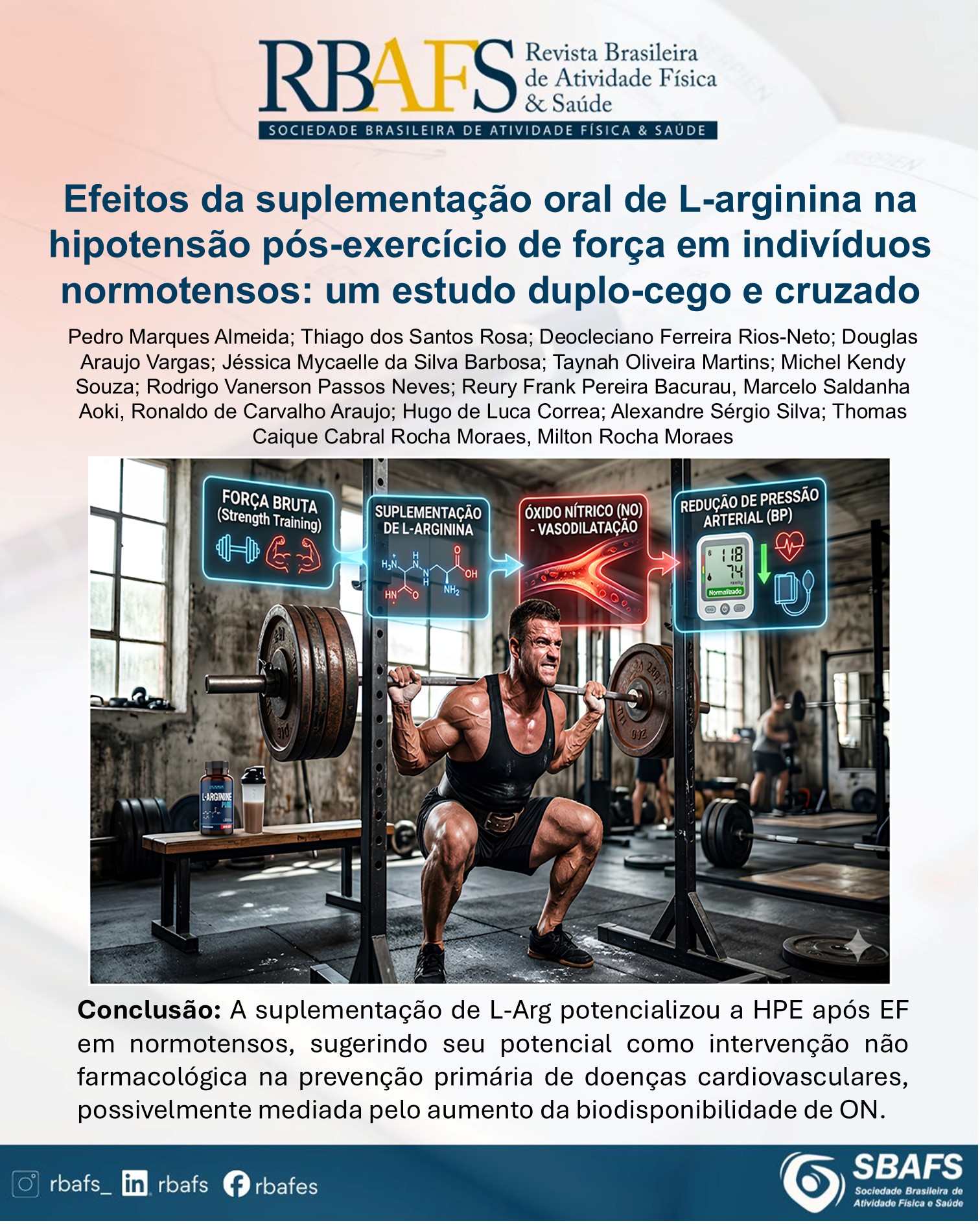
Los EFECTOS DE LA SUPLEMENTACIÓN ORAL DE L-ARGININA SOBRE LA HIPOTENSIÓN POST-EJERCICIO DE RESISTENCIA EN INDIVIDUOS NORMOTENSOS: UN ENSAYO DE CONTROL ALEATORIZADO, DOBLE CIEGO
DOI:
https://doi.org/10.12820/rbafs.31e0443Palabras clave:
Ergogenic aidsResumen
La L-arginina es esencial para la síntesis de óxido nítrico, y estudios han demostrado que el óxido nítrico promueve efectos hipotensores después de la suplementación con L-arginina. Sin embargo, no hay evidencia que evalúe el efecto de la suplementación con L-arginina sobre la hipotensión post-ejercicio en individuos normotensos después de una sola sesión de ejercicio de resistencia. Por lo tanto, el objetivo de este estudio fue investigar si la hipotensión post-ejercicio de resistencia aumenta después de la suplementación oral con L-arginina en individuos normotensos sometidos a ejercicio de resistencia. Se reclutaron doce sujetos varones sedentarios y normotensos. Los voluntarios recibieron 6 g de L-arginina oral o placebo antes del ejercicio de resistencia. Se tomaron muestras de presión arterial [PA] y de sangre para el análisis de óxido nítrico antes y 60 minutos después del ejercicio de resistencia. La sesión de ejercicio de resistencia comenzó inmediatamente después de la toma de la muestra de sangre; se realizó al 60% de la fuerza contráctil voluntaria isotónica máxima en 3 series de 12 repeticiones para los principales grupos musculares. La presión arterial sistólica del grupo de L-arginina fue significativamente menor que la del grupo placebo 60 minutos después del ejercicio de resistencia. La concentración plasmática de óxido nítrico fue significativamente mayor en el grupo de L-arginina que en el grupo placebo 60 minutos después del ejercicio de resistencia. En conclusión, la suplementación con L-arginina redujo la presión arterial en sujetos normotensos después del ejercicio de resistencia, probablemente mediante un aumento en la concentración de óxido nítrico. El efecto hipotensor de la L-arginina en sujetos normotensos sometidos a ejercicio de resistencia podría mejorarse mediante la prevención de enfermedades cardiovasculares primarias.
Palabras clave: ayudas ergogénicas, óxido nítrico, presión arterial, ejercicio de fuerza
Descargas
Citas
1. Oyovwi MO, Atere AD. Exploring the medicinal significance of l-Arginine mediated nitric oxide in preventing health disorders. Eur J Med Chem Rep. 2024;12(6):100175-84. DOI: https://doi.org/10.1016/j.ejmcr.2024.100175
2. Kiani AK, Bonetti G, Medori MC, Caruso P, Manganotti P, Fioretti F, et al. Dietary supplements for improving nitric-oxide synthesis. J Prev Med Hyg. 2022;63(2 Suppl 3):E239-E45.
3. Wu G, Bazer FW, Davis TA, Kim SW, Li P, Marc Rhoads J, et al. Arginine metabolism and nutrition in growth, health and disease. Amino Acids. 2009;37(1):153-68. DOI: https://doi.org/10.1007/s00726-008-0210-y
4. Rashid J, Kumar SS, Job KM, Liu X, Fike CD, Sherwin CMT. Therapeutic Potential of Citrulline as an Arginine Supplement: A Clinical Pharmacology Review. Paediatr Drugs. 2020;22(3):279-93. DOI: https://doi.org/10.1007/s40272-020-00384-5
5. Moraes MR, Bacurau RF, Ramalho JD, Reis FC, Casarini DE, Chagas JR, et al. Increase in kinins on post-exercise hypotension in normotensive and hypertensive volunteers. Biol Chem. 2007;388(5):533-40. DOI: https://doi.org/10.1515/BC.2007.055
6. Dong JY, Qin LQ, Zhang Z, Zhao Y, Wang J, Arigoni F, et al. Effect of oral L-arginine supplementation on blood pressure: a meta-analysis of randomized, double-blind, placebo-controlled trials. Am Heart J. 2011;162(6):959-65. DOI: https://doi.org/10.1016/j.ahj.2011.09.012
7. Rifkind JM, Nagababu E, Barbiro-Michaely E, Ramasamy S, Pluta RM, Mayevsky A. Nitrite infusion increases cerebral blood flow and decreases mean arterial blood pressure in rats: a role for red cell NO. Nitric Oxide. 2007;16(4):448-56. DOI: https://doi.org/10.1016/j.niox.2007.04.002
8. Shiraseb F, Asbaghi O, Bagheri R, Wong A, Figueroa A, Mirzaei K. Effect of l-Arginine Supplementation on Blood Pressure in Adults: A Systematic Review and Dose-Response Meta-analysis of Randomized Clinical Trials. Adv Nutr. 2022;13(4):1226-42. DOI: https://doi.org/10.1093/advances/nmab155
9. Alvares TS, Conte CA, Paschoalin VM, Silva JT, Meirelles Cde M, Bhambhani YN, et al. Acute l-arginine supplementation increases muscle blood volume but not strength performance. Appl PhysiolNutrMetab. 2012;37(1):115-26. DOI: https://doi.org/10.1139/h11-144
10. Pescatello LS, Franklin BA, Fagard R, Farquhar WB, Kelley GA, Ray CA. American College of Sports Medicine position stand. Exercise and hypertension. Med Sci Sports Exerc. 2004;36(3):533-53. DOI: https://doi.org/10.1249/01.MSS.0000115224.88514.3A
11. Moraes MR, Bacurau RF, Simoes HG, Campbell CS, Pudo MA, Wasinski F, et al. Effect of 12 weeks of resistance exercise on post-exercise hypotension in stage 1 hypertensive individuals. J Hum Hypertens. 2012;26(9):533-9. DOI: https://doi.org/10.1038/jhh.2011.67
12. Lu X, Goulding RP, Mundel T, Schlader ZJ, Cotter JD, Koga S, et al. Interactive effects of exercise intensity and recovery posture on postexercise hypotension. Am J Physiol Regul Integr Comp Physiol. 2024;326(6):R567-R77. DOI: https://doi.org/10.1152/ajpregu.00036.2024
13. Gielen S, Schuler G, Adams V. Cardiovascular effects of exercise training: molecular mechanisms. Circulation. 2010;122(12):1221-38. DOI: https://doi.org/10.1161/CIRCULATIONAHA.110.939959
14. Simões GC, Moreira SR, Kushnick MR, Simões HG, Campbell CS. Postresistance exercise blood pressure reduction is influenced by exercise intensity in type-2 diabetic and nondiabetic individuals. J Strength Cond Res. 2010;24(5):1277-1284. DOI: https://doi.org/10.1519/JSC.0b013e3181d67488
15. MacDonald HV, Johnson BT, Huedo-Medina TB, Livingston J, Forsyth KC, Kraemer WJ, et al. Dynamic Resistance Training as Stand-Alone Antihypertensive Lifestyle Therapy: A Meta-Analysis. J Am Heart Assoc. 2016;5(10). DOI: https://doi.org/10.1161/JAHA.116.003231
16. Gargallo P, Casana J, Suso-Marti L, Cuenca-Martinez F, Lopez-Bueno R, Andersen LL, et al. Minimal Dose of Resistance Exercise Required to Induce Immediate Hypotension Effect in Older Adults with Hypertension: Randomized Cross-Over Controlled Trial. Int J Environ Res Public Health. 2022;19(21). DOI: https://doi.org/10.3390/ijerph192114218
17. Cornelissen VA, Fagard RH, Coeckelberghs E, Vanhees L. Impact of resistance training on blood pressure and other cardiovascular risk factors: a meta-analysis of randomized, controlled trials. Hypertension. 2011;58(5):950-8. DOI: https://doi.org/10.1161/HYPERTENSIONAHA.111.177071
18. Moraes MR, Bacurau RF, Casarini DE, Jara ZP, Ronchi FA, Almeida SS, et al. Chronic conventional resistance exercise reduces blood pressure in stage 1 hypertensive men. J Strength Cond Res. 2012;26(4):1122-9. DOI: https://doi.org/10.1519/JSC.0b013e31822dfc5e
19. Aguiar SS, Sousa CV, Simoes HG, Neves RVP, Costa F, de Souza MK, et al. Acute metabolic responses following different resistance exercise protocols. Appl Physiol Nutr Metab. 2018;43(8):838-43. DOI: https://doi.org/10.1139/apnm-2017-0771
20. Brasil IA, Silva J, Pescatello LS, Farinatti P. Central and peripheral mechanisms underlying postexercise hypotension: a scoping review. J Hypertens. 2024;42(5):751-63. DOI: https://doi.org/10.1097/HJH.0000000000003702
21. Gokce N. L-arginine and hypertension. J Nutr. 2004;134(10 Suppl):2807S-11S; discussion 18S-19S. DOI: https://doi.org/10.1093/jn/134.10.2807S
22. Casonatto J, Cavalari JV. A Single Dosage of l-Arginine Oral Supplementation Induced Post-Aerobic Exercise Hypotension in Hypertensive Patients. J Diet Suppl. 2023;20(5):735-48. DOI: https://doi.org/10.1080/19390211.2022.2106006
23. Lima FF, Da Silva TF, Neto MM, Toscano LT, Da Silva CSO, Silva AS. Effect of L-arginine intake on exercise-induced hypotension. Nutr Hosp. 2018;35(5):1195-200. DOI: https://doi.org/10.20960/nh.1708
24. Park HY, Kim SW, Seo J, Jung YP, Kim H, Kim AJ, et al. Dietary Arginine and Citrulline Supplements for Cardiovascular Health and Athletic Performance: A Narrative Review. Nutrients. 2023;15(5). DOI: https://doi.org/10.3390/nu15051268
25. Busnatu SS, Andronic O, Pana MA, Stoian AP, Scafa-Udriste A, Paun N, et al. Oral Arginine Supplementation in Healthy Individuals Performing Regular Resistance Training. Healthcare (Basel). 2023;11(2). DOI: https://doi.org/10.3390/healthcare11020182
26. Hopewell S, Chan AW, Collins GS, Hróbjartsson A, Moher D, Schulz KF, et al. CONSORT 2025Statement: updated guideline for reporting randomised trials. BMJ. 2025; 388:e081123.
27. Kotopoulou S, Zampelas A, Magriplis E. Dietary nitrate and nitrite and human health: a narrative review by intake source. Nutr Rev. 2022;80(4):762-73. DOI: https://doi.org/10.1093/nutrit/nuab113
28. Alvares TS, Meirelles CM, Bhambhani YN, Paschoalin VM, Gomes PS. L-Arginine as a potential ergogenic aid in healthy subjects. Sports Med. 2011;41(3):233-48. DOI: https://doi.org/10.2165/11538590-000000000-00000
29. Griesenbeck JS, Steck MD, Huber JC, Jr., Sharkey JR, Rene AA, Brender JD. Development of estimates of dietary nitrates, nitrites, and nitrosamines for use with the Short Willet Food Frequency Questionnaire. Nutr J. 2009;8:16. DOI: https://doi.org/10.1186/1475-2891-8-16
30. Bode-Boger SM, Boger RH, Galland A, Tsikas D, Frolich JC. L-arginine-induced vasodilation in healthy humans: pharmacokinetic-pharmacodynamic relationship. Br J Clin Pharmacol. 1998;46(5):489-97. DOI: https://doi.org/10.1046/j.1365-2125.1998.00803.x
31. Jackson AS, Pollock ML. Practical Assessment of Body Composition. Phys Sportsmed. 1985;13(5):76-90. DOI: https://doi.org/10.1080/00913847.1985.11708790
32. Comfort P, Haff GG, Suchomel TJ, Soriano MA, Pierce KC, Hornsby WG, et al. National Strength and Conditioning Association Position Statement on Weightlifting for Sports Performance. J Strength Cond Res. 2023;37(6):1163-90. DOI: https://doi.org/10.1519/JSC.0000000000004476
33. American College of Sports Medicine position stand. Progression models in resistance training for healthy adults. Med Sci Sports Exerc. 2009;41(3):687-708. DOI: https://doi.org/10.1249/MSS.0b013e3181915670
34. Miranda KM, Espey MG, Wink DA. A rapid, simple spectrophotometric method for simultaneous detection of nitrate and nitrite. Nitric Oxide. 2001;5(1):62-71. DOI: https://doi.org/10.1006/niox.2000.0319
35. Pickering TG, Hall JE, Appel LJ, Falkner BE, Graves J, Hill MN, et al. Recommendations for blood pressure measurement in humans and experimental animals: part 1: blood pressure measurement in humans: a statement for professionals from the Subcommittee of Professional and Public Education of the American Heart Association Council on High Blood Pressure Research. Circulation. 2005;111(5):697-716. DOI: https://doi.org/10.1161/01.CIR.0000154900.76284.F6
36. Khalaf D, Kruger M, Wehland M, Infanger M, Grimm D. The Effects of Oral l-Arginine and l-Citrulline Supplementation on Blood Pressure. Nutrients. 2019;11(7). DOI: https://doi.org/10.3390/nu11071679
37. Maxwell AJ, Schauble E, Bernstein D, Cooke JP. Limb blood flow during exercise is dependent on nitric oxide. Circulation. 1998;98(4):369-74. DOI: https://doi.org/10.1161/01.CIR.98.4.369
38. Aly K, Yeung PK. Post-Exercise Hypotension: An Alternative Management Strategy for Hypertension and Cardiovascular Disease? J Clin Med. 2023;12(13). DOI: https://doi.org/10.3390/jcm12134456
39. Paluch AE, Boyer WR, Franklin BA, et al. Resistance Exercise Training in Individuals With and Without Cardiovascular Disease: 2023 Update: A Scientific Statement From the American Heart Association. Circulation. 2024;149(3):e217-e231. DOI: https://doi.org/10.1161/CIR.0000000000001189
40. Casonatto J, Zago DM, Enokida DM, Grandolfi K, Aguiar AF. L-Arginine Supplementation Improves Post-Exercise Hypotension In Elderly Women. Rev Bras Med Esporte. 2019;25(4):333-7. DOI: https://doi.org/10.1590/1517-869220192504182865
Descargas
Publicado
Cómo citar
Número
Sección
Licencia
Derechos de autor 2026 Pedro Marques Almeida, Thiago dos Santos Rosa, Deocleciano Ferreira Rios-Neto, Douglas Araujo Vargas, Jessica Mycaelle da Silva Barbosa, Taynah Oliveira Martins, Michel Kendy Souza, Rodrigo Vanerson Passos Neves, Reury Frank Pereira Bacurau, Marcelo Saldanha Aoki, Ronaldo Carvalho Araujo, Hugo de Luca Correa, Alexandre Sérgio Silva, Thomas Caique Cabral Rocha Moraes, Milton Rocha Moraes

Esta obra está bajo una licencia internacional Creative Commons Atribución 4.0.
Al enviar un manuscrito a la Revista Brasileira de Atividade Física & Saúde, los autores mantienen la titularidad de los derechos de autor sobre el artículo y autorizan a la Revista Brasileira de Atividade Física & Saúde a publicar este manuscrito bajo la Licencia Creative Commons Atribución 4.0 e identificarla como el vehículo de su publicación original.