Use of public spaces for physical activity: An exploratory study in Oeiras, Portugal
DOI:
https://doi.org/10.12820/rbafs.31e0431Palabras clave:
Physical activity, Sedentary behavior, Public parks, Public healthResumen
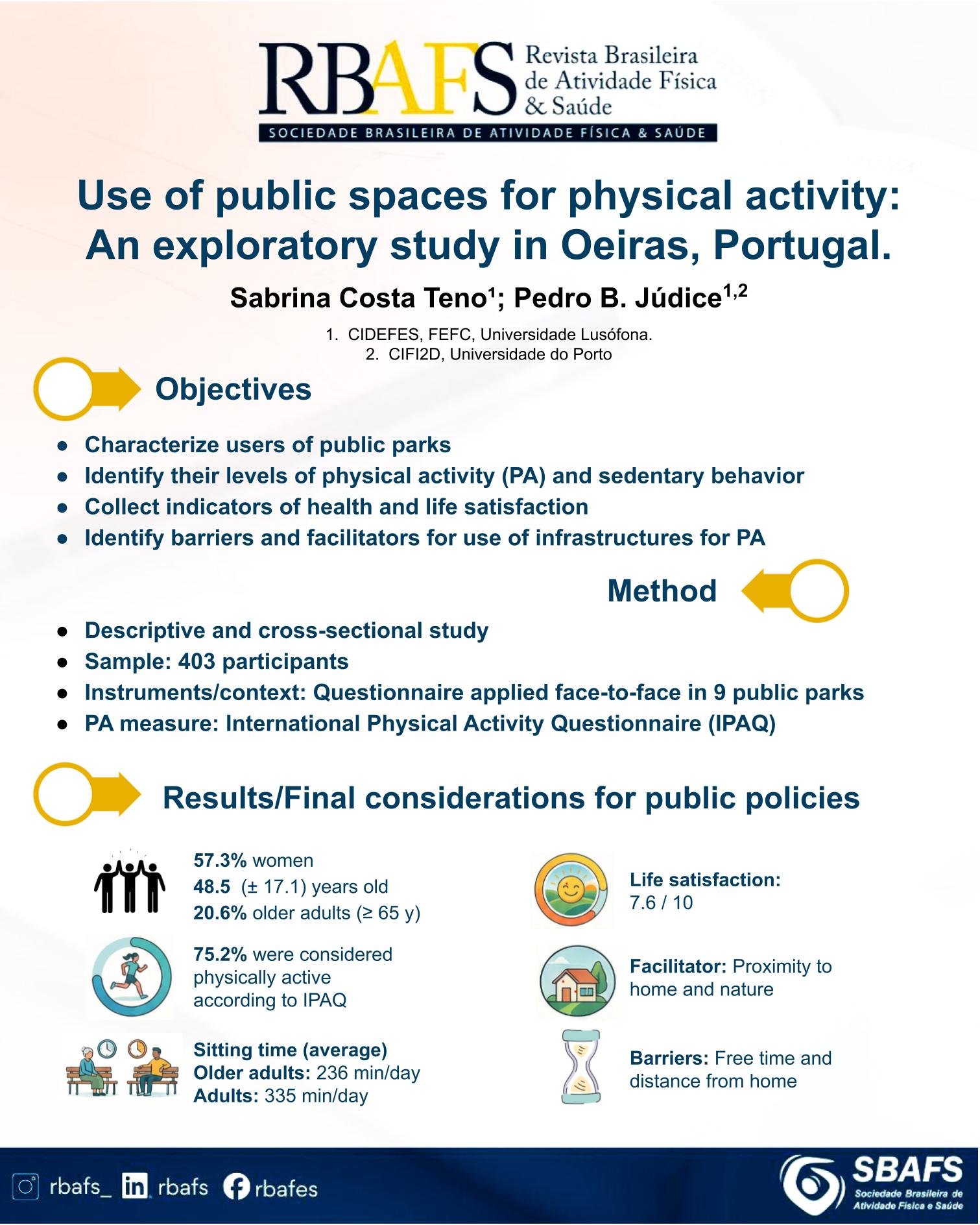
Introduction: Previous systematic reviews indicate that easy access to places for walking and exercise favors the practice of physical activity (PA). However, despite the effort and investment in improving structures for PA practice in the municipality of Oeiras, Portugal, no study has been dedicated to identifying the profile of its occupants, health indicators, and their relation with these spaces. Objective: This exploratory-descriptive study aimed to characterize the users of public parks, describing their PA and sedentary behavior (SB) levels, perception of health, life satisfaction, and the relationship with the spaces used for PA practice. Method: Through a convenience sample, 403 interviews were carried out by questionnaire applied face-to-face in public areas in 9 infrastructures for PA practice, and descriptive analyses were employed. Results: Results indicated that the PA levels of public park users are above those described by other national studies (153 ± 291 min/week of vigorous-intensity PA and 417 ± 657 min/week of moderate-intensity PA). In addition, the participants reported spend-ing an average of 314 ± 164 minutes/day (5.2 hours/day) in SB and had a high life satisfaction (mean = 7.6 – on a scale of 0 to 10). Besides that, they reported that the main reasons for choosing that place were proximity to home (45.7%) and being in contact with nature (22.1%). Conclusion: Our descriptive study demonstrates that people who attend public parks dedicated to PA practice tend to be more physically active, spend less time in SB, which contributes to reducing physical inactivity.
Descargas
Citas
1. Bull FC, Al-Ansari SS, Biddle S, et al. World Health Organization 2020 guidelines on physical activity and sedentary behaviour. Br J Sports Med. 2020;54(24):1451–62. doi: https://doi.org/10.1136/bjsports-2020-102955 DOI: https://doi.org/10.1136/bjsports-2020-102955
2. Pedersen BK, Saltin B. Exercise as medicine - evidence for prescribing exercise as therapy in 26 different chronic diseases. Scand J Med Sci Sports. 2015;25:1–72. doi: 10.1111/sms.12581 DOI: https://doi.org/10.1111/sms.12581
3. Marquez DX, Aguiñaga S, Vásquez PM, Conroy DE, Erickson KI, Hillman C, et al. A systematic review of physical activity and quality of life and well-being. Transl Behav Med. 2020;10(5):1098–109. doi: https://doi.org/10.1093/tbm/ibz198 DOI: https://doi.org/10.1093/tbm/ibz198
4. Thivel D, Tremblay A, Genin PM, Panahi S, Rivière D, Duclos M. Physical Activity, Inactivity, and Sedentary Behaviors: Definitions and Implications in Occupational Health. Front Public Health. 2018;6:288. doi: https://doi.org/10.3389/fpubh.2018.00288 DOI: https://doi.org/10.3389/fpubh.2018.00288
5. Júdice PB, Silva AM, Santos DA, Baptista F, Sardinha LB. Associations of breaks in sedentary time with abdominal obesity in Portuguese older adults. Age (Dordr). 2015;37(2):23. doi: https://doi.org/10.1007/s11357-015-9760-6 DOI: https://doi.org/10.1007/s11357-015-9760-6
6. Patterson R, McNamara E, Tainio M, de Sá TH, Smith AD, Sharp SJ, et al. Sedentary behaviour and risk of all-cause, cardiovascular and cancer mortality, and incident type 2 diabetes: a systematic review and dose response meta-analysis. Eur J Epidemiol. 2018;33(9):811–29. doi: https://doi.org/10.1007/s10654-018-0380-1 DOI: https://doi.org/10.1007/s10654-018-0380-1
7. Wang X, Li Y, Fan H. The associations between screen time-based sedentary behavior and depression: a systematic review and meta-analysis. BMC Public Health. 2019;19(1):1524. doi: https://doi.org/10.1186/s12889-019-7904-9 DOI: https://doi.org/10.1186/s12889-019-7904-9
8. Mansoubi M, Pearson N, Biddle SJ, Clemes S. The relationship between sedentary behaviour and physical activity in adults: A systematic review. Prev Med. 2014;69:28–35. doi: https://doi.org/10.1016/j.ypmed.2014.08.028 DOI: https://doi.org/10.1016/j.ypmed.2014.08.028
9. Europen Comission. Desporto e Atividade Física - Setembro 2022 - Inquérito Eurobarómetro. 2022. Available from: <https://europa.eu/eurobarometer/surveys/detail/2668> [2022 September].
10. Chau JY, Grunseit AC, Chey T, Stamatakis E, Brown WJ, Matthews CE, et al. Daily Sitting Time and All-Cause Mortality: A Meta-Analysis. PLOS ONE 2013;8(11):e80000. doi: https://doi.org/10.1371/journal.pone.0080000 DOI: https://doi.org/10.1371/journal.pone.0080000
11. S Smith M, Hosking J, Woodward A, Witten K, MacMillan A, Field A, et al. Systematic literature review of built environment effects on physical activity and active transport – an update and new findings on health equity. Int J Behav Nutr Phys Act. 2017;14(1):158. doi: https://doi.org/10.1186/s12966-017-0613-9 DOI: https://doi.org/10.1186/s12966-017-0613-9
12. Sallis JF, Cerin E, Conway TL, Adams MA, Frank LD, Pratt M, et al. Physical activity in relation to urban environments in 14 cities worldwide: a cross-sectional study. Lancet. 2016;387(10034):2207–17. doi: https://doi.org/10.1016/S0140-6736(15)01284-2 DOI: https://doi.org/10.1016/S0140-6736(15)01284-2
13. Derdouri A, Murayama Y, Morimoto T, Wang R, Aghasi NHM. Urban green space in transition: A cross-continental perspective from eight Global North and South cities. Landsc Urban Plann. 2025;253:105220. doi: https://doi.org/10.1016/j.landurbplan.2024.105220 DOI: https://doi.org/10.1016/j.landurbplan.2024.105220
14. Radha RA, Mohammed-Amin RK, Ali AF. Assessing Walkability in Sulaimani City Center. KJAR. 2020;5(1):175–99. doi: https://doi.org/10.24017/science.2020.1.13 DOI: https://doi.org/10.24017/science.2020.1.13
15. Fundação Francisco Manuel dos Santos. Pordata. Retatros dos Municípios. População - Oeiras. n.d. Available from: <https://retratos.pordata.pt/populacao/oeiras> [2025 November].
16. Instituto Nacional de Estatísticas. Estatísticas do Rendimento ao Nível Local - 2020. Available from https://www.ine.pt/documentos/municipios/rnlocal/ano2022/1110.pdf> [2022 September].
17. Oeiras Valley. Município de Oeiras. Espaço Verdes. 2023. Available from: <https://www.oeiras.pt/espa%C3%A7o-verdes?p_l_back_url=%2Fpesquisa%3Fq%3Despa%25C3%25A7os%2Bverdes> [2023 May].
18. von Elm E, Altman DG, Egger M, Pocock SJ, Gøtzsche PC, Vandenbroucke JP. Strengthening the reporting of observational studies in epidemiology (STROBE) statement: guidelines for reporting observational studies. BMJ. 2007;335(7624):806–8. doi: https://doi.org/10.1136/bmj.39335.541782.AD DOI: https://doi.org/10.1136/bmj.39335.541782.AD
19. Diener E, Emmons RA, Larsen RJ, Griffin S. The Satisfaction With Life Scale. J Pers Assess. 1985;49(1):71–5. doi: https://doi.org/10.1207/s15327752jpa4901_13 DOI: https://doi.org/10.1207/s15327752jpa4901_13
20. Craig CL, Marshall AL, Sjöström M, Bauman AE, Booth ML, Ainsworth BE, et al. International physical activity questionnaire: 12-country reliability and validity. Med Sci Sports Exerc. 2003;35(8):1381–95. doi: https://doi.org/10.1249/01.MSS.0000078924.61453.FB DOI: https://doi.org/10.1249/01.MSS.0000078924.61453.FB
21. Rezende LFM, Sá TH, Mielke GI, Viscondi JYK, Rey-López JP, Garcia LMT. All-Cause Mortality Attributable to Sitting Time: Analysis of 54 Countries Worldwide. Am J Prev Med. 2016;51(2):253–63. doi: https://doi.org/10.1016/j.amepre.2016.01.022 DOI: https://doi.org/10.1016/j.amepre.2016.01.022
22. Spiteri K, Broom D, Bekhet AH, et al. Barriers and Motivators of Physical Activity Participation in Middle-aged and Older-adults - A Systematic Review. J Aging Phys Act. 2019;27(4):929–944. doi: https://doi.org/10.1123/japa.2018-0343 DOI: https://doi.org/10.1123/japa.2018-0343
23. Fundação Francisco Manuel dos Santos. Pordata. População Residente Segundo Os Censos: Total e Por Grandes Grupos Etários. n.d. Available from: <https://www.pordata.pt/Portugal/Popula%C3%A7%C3%A3o+residente+segundo+os+Censos+total+e+por+grandes+grupos+et%C3%A1rios-512-2541> [2022 May].
24. Teixeira PJ, Marques A, Lopes C, Sardinha LB, Mota JA. Prevalence and Preferences of Self-Reported Physical Activity and Nonsedentary Behaviors in Portuguese Adults. J Phys Act Health. 2019;16(4):251–8. doi: https://doi.org/10.1123/jpah.2018-0340 DOI: https://doi.org/10.1123/jpah.2018-0340
25. República Portuguesa. Serviço Nacional de Saúde. Direção-Geral da Saúde. REACT-COVID 2.0 Inquérito Sobre Alimentação e Atividade Física em Contexto da Pandemia COVID-19. Available from: <https://alimentacaosaudavel.dgs.pt/wp-content/uploads/2022/07/REACT_COVID_20_Out2021.pdf> [2022 September]
26. Aerts N, Le Goff D, Odorico M, Le Reste JY, Van Bogaert P, Peremans L, et al. Systematic review of international clinical guidelines for the promotion of physical activity for the primary prevention of cardiovascular diseases. BMC Fam Pract. 2021;22(1):97. doi: https://doi.org/10.1186/s12875-021-01409-9 DOI: https://doi.org/10.1186/s12875-021-01409-9
27. Zheng C, Gill JMR, Sun FH, Huang WY, Sheridan S, Chen XK, et al. Effects of increasing light versus moderate-to-vigorous physical activity on cardiometabolic health in Chinese adults with obesity. J Sports Sci. 2023;41(16):1547–57. doi: https://doi.org/10.1080/02640414.2023.2282278 DOI: https://doi.org/10.1080/02640414.2023.2282278
28. Organization for Economic Cooperation and Development (OECD). OECD Better Life Index. 2021. Available from: <https://www.oecdbetterlifeindex.org/pt/sobre/> [2021 September].
29. Humpel N, Owen N, Leslie E. Environmental factors associated with adults’ participation in physical activity: A review. Am J Prev Med. 2002;22(3):188–99. doi: https://doi.org/10.1016/S0749-3797(01)00426-3 DOI: https://doi.org/10.1016/S0749-3797(01)00426-3
30. Moran M, Van Cauwenberg J, Hercky-Linnewiel R, Cerin E, Deforche B, Plaut P. Understanding the relationships between the physical environment and physical activity in older adults: a systematic review of qualitative studies. Int J Behav Nutr Phys Act. 2014;11:79. doi: https://doi.org/10.1186/1479-5868-11-79 DOI: https://doi.org/10.1186/1479-5868-11-79
31. Pretty J, Peacock J, Sellens M, Griffin M. The mental and physical health outcomes of green exercise. Int J Environ Health Res. 2005;15(5):319–37. doi: https://doi.org/10.1080/09603120500155963 DOI: https://doi.org/10.1080/09603120500155963
Descargas
Publicado
Cómo citar
Número
Sección
Licencia
Derechos de autor 2026 Sabrina Costa Teno, Pedro Barracha Júdice

Esta obra está bajo una licencia internacional Creative Commons Atribución 4.0.
Al enviar un manuscrito a la Revista Brasileira de Atividade Física & Saúde, los autores mantienen la titularidad de los derechos de autor sobre el artículo y autorizan a la Revista Brasileira de Atividade Física & Saúde a publicar este manuscrito bajo la Licencia Creative Commons Atribución 4.0 e identificarla como el vehículo de su publicación original.