Factors associated with the longitudinal maintenance of active life among Brazilian adults (CUME Study)
DOI:
https://doi.org/10.12820/rbafs.30e0407Palabras clave:
Cohort study, Adult, Physical activity, NOVA Food ClassificationResumen
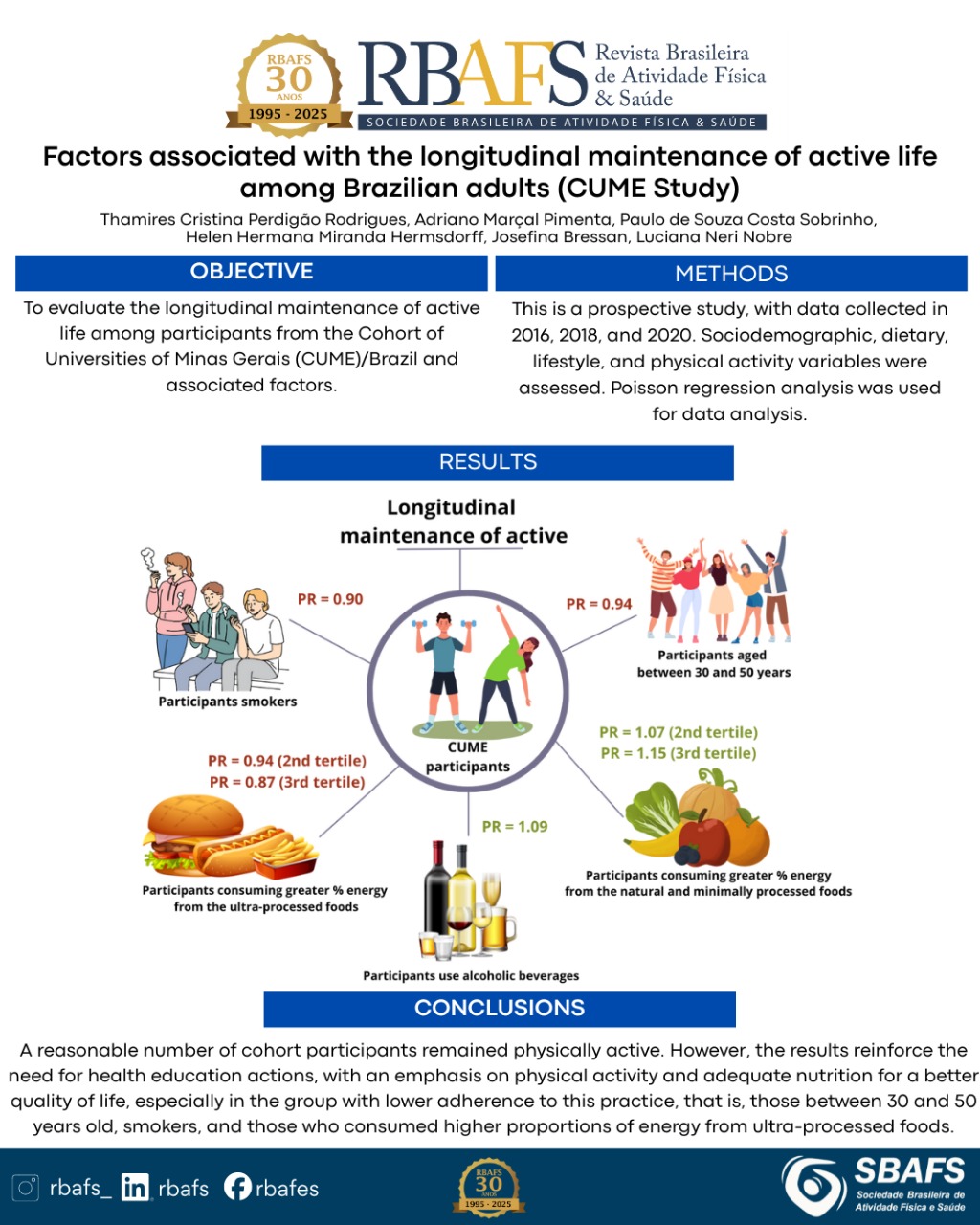
Introduction: The benefits of regular physical exercise for the prevention and treatment of chronic diseases have been well documented; and physically active individuals tend to adopt other positive health habits. Objective: To evaluate the longitudinal maintenance of active life among participants from the Cohort of Universities of Minas Gerais (CUME)/Brazil and associated factors. Methods: This is a prospective study, with data collected in 2016, 2018, and 2020. Sociodemographic, dietary, lifestyle, and physical activity variables were assessed. Poisson regression analysis was used for data analysis. Results: A total of 2,546 volunteers participated in the study. During this period, 40% of participants remained active from baseline to the first wave, 30% from the second to the third wave, and 29% throughout follow-up. For data analysis, two models were tested, one including ultra-processed foods and the other including natural and minimally processed foods. In the model adjusted with ultra-processed foods, the participants who were least likely to remain physically active were those aged between 30 and 50 years (PR = 0.94; p-value = 0.005), smokers (PR = 0.90; p-value = 0.003), and those who consumed higher proportions of energy from ultra processed foods (2nd tertile RP = 0.94, p-value = 0.007 and 3rd tertile RP = 0.97, p-value <0.001); while consuming alcoholic beverages was protective (PR = 1.09; p-value <0.001). A similar result was observed in the model with the inclusion of natural and minimally processed foods; however, a higher proportion of energy from minimally processed foods increased the likelihood of maintaining an active lifestyle (2nd tertile PR = 1.07, p-value = 0.004 and 3rd tertile PR = 1.15, p-value p<0.001). Conclusions: A reasonable number of cohort participants remained physically active. However, the results reinforce the need for health education actions, with an emphasis on physical activity and adequate nutrition for a better quality of life, especially in the group with lower adherence to this practice, that is, those between 30 and 50 years old, smokers, and those who consumed higher proportions of energy from ultra-processed foods.
Descargas
Citas
1. Pedersen BK, Saltin B. Exercise as medicine Evidence for prescribing exercise therapy in 26 chronic diseases. Scand. J. Med. Sci. Sports. 2015;25:1-72. DOI: https://doi.org/10.1111/sms.12581
2. Collado-Mateo D, Lavín-Pérez AM, Peñacoba C, Del Coso J, Leyton-Román M, Luque-Casado A, et al. Key Factors Associated with Adherence to Physical Exercise in Patients with Chronic Diseases and Older Adults: An Umbrella Review. Int J Environ Res Public Health. 2021;18:2023. DOI: https://doi.org/10.3390/ijerph18042023
3. Marques A, Peralta M, Sarmento H, Martins J, Valeiro MG. Associations between vigorous physical activity and chronic diseases in older adults: a study in 13 European countries. Eur J Public Health. 2018;28:950-5. DOI: https://doi.org/10.1093/eurpub/cky086
4. Caspersen CJ, Powell KE, Christenson GM. Physical activity, exercise, and physical fitness: definitions and distinctions for health-related research. Public Health Rep. 1985;100:126-31.
5. Bull FC, Al-Ansari SS, Biddle S, Borodulin K, Buman MP, et al. World Health Organization Guidelines on Physical Activity and Sedentary Behavior: At a Glance; World Health Organization: Geneva, Switzerland. Br J Sports Med. 2020;54:1451-62. DOI: https://doi.org/10.1136/bjsports-2020-102955
6. Liu R, Menhas R, Saqib ZA. Does physical activity influence health behavior, mental health, and psychological resilience under the moderating role of quality of life? Front. Psychol. 2024;15:1349880. DOI: https://doi.org/10.3389/fpsyg.2024.1349880
7. World Health Organization. Global action plan on physical activity 2018-2030: more active people for a healthier world. Geneva: World Health Organization. 2018.
8. Domingos ALG, Miranda AES, Pimenta AM, Hermsdorff HHM, Oliveira FLP, Santos LC, et al. Cohort Profile: The Cohort of Universities of Minas Gerais (CUME). Int J Epidemiol. 2018; 47:1743-44. DOI: https://doi.org/10.1093/ije/dyy152
9. Chung L. O que é uma boa taxa de resposta para pesquisas on-line com clientes? 2024. Available from: <https://delighted.com/pt-br/blog/taxa-media-de-resposta-a-pesquisa> [2024 April].
10. Souza Lopes AC, Caiaffa WT, Mingoti SA, Lima-Costa MFF. Ingestão alimentar em estudos epidemiológicos. Rev Bras Epidemiol. 2003;6:209-19. DOI: https://doi.org/10.1590/S1415-790X2003000300004
11. Farinatti PTV. Presentation of a Portuguese version of the compendium of physical activities: a contribution to researchers and professionals in exercise physiology. Rev Bras Fisiol Exerc. 2003;2:177–208.
12. World Health Organization. Global recommendations on physical activity for health. Genebra: World Health Organization. 2010. Available from: <https://www.who.int/publications/i/item/9789241599979> [2022 April].
13. Monteiro CA, Cannon G, Moubarac JC, Levy RB, Louzada MLC, Jaime PC. The UN Decade of Nutrition, the NOVA food classification, and the trouble with ultra-processing. Public Health Nutr. 2018;21:5-17. DOI: https://doi.org/10.1017/S1368980017000234
14. WHO Consultation on Obesity (1999: Geneva, Switzerland) & World Health Organization (2000). Obesity: preventing and managing the global epidemic: report of a WHO consultation. World Health Organization. Available from: < https://iris.who.int/handle/10665/42330> [2022 April].
15. Sociedade Brasileira de Diabetes – SBD. 2021. Diretrizes da Sociedade Brasileira de Diabetes 2019-2020. Available from: <https://portaldeboaspraticas.iff.fiocruz.br/wp-content/uploads/2021/08/Diretrizes-Sociedade-Brasileira-de-Diabetes-2019-2021.pdf>. [2022 April].
16. Sociedade Brasileira de Cardiologia – SBC, 2020. Diretrizes Brasileiras de Hipertensão Arterial 2020. Available from: <https://abccardiol.org/wp-content/uploads/articles_xml/0066-782X-abc-116-03-0516/0066-782X-abc-116-03-0516.x44344.pdf>. [2022 April].
17. Miranda AES, Ferreira AVM, Oliveira FLP, Hermsdorff HHM, Josefina B, Pimenta AM. Validation of Metabolic Syndrome and Its Self-Reported Components in the Cume Study. Rev Min Enferm. 2017;21:1-7. DOI: https://doi.org/10.5935/1415-2762.20170079
18. Azarias HGA, Marques-Rocha JL, Miranda AES, Santos LC, Domingos ALG, Hermsdorff HHM. Online food frequency questionnaire from the cohort of universities of Minas Gerais (CUME project, Brazil): construction, validity, and reproducibility. Front. Nutr. 2021;8:709915. DOI: https://doi.org/10.3389/fnut.2021.709915
19. Instituto Brasileiro de Geografia e Estatística - IBGE. 2010. Pesquisa de Orçamentos Familiares 2008-2009: Tabela de Medidas Referidas para os Alimentos Consumidos no Brasil. Available from: <https://portaldeboaspraticas.iff.fiocruz.br/wp-content/uploads/2019/07/liv50063.pdf> [2022 April].
20. Willett WC, Colditz GA. Approaches for conducting large cohort studies. Epidemiol Rev. 1998;20:91-9. DOI: https://doi.org/10.1093/oxfordjournals.epirev.a017975
21. Heck RH, Thomas SL, Tabata LN. Multilevel and longitudinal modeling with IBM SPSS. Routledge. 2012. DOI: https://doi.org/10.4324/9780203855263
22. Strain T, Flaxman S, Guthold R, Semenova E, Cowan M. et al. National, regional, and global trends in insufficient physical activity among adults from 2000 to 2022: a pooled analysis of 507 populationbased surveys with 5·7 million participants. Lancet Glob Health 2024; 12: e1232–43.
23. Azevedo MR, Horta BL, Gigante DP, Sibbritt D. Continuidade da atividade física na Coorte de Nascimentos de 1982 de Pelotas. Rev. Bras. Ativ. Fís. Saúde. 2012;16:156-61.
24. Gropper H, John JM, Sudeck G, Thiel A. The impact of life events and transitions on physical activity: A scoping review. PLoS One. 2020;15:e0234794. DOI: https://doi.org/10.1371/journal.pone.0234794
25. Zhang J, Cao Y, Mo H, Feng R. The association between different types of physical activity and smoking behavior. BMC Psychiatry. 2023;23:927. DOI: https://doi.org/10.1186/s12888-023-05416-1
26. Piazza-Gardner AK, Barry AE. Examining physical activity levels and alcohol consumption: are people who drink more active? Am J Health Promot 2012;26:e95-104. DOI: https://doi.org/10.4278/ajhp.100929-LIT-328
27. Conway TL, Cronan TA. Smoking, exercise, and physical fitness. Prev Med. 1992;21(6):723-34. DOI: https://doi.org/10.1016/0091-7435(92)90079-W
28. Lima D, da Silva M, Júnior O, Lima L, Sampaio A, Luiz O. Associação da atividade física de lazer com o consumo de bebidas alcoólicas em adultos. Rev. Bras. Ativ. Fís. Saúde. 2018;22:576-83. DOI: https://doi.org/10.12820/rbafs.v.22n6p576-583
29. Henderson CE, Najjar LZ, Chelsie MY, Leasure JL, Neighbors C, Longitudinal Relations Between Physical Activity and Alcohol Consumption Among. Psychol Addict Behav. 2023;37:285-93. DOI: https://doi.org/10.1037/adb0000807
30. Dodge T, Clarke P, Dwan R. The Relationship Between Physical Activity and Alcohol Use Among Adults in the United States: A Systematic Review of the Literature. Am J Health Promot. 2017;31:97-108. DOI: https://doi.org/10.1177/0890117116664710
31. Leasure JL, Neighbors C. Impulsivity moderates the association between physical activity and alcohol consumption. Alcohol. 2014;48:361-6. DOI: https://doi.org/10.1016/j.alcohol.2013.12.003
32. Gamage AU, Seneviratne RA. Physical inactivity and its association with hypertension among employees in the district of Colombo. BMC Public Health. 2021;21:2186. DOI: https://doi.org/10.1186/s12889-021-12013-y
33. Alpsoy S. Exercise and Hypertension. Adv Exp Med Biol. 2020;1228:153-167. DOI: https://doi.org/10.1007/978-981-15-1792-1_10
34. Duclos M, Dejager S, Postel-Vinay N, di Nicola S, Quéré S, Fiquet B. Physical activity in patients with type 2 diabetes and hypertension – insights into motivations and barriers from the MOBILE study. Vasc Health Risk Manag. 2015;11:361-71. DOI: https://doi.org/10.2147/VHRM.S84832
35. Murta IG, Agostini DFB, Mendes Júnior F, Luz MS, Mourão PA, Lucinda LMF. Avaliação das barreiras à prática de atividade física em pacientes com doenças crônicas não transmissíveis. Rev. méd. Minas Gerais. 2018;28:12-18.
36. Acar Z, Jackson S, Klosterhalfen S, Kotz D. Physical activity and tobacco smoking in the German adult population. BMJ Open Sport Exerc Mede. 2024;10:e002087. DOI: https://doi.org/10.1136/bmjsem-2024-002087
37. Silva CLDA, Sousa, AG, Borges, LPSL, Costa THM. Usual consumption of ultra-processed foods and its association with sex, age, physical activity, and body mass index in adults living in Brasília city, Brazil. Rev. bras. Epidemiol. 2021;24:E210033. DOI: https://doi.org/10.1590/1980-549720210033
38. Rothman KJ, Gallacher JE, Hatch EE. Why representativeness should be avoided. Int J Epidemiol. 2013;42:1012-14. DOI: https://doi.org/10.1093/ije/dys223
Descargas
Publicado
Cómo citar
Número
Sección
Licencia
Derechos de autor 2025 Thamires Cristina Perdigão Rodrigues, Adriano Marçal Pimenta, Paulo de Souza Costa Sobrinho, Helen Hermana Miranda Hermsdorff, Josefina Bressan, Luciana Neri Nobre

Esta obra está bajo una licencia internacional Creative Commons Atribución 4.0.
Al enviar un manuscrito a la Revista Brasileira de Atividade Física & Saúde, los autores mantienen la titularidad de los derechos de autor sobre el artículo y autorizan a la Revista Brasileira de Atividade Física & Saúde a publicar este manuscrito bajo la Licencia Creative Commons Atribución 4.0 e identificarla como el vehículo de su publicación original.