Urban environment and sociodemographic factors in physical activity among adults and older adults
DOI:
https://doi.org/10.12820/rbafs.31e0466Keywords:
Physical activity, Built environment, Aging, Active mobility, Health promotionAbstract
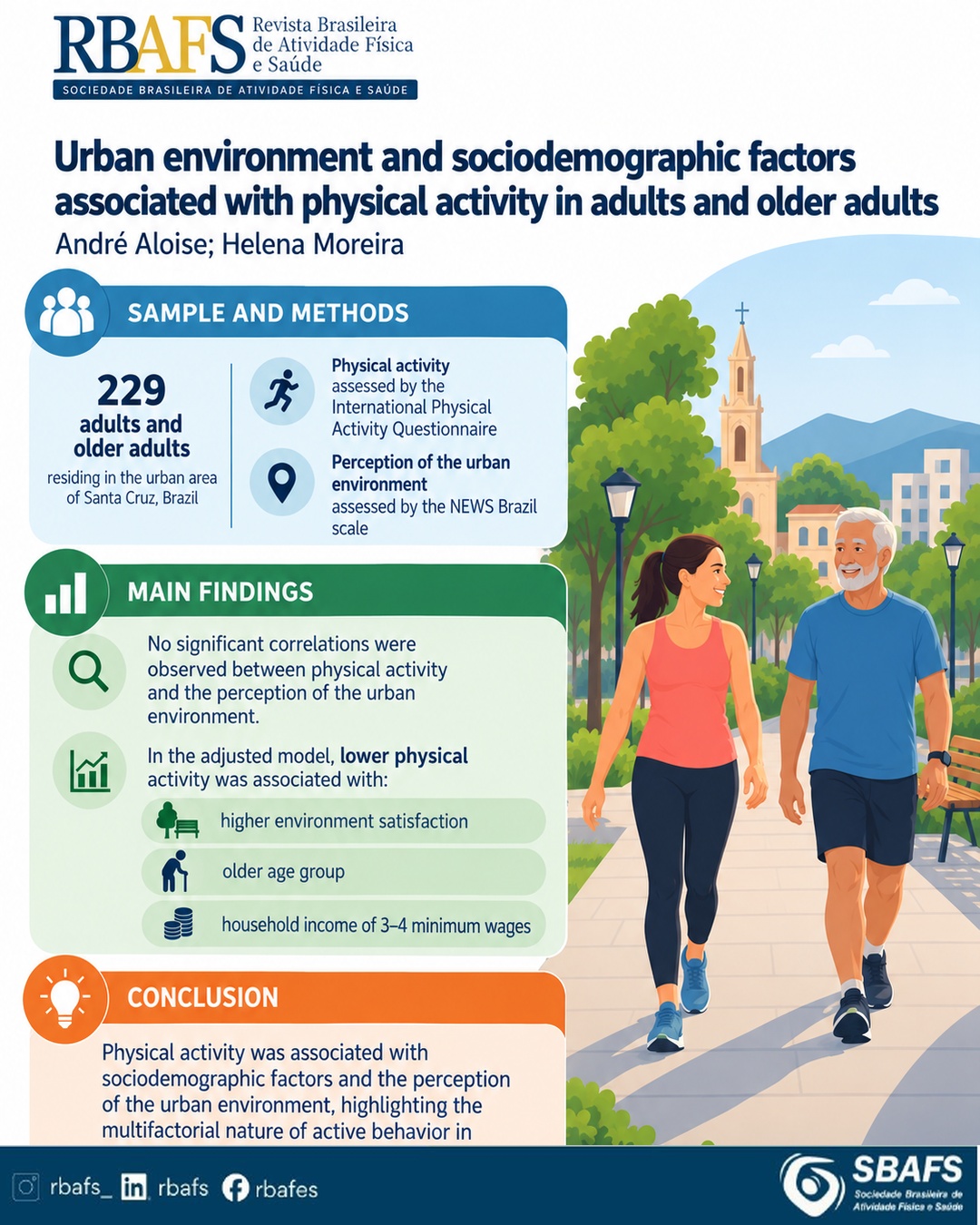
Introduction: Insufficient physical activity is a public health challenge as it may be associated with an increased risk of chronic noncommunicable conditions and reduced perception of quality of life. Although environmental and sociodemographic factors influence physical activity, studies in cities in the Brazilian countryside remain limited. Objective: To analyze the relationship between perceived urban environment, sociodemographic factors, and physical activity among adults and older adults living in the urban area of Santa Cruz, Rio Grande do Norte, Brazil. Methods: A cross-sectional observational study with a quantitative approach was conducted with 229 participants. Physical activity was assessed using the International Physical Activity Questionnaire (IPAQ), and environmental perception was evaluated using the Neighborhood Environment Walkability Scale (NEWS). Descriptive analyses, correlations, the Student’s t test, and multiple linear regression were performed (p < 0.05). Results: No correlations were observed between physical activity, age, and perceived urban environment, nor were differences in physical activity observed between adults and older adults (p > 0.05). In the multiple linear regression analysis, satisfaction with the environment (β = -142.52; 95% CI: -236.90 to -48.14; p = 0.003), age group (β = -156.47; 95% CI: -273.16 to -39.79; p = 0.009), and income (β = -230.93; 95% CI: -420.47 to -41.39; p = 0.017) remained associated with physical activity. Conclusion: Sociodemographic factors and perceived urban environment were associated with physical activity, suggesting the multifactorial nature of physically active behavior in urban contexts.
Downloads
References
1. World Health Organization. WHO Guidelines on Physical Activity and Sedentary Behaviour. 1st ed. Geneva: World Health Organization; 2020.
2. Blair SN, Cheng Y, Holder JS. Is physical activity or physical fitness more important in defining health benefits? Med Sci Sports Exerc. 2001;33(6 Suppl):S379-99.
3. Lee IM, Skerrett PJ. Physical activity and all-cause mortality: what is the dose-response relation? Med Sci Sports Exerc. 2001;33(Suppl):S459-71.
4. Porto LGG, Azevedo MR, Molina GE, Guedes DP, Nahas MV, Hallal PC, et al. A relação entre atividade física e saúde: uma abordagem histórica e conceitual. Rev Bras Ativ Fís Saúde. 2023;28:1–7.
5. Brasil. Ministério da Saúde. Secretaria de Vigilância em Saúde e Ambiente. Vigitel Brasil 2006-2024: vigilância de fatores de risco e proteção para doenças crônicas por inquérito telefônico. Brasília: Ministério da Saúde; 2025.
6. Guthold R, Stevens GA, Riley LM, Bull FC. Worldwide trends in insufficient physical activity from 2001 to 2016: a pooled analysis of 358 population-based surveys with 1·9 million participants. Lancet Glob Health. 2018;6(10):e1077–e1086.
7. Sallis JF, Spoon C, Cavill N, Engelberg JK, Gebel K, Parker M, et al. Co-benefits of designing communities for active living: an exploration of literature. Int J Behav Nutr Phys Act. 2015;12(1):30.
8. Bauman AE, Reis RS, Sallis JF, Wells JC, Loos RJ, Martin BW; Lancet Physical Activity Series Working Group. Correlates of physical activity: why are some people physically active and others not? Lancet. 2012;380(9838):258-71.
9. Sallis JF, Owen N, Fisher EB. Ecological models of health behavior. in: Glanz K, Rimer BK, Viswanath K, editors. Health behavior and health education: Theory, research, and practice. 4th ed. San Francisco: Jossey-Bass; 2008. p. 465-86.
10. Sallis JF, Cerin E, Conway TL, Adams MA, Frank LD, Pratt M, et al. Physical activity in relation to urban environments in 14 cities worldwide: a cross-sectional study. Lancet. 2016;387(10034):2207-17.
11. Westenhöfer J, Nouri E, Reschke ML, Seebach F, Buchcik J. Walkability and urban built environments—a systematic review of health impact assessments (HIA). BMC Public Health. 2023;23(1):518.
12. Monteiro LZ, Farias JM, Lima TR, Schäfer AA, Meller FO, Silva DAS. Physical activity and perceived environment among adults from a city in Southern Brazil. Cien Saude Colet. 2022;27(6):2197-210.
13. Kloss RF, Lorca JC, Rivera AR, Saldaña BF, De Victo ER, Ferrari G. Perceived neighborhood built environment and physical activity in urban population in Chile. BMC Public Health. 2025;25(1):969.
14. Zhang Y, Koene M, Chen C, Wagenaar C, Reijneveld SA. Associations between the built environment and physical activity in children, adults and older people: A narrative review of reviews. Prev Med. 2024;180:107856. doi: https://doi.org/10.1016/j.ypmed.2024.107856
15. Sun F, Norman IJ, While AE. Physical activity in older people: a systematic review. BMC Public Health. 2013;13(1):449.
16. Barnett DW, Barnett A, Nathan A, Van Cauwenberg J, Cerin E. Built environmental correlates of older adults’ total physical activity and walking: a systematic review and meta-analysis. Int J Behav Nutr Phys Act. 2017;14(1):103.
17. Hallal PC, Andersen LB, Bull FC, Guthold R, Haskell W, Ekelund U; Lancet Physical Activity Series Working Group. Global physical activity levels: surveillance progress, pitfalls, and prospects. Lancet. 2012;380(9838):247–57.
18. Murtagh EM, Murphy MH, Murphy NM, Woods C, Nevill AM, Lane A. Prevalence and correlates of physical inactivity in community-dwelling older adults in Ireland. PLoS One. 2015;10(2):e0118293.
19. Malkowski OS, Harvey J, Townsend NP, Kelson MJ, Foster CEM, Western MJ; Physical Activity Inequalities in Later Life consortium. Correlates and determinants of physical activity among older adults of lower versus higher socio-economic status: a systematic review and meta-analysis. Int J Behav Nutr Phys Act. 2025;22(1):83.
20. Rhodes RE, Janssen I, Bredin SSD, Warburton DER, Bauman A. Physical activity: health impact, prevalence, correlates and interventions. Psychol Health. 2017;32(8):942-75.
21. Duncan MJ, Spence JC, Mummery WK. Perceived environment and physical activity: a meta-analysis of selected environmental characteristics. Int J Behav Nutr Phys Act. 2005;2(1):11.
22. Fermino R, Reis R. Variáveis individuais, ambientais e sociais associadas com o uso de espaços públicos abertos para a prática de atividade física: uma revisão sistemática. Rev Bras Ativ Fis Saude. 2013;18(5):523-35.
23. Hino AAF, Reis RS, Florindo AA. Ambiente construído e atividade física: uma breve revisão dos métodos de avaliação. Rev Bras Cineantropom Desempenho Hum. 2010;12(5):387-94.
24. Custódio IG, Lopes AADS, Kopp D, Silva ATD, De Chaves RN, Rodriguez-Añez CR, et al. Padrão de utilização de espaços públicos abertos e nível de atividade física em São José dos Pinhais, Paraná. Rev Bras Ciênc Esporte. 2021;43:e011220.
25. Hino AAF, Rech CR, Gonçalves PB, Reis RS. Acessibilidade a espaços públicos de lazer e atividade física em adultos de Curitiba, Paraná, Brasil. Cad Saúde Pública. 2019;35(12):e00020719.
26. Instituto Brasileiro de Geografia e Estatística (IBGE). Santa Cruz (RN): cidades e estados; 2023. Disponível em: <https://www.ibge.gov.br/cidades-e-estados/rn/santa-cruz.html> [2026 março].
27. Craig CL, Marshall AL, Sjöström M, Bauman AE, Booth ML, Ainsworth BE, et al. International physical activity questionnaire: 12-country reliability and validity, Med Sci Sports Exerc. 2003;35(8):1381-95.
28. Matsudo S, Araujo T, Matsudo V, Andrade D, Andrade E, Oliveira LC, et al. Questionário internacional de atividade física (IPAQ): estudo de validade e reprodutibilidade no Brasil. Rev Bras Ativ Fis Saude. 2001;6(2):5-18.
29. Saelens BE, Sallis JF, Black JB, Chen D. Neighborhood-Based Differences in Physical Activity: An Environment Scale Evaluation. Am J Public Health. 2003;93(9):1552-8.
30. Malavasi LM, Duarte MFS, Both J, Reis RS. Escala de mobilidade ativa no ambiente comunitário – NEWS Brasil: retradução e reprodutibilidade. Rev Bras Cineantropom Desempenho Hum. 2007;9(4):339-50.
31. Faul F, Erdfelder E, Buchner A, Lang AG. Statistical power analyses using G*Power 3.1: Tests for correlation and regression analyses. Behav Res Methods. 2009;41(4):1149-60. doi: https://doi.org/10.3758/BRM.41.4.1149
32. Cohen J. Statistical power analysis for the behavioral sciences. 2nd ed. Hillsdale: Lawrence Erlbaum Associates; 1988.
33. You Y, Chen Y, Zhang Q, Hu X, Li X, Yang P, et al. Systematic and meta-based evaluation of the relationship between the built environment and physical activity behaviors among older adults. PeerJ. 2023;11:e16173.
34. Iamtrakul P, Chayphong S. Analyzing the link between built environment and physical activity: a spatial study in suburban area. Front Built Environ. 2024;10:1420020.
35. Van Holle V, Deforche B, Van Cauwenberg J, Goubert L, Maes L, Van De Weghe N, et al. Relationship between the physical environment and different domains of physical activity in European adults: a systematic review. BMC Public Health. 2012;12(1):807.
36. Sallis JF, Cerin E, Kerr J, Adams MA, Sugiyama T, Christiansen LB, et al. Built environment, physical activity, and obesity: Findings from the International Physical Activity and Environment Network (IPEN) Adult Study. Annu Rev Public Health. 2020;41(1):119-39.
37. Walia AS, King AC, Campero MI, Garcia DM, Lee RE, Zamora AN. Exploring the relationship between built environment attributes and physical activity in lower-income aging adults: preliminary insights from a multi-level trial. Int J Environ Res Public Health. 2024;21(5):607.
38. Zhu J, Kodali H, Wyka KE, Huang TTK. Perceived neighborhood environment walkability and health-related quality of life among predominantly Black and Latino adults in New York City. BMC Public Health. 2023;23(1):127.
39. Arango CM, Páez DC, Reis RS, Brownson RC, Parra DC. Association between the perceived environment and physical activity among adults in Latin America: a systematic review. Int J Behav Nutr Phys Act. 2013;10(1):122.
40. Peng Z, Zhang Y, Yang R, Wang Z, Guo J, Zhang M. Significant associations between multidimensional factors and physical activity among older adults: an application of Andersen’s behavioral model. Front Public Health. 2026;14:1756044.
Downloads
Published
How to Cite
Issue
Section
License
Copyright (c) 2026 André Luiz Aloise, Helena Moreira

This work is licensed under a Creative Commons Attribution 4.0 International License.
When submitting a manuscript to the Revista Brasileira de Atividade Física & Saúde, the authors retain the copyright to the article and authorize the Revista Brasileira de Atividade Física & Saúde to publish the manuscript under the Creative Commons Attribution 4.0 License and identify it as the original publication source.