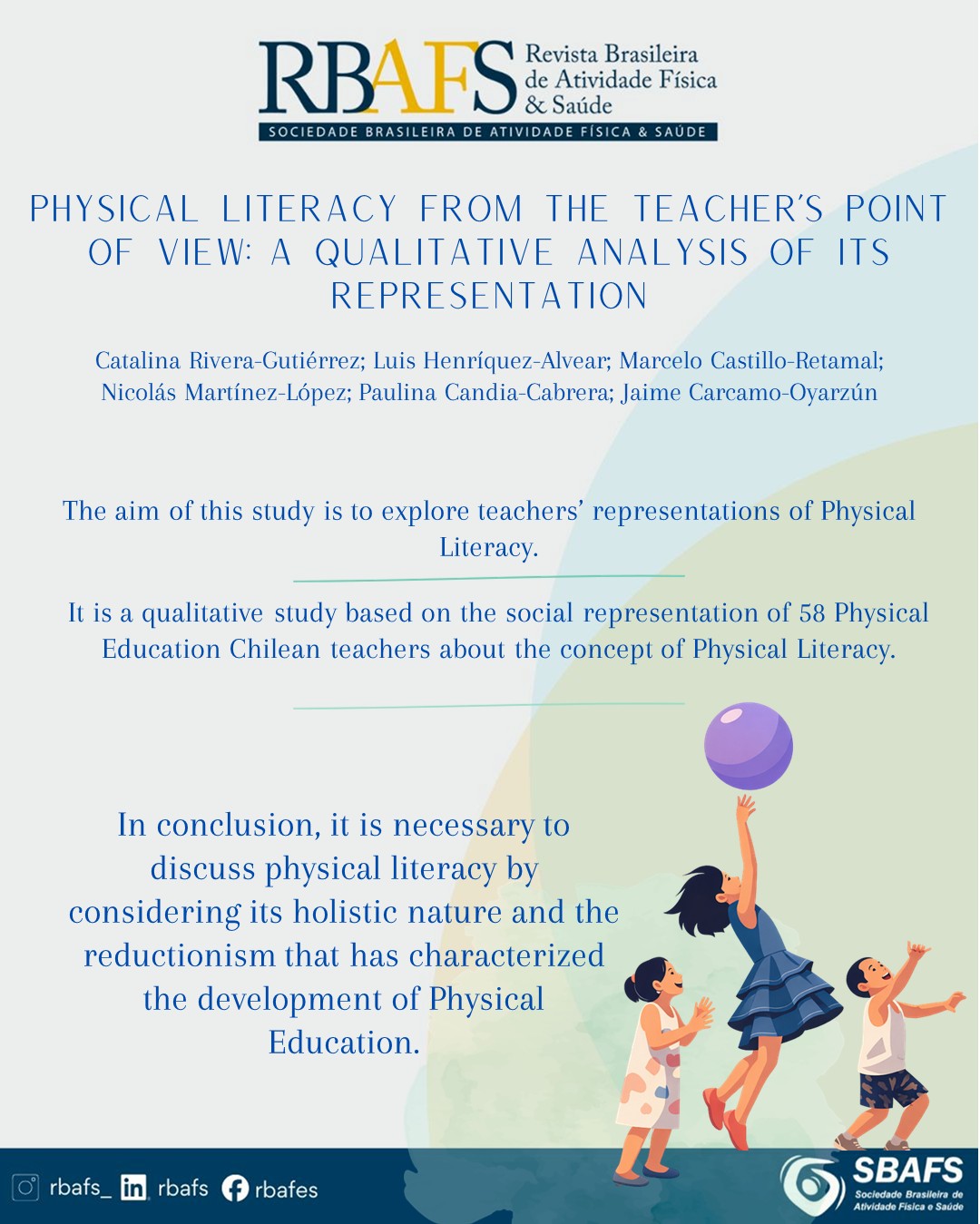
Physical literacy from the teacher’s point of view: a qualitative analysis of its representation
DOI:
https://doi.org/10.12820/rbafs.31e0465Keywords:
Physical literacy, Physical education, Social representations, TeachersAbstract
Introduction: Physical literacy is an approach that has generated great interest in the field of Physical Education; however, its conceptualisation is understood in different ways. Objective: This study aims to explore teachers’ representations of physical literacy. Methods: An interpretive qualitative study based on structure of social representations, in which 58 Physical Education teachers from the Araucanía region of Chile answered questions about the concept of physical literacy. By means of content analysis, the responses were coded and organised into categories according to their relationships. Results: Two categories were generated regarding the representation of physical literacy. Both categories were based on prior knowledge of the concept, indicating functional and traditional representations of Physical Education. Conclusion: It is necessary to approach and discuss the conceptualisation of Physical Literacy, considering its holistic character, and to separate it from the reductionism to the physical that has characterised the development of Physical Education.
Downloads
References
1. GloPL Consortium. The Global Physical Literacy Action Framework. Geelong, VIC, Austrália: Consórcio GloPL, 2026.
2. Carl J, Barratt J, Wanner P, Töpfer C, Cairney J, Pfeifer K. The effectiveness of physical literacy interventions: a systematic review with meta-analysis. Sports Med. 2022;52(12):2965-99.
3. Lim ML, van Schooten KS, Radford KA, Delbaere K. Association between health literacy and physical activity in older people: a systematic review and meta-analysis. Health Promot Int. 2021;36(5):1482-97.
4. Durden-Myers EJ, Mackintosh C. The structural and micropolitical realities of physical literacy professional development in the United Kingdom: navigating professional vulnerability. Sport Educ Soc. 2022;1-16.
5. Whitehead M. Physical literacy across the world. London: Routledge; 2019.
6. Shearer C, Goss HR, Edwards LC, Keegan RJ, Knowles ZR, Boddy LM, et al. How is physical literacy defined? A contemporary update. J Teach Phys Educ. 2018;37(3):237-45.
7. International Physical Literacy Association. Definition of physical literacy; 2017. Available in: <https://www.physical-literacy.org.uk/> [2026 June].
8. Santos-Miranda E, Cárcamo-Oyarzún J, Carballo-Fazanes A, Abelairas-Gómez C, García-Massó X, Estevan I. Conceptualización y estructura de la alfabetización motriz en población de habla hispana. Una revisión sistemática. Sportis Sci J Sch Sport Phys Educ Psychomot. 2025;11(4):1-30.
9. Pot N, Whitehead ME, Durden-Myers EJ. Physical literacy from philosophy to practice. J Teach Phys Educ. 2018;37(3):246-51.
10. Whitehead M. The concept of physical literacy. Eur J Phys Educ. 2001;6(2):127-38.
11. Whitehead M. Physical literacy: throughout the lifecourse. 1ª ed. London: Routledge; 2010.
12. Jurbala P. What is physical literacy, really? Quest. 2015;67(4):367-83.
13. Longmuir PE, Tremblay MS. Top 10 research questions related to physical literacy. Res Q Exerc Sport. 2016;87(1):28-35.
14. Young L, O’Connor J, Alfrey L. Mapping the physical literacy controversy: an analysis of key actors within scholarly literature. Phys Educ Sport Pedagog. 2023;28(6):658-74.
15. Martins J, Onofre M, Mota J, Murphy C, Repond R-M, Vost H, et al. International approaches to the definition, philosophical tenets, and core elements of physical literacy: a scoping review. Prospects. 2021;50(1-2):13-30.
16. UNESCO. Quality Physical Education (QPE): guidelines for policy makers. Paris: UNESCO; 2015. Available in: <https://unesdoc.unesco.org/ark:/48223/pf0000231101> [2026 June].
17. Durden-Myers E, Bartle G. Physical-literacy-enriched physical education: a capabilities perspective. Children (Basel). 2023;10(9):1503.
18. Almonacid-Fierro A. La educación física como espacio de transformación social y educativa: perspectivas desde los imaginarios sociales y la ciencia de la motricidad humana. Estud Pedagóg. 2012;38(177-90).
19. Cárcamo J. El profesor de Educación Física desde la perspectiva de los escolares. Estud Pedagóg. 2012;38(1):105-19.
20. Castillo-Retamal F, Almonacid-Fierro A, Castillo-Retamal M, Oliveira AAB. Formación de profesores de Educación Física en Chile: una mirada histórica. Retos. 2020;(38):317-24.
21. Moreno-Doña A, Rivera-García E, Trigueros-Cervantes C. Sistema de medición de la calidad de la Educación Física Chilena: un análisis crítico. Movimento. 2014;20(1):145-67.
22. Peña-Troncoso S, Osses-Bustingorry S, Aburto BN, Véliz JCB. Hacia la disminución de los test físicos como indicadores de salud en el contexto educativo. Salud Publica Mex. 2017;59(5):506.
23. Moreno-Doña A, Rivera-García E, Trigueros-Cervantes C. La educación física en Chile: un análisis de las creencias del profesorado de la enseñanza primaria y secundaria. Movimento. 2014;20:81-96.
24. Vasilachis I. Estrategias de investigación cualitativa. 2ª ed. Barcelona: Gedisa; 2006.
25. Moscovici S. Psychoanalysis: its image and its public. Cambridge: Polity; 2008.
26. Moscovici S. Psicología social, II. 6ª ed. Barcelona: Paidos; 2013.
27. Lynch G. La investigación de las Representaciones Sociales: enfoques teóricos e implicaciones metodológicas. Red Sociales. 2020;7(1):102-18. Available in: <https://ri.unlu.edu.ar/items/73e8e958-6233-4cd9-a157-a78081260750> [2026 June].
28. Knapp E, Suarez M, Mesa M. Aspectos teóricos y epistemológicos de la categoría representación social. Rev Cubana Psicol. 2003;20(1):23-34. Available in: <https://pepsic.bvsalud.org/pdf/rcp/v20n1/03.pdf> [2026 June].
29. Mato D, Arizpe S. Estudios latinoamericanos sobre cultura y transformaciones sociales en tiempos de globalización. Buenos Aires: CLACSO; 2001. Available in: <https://libreria.clacso.org/publicacion.php?p=277&c=5> [2026 June].
30. Cáceres P. Análisis cualitativo de contenido: una alternativa metodológica alcanzable. Psicoperspectivas. 2008;2(1):53-82.
31. Stoddart AL, Humbert L. Physical literacy is…? What teachers really know. Rev phén EPS PHEnex J. 2017;8(3). Available in: <https://ojs.acadiau.ca/index.php/phenex/article/view/1667> [2026 June].
32. Uljas L, Valtonen JO, Autio O, Ruismäki H. Supporting physical literacy: a case study of preservice classroom teachers’ perceptions. J Phys Educ Sport. 2022;22(9):2069-75.
33. Carcamo-Oyarzun J, Rivera-Gutierrez C, Henriquez-Alvear L, Delgado-Floody P, Ferbol C, et al. Development of a physical literacy consensus statement for Chile: study protocol. Front Public Health. 2025;13:1554070.
34. Contreras-Zapata K, Roa-Quintero T, Vásquez-Muñoz C, Castillo-Retamal F, Castillo-Retamal M. Aproximación a la implementación de la alfabetización física en Chile: una revisión narrativa. Retos. 2022;(47):96-102.
35. Peña-Troncoso S, Toro-Arevalo S, Carcamo-Oyarzún J, Hernandez-Mosqueira C, Cresp-Barria M. La fragmentación del conocer en educación física. Retos. 2021;39:231-7.
36. Rodriguez-Rodriguez F, Gatica CC, Gómez DE, Eberhar LV. Propuesta de evaluación de la educación física escolar en Chile. Educ Fis Cienc. 2016;18(1). Available in: <http://www.efyc.fahce.unlp.edu.ar/article/view/EFyCv18n01a03/> [2026 June].
37. Rivera C. Recorrido histórico disciplinar de la educación física en Chile, instauración de cuerpos dominantes y dominados. In: Alves MF, Pinto R-MN (eds). Trajetória, memória e história da educação pública na América do Sul. Editora da Imprensa Universitária; 2020.
38. Rivera C, Henríquez-Alvear L. Análisis de los documentos (1872–1886) que influyeron en los programas de la disciplina de educación física en Chile. J Sport Health Res. 2019;11(Suppl 2):117-28. Available in: <https://recyt.fecyt.es/index.php/JSHR/article/view/80953> [2026 June].
39. Tello C. Formación docente y conocimiento: un binomio en crisis. El caso argentino. Educere. 2006;10(22):293-301. Available in: <https://www.redalyc.org/pdf/356/35603313.pdf> [2026 June].
40. Manghi D, Crespo N, Bustos A, Haas V. Concepto de alfabetización: ejes de tensión y formación de profesores. Rev Electron Investig Educ. 2016;18(2):79-92. Available in: <https://redie.uabc.mx/redie/article/view/1038> [2026 June].
Downloads
Published
How to Cite
Issue
Section
License
Copyright (c) 2026 Catalina Rivera-Gutierrez, Luis Henríquez-Alvear, Marcelo Castillo-Retamal, Nicolas Martinez-Lopez, Paulina Candia-Cabrera, Jaime Carcamo-Oyarzun

This work is licensed under a Creative Commons Attribution 4.0 International License.
When submitting a manuscript to the Revista Brasileira de Atividade Física & Saúde, the authors retain the copyright to the article and authorize the Revista Brasileira de Atividade Física & Saúde to publish the manuscript under the Creative Commons Attribution 4.0 License and identify it as the original publication source.