Effects of a 12-week structured exercise program during physical education lessons on physical fitness and health-related quality of life in adolescents
DOI:
https://doi.org/10.12820/rbafs.31e0469Keywords:
Exercise, Cardiorespiratory fitness, Muscular fitness, Quality of life, YouthsAbstract
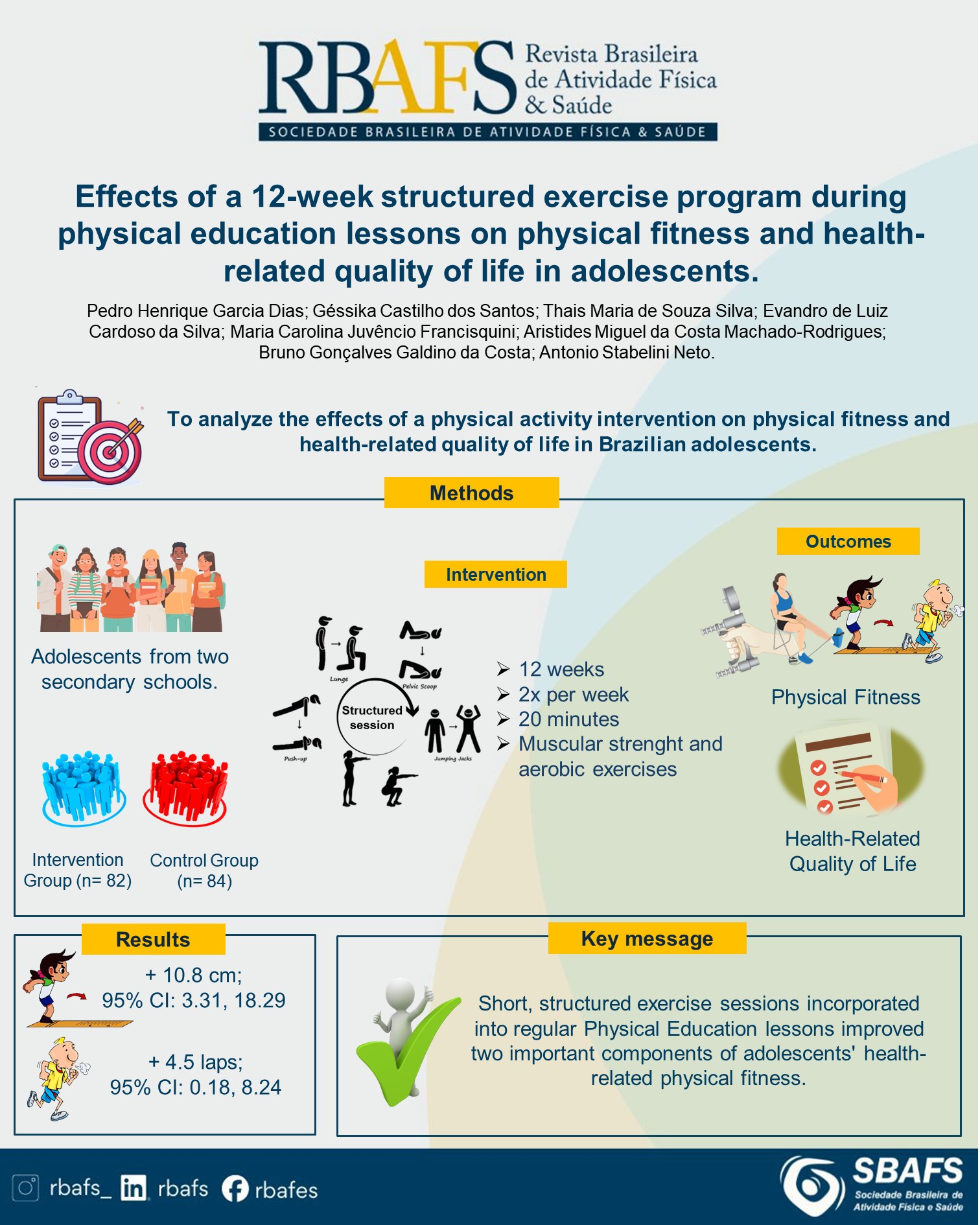
Introduction: Evaluating both Physical Fitness and Health Related Quality of Life (HRQoL) in school-based interventions may offer a more comprehensive understanding of the impact of physical activity (PA) on adolescent well-being. Objective: To analyze the effects of a PA intervention on physical fitness and HRQoL in Brazilian adolescents. Methods: Students from two secondary schools participated in this randomized controlled trial and they were assigned to intervention group (n = 82) or control group (n = 84). The intervention lasted 12 weeks and was carried out in physical education classes. The structured session lasted 20 minutes each and consisted of warm-up; structured PA (muscular strength and aerobic exercises); and cool-down. Muscular fitness was assessed using handgrip and knee extension strength. Lower limb muscular power was assessed using standing long jump. Cardiorespiratory fitness (CRF) was measured with the 20m shuttle run test. HRQoL was assessed by the KIDSCREEN-10 questionnaire. Results: The sample consisted of 166 adolescents (52.5% females; 13.8 ± 0.9 years). Findings revealed significant intervention effects favorable to intervention group for the standing long jump (mean difference: 10.8 cm; 95% CI: 3.3, 18.3; n2 0,074) and CRF (mean difference: 4.5 laps; 95% CI: 0.2, 8.2; n2 0,054).. No significant intervention effects were found for the handgrip, knee extension strength, and health-related quality of life. Conclusion: The present 12-week intervention implemented during physical education classes was effective in improving adolescents’ CRF and lower-body muscular fitness. Therefore, exercise sessions performed in 20-minute, twice a week, including aerobic and muscle-strengthening exercises might improve the health-related physical fitness of adolescents.
Downloads
References
1. Peixoto MB, Borges TT, Reichert FF. Associação entre prática de atividade física e aptidão cardiorrespiratória em adolescentes. Rev Bras Ativ Fis Saude. 2024;29:1-9.
2. Kracht CL, Katzmarzyk PT, Champagne CM, Broyles ST, Hsia DS, Newton RL Jr, et al. Association between sleep, sedentary time, physical activity, and adiposity in adolescents: a prospective observational study. Med Sci Sports Exerc. 2023;55(1):110-8.
3. Lehtovirta M, Wu F, Rovio SP, Heinonen OJ, Laitinen TT, Niinikoski H, et al. Association of physical activity with metabolic profile from adolescence to adulthood. Scand J Med Sci Sports. 2023;33(3):307-18.
4. Brailey G, Metcalf B, Price L, Cumming S, Rowlands A, Olds T, et al. Improving the identification of bone-specific physical activity using wrist-worn accelerometry: a cross-sectional study in 11-12-year-old Australian children. Eur J Sport Sci. 2024;24(7):987-98.
5. Wassenaar TM, Wheatley CM, Beale N, Nichols T, Salvan P, Meaney A, et al. The effect of a one-year vigorous physical activity intervention on fitness, cognitive performance and mental health in young adolescents: the Fit to Study cluster randomised controlled trial. Int J Behav Nutr Phys Act. 2021;18(1):1-15.
6. Ramires VV, dos Santos PC, Filho VCB, da Silva Bandeira A, Tenório MCM, de Camargo EM, et al. Physical education for health among school-aged children and adolescents: a scoping review of reviews. J Phys Act Health. 2023;20(7):586-99.
7. Ortega FB, Ruiz JR, Castillo MJ, Sjöström M. Physical fitness in childhood and adolescence: a powerful marker of health. Int J Obes. 2008;32(1):1-11.
8. Caspersen CJ, Powell KE, Christenson GM. Physical activity, exercise, and physical fitness: definitions and distinctions for health-related research. Public Health Rep. 1985;100(2):126-31.
9. Garcia-Hermoso A, Vegas-Heredia ED, Fernández-Vergara O, Ceballos-Ceballos R, Andrade-Schnettler R, Arellano-Ruiz P, et al. Independent and combined effects of handgrip strength and adherence to a Mediterranean diet on blood pressure in Chilean children. Nutrition. 2019;60:170-4.
10. Cadenas-Sanchez C, Mena-Molina A, Torres-Lopez LV, Migueles JH, Rodriguez-Ayllon M, Lubans DR, et al. Healthier minds in fitter bodies: a systematic review and meta-analysis of the association between physical fitness and mental health in youth. Sports Med. 2021;51(12):2571-605.
11. Oliveira L, Braga F, Lemes V, Dias A, Brand C, Mello J, et al. Effect of an intervention in Physical Education classes on health related levels of physical fitness in youth. Rev Bras Ativ Fis Saude. 2017;22(1):46-53.
12. Castilho Dos Santos G, de Souza Silva TM, da Silva JM, de Oliveira Barbosa R, Kennedy SG, Lubans DR, et al. Impact of the ActTeens Program on physical activity and fitness in adolescents: a cluster randomized controlled trial. BMC Pediatr. 2024;24(1):447.
13. Ravens-Sieberer U, Herdman M, Devine J, Otto C, Bullinger M, Rose M, et al. The European KIDSCREEN approach to measure quality of life and well-being in children: development, current application, and future advances. Qual Life Res. 2014;23(3):791-803.
14. Bermejo-Cantarero A, Sánchez-López M, Álvarez-Bueno C, Redondo-Tébar A, García-Hermoso A, Martínez-Vizcaino V. Are physical activity interventions effective in improving health-related quality of life in children and adolescents? A systematic review and meta-analysis. Sports Health. 2024;16(6):877-85.
15. Rodriguez-Ayllon M, Cadenas-Sánchez C, Estévez-López F, Muñoz NE, Mora-Gonzalez J, Migueles JH, et al. Role of physical activity and sedentary behavior in the mental health of preschoolers, children and adolescents: a systematic review and meta-analysis. Sports Med. 2019;49(9):1383-410.
16. Azevedo LB, Burges Watson D, Haighton C, Adams J. The effect of dance mat exergaming systems on physical activity and health-related outcomes in secondary schools: results from a natural experiment. BMC Public Health. 2014;14:951.
17. Ha AS, Burnett A, Sum R, Medic N, Ng JYY. Outcomes of the rope skipping "STAR" programme for schoolchildren. J Hum Kinet. 2015;45:233-40.
18. Finkelstein EA, Tan YT, Malhotra R, Lee CF, Goh SS, Saw SM. A cluster randomized controlled trial of an incentive-based outdoor physical activity program. J Pediatr. 2013;163(1):167-72.e1.
19. Resaland GK, Aadland E, Moe VF, Kolotkin RL, Anderssen SA, Andersen JR. Effects of a physical activity intervention on schoolchildren's health-related quality of life: the Active Smarter Kids (ASK) cluster-randomized controlled trial. Prev Med Rep. 2019;13:1-4.
20. Höner O, Demetriou Y. Effects of a health-promotion programme in sixth grade German students' physical education. Eur J Sport Sci. 2014;14(4):341-51.
21. Moher D, Hopewell S, Schulz KF, Montori V, Gøtzsche PC, Devereaux PJ, et al. CONSORT 2010 explanation and elaboration: updated guidelines for reporting parallel group randomised trials. Int J Surg. 2012;10(1):28-55.
22. de Farias Júnior JC, Loch MR, de Lima Neto AJ, Sales JM, de Lima Ferreira FEL. Reprodutibilidade, consistência interna e validade de construto do KIDSCREEN-27 em adolescentes brasileiros. Cad Saude Publica. 2017;33(9):e00131116.
23. Ravens-Sieberer U, Erhart M, Rajmil L, Herdman M, Auquier P, Bruil J, et al. Reliability, construct and criterion validity of the KIDSCREEN-10 score: a short measure for children and adolescents' well-being and health-related quality of life. Qual Life Res. 2010;19(10):1487-500.
24. Meredith M, Welk G. Fitnessgram/activitygram test administration manual. Dallas, TX: The Cooper Institute; 213. 2016.
25. Peterson MD, Saltarelli WA, Visich PS, Gordon PM. Strength capacity and cardiometabolic risk clustering in adolescents. Pediatrics. 2014;133(4):e896-903.
26. Castro-Piñero J, Ortega FB, Artero EG, Girela-Rejón MJ, Mora J, Sjöström M, et al. Assessing muscular strength in youth: usefulness of standing long jump as a general index of muscular fitness. J Strength Cond Res. 2010;24(7):1810-7.
27. Guedes DP, Guedes JERP. Medida da atividade física em jovens brasileiros: reprodutibilidade e validade do PAQ-C e do PAQ-A. Rev Bras Med Esporte. 2015;21(6):425-32.
28. CDC - Center for Disease C and P (2002) 2000 CDC Growth Charts for the United States: Methods and Development.
29. Vickers AJ, Altman DG. Statistics notes: analysing controlled trials with baseline and follow up measurements. BMJ. 2001;323(7321):1123-4.
30. Gall S, Walter C, du Randt R, Adams L, Joubert N, Müller I, et al. Changes in self-reported physical activity predict health-related quality of life among South African schoolchildren: findings from the DASH intervention trial. Front Public Health. 2020;8:492618.
31. Lubans D, Richards J, Hillman C, Faulkner G, Beauchamp M, Nilsson M, et al. Physical activity for cognitive and mental health in youth: a systematic review of mechanisms. Pediatrics. 2016;138(3):e20161642.
32. de Oliveira RG, Guedes DP. Physical activity, sedentary behavior, cardiorespiratory fitness and metabolic syndrome in adolescents: systematic review and meta-analysis of observational evidence. PLoS One. 2016;11(12):e0168503.
33. Kolle E, Solberg RB, Säfvenbom R, Dyrstad SM, Berntsen S, Resaland GK, et al. The effect of a school-based intervention on physical activity, cardiorespiratory fitness and muscle strength: the School in Motion cluster randomized trial. Int J Behav Nutr Phys Act. 2020;17(1):154.
34. Lu Y, Yu K, Jin J, Gan X. The effects of a multicomponent social support intervention on physical fitness and exercise attitude in children: a 12-week randomized controlled trial. Int J Environ Res Public Health. 2022;19(16):9922.
35. Palacio-Agüero A, Díaz-Torrente X, Dourado DQS. Relative handgrip strength, nutritional status and abdominal obesity in Chilean adolescents. PLoS One. 2020;15(6):e0234316.
36. da Silva PR, dos Santos GC, da Silva JM, de Faria WF, de Oliveira RG, Stabelini Neto A. Health-related physical fitness indicators and clustered cardiometabolic risk factors in adolescents: a longitudinal study. J Exerc Sci Fit. 2020;18(3):162-7.
37. Donato ANA, Waclawovsky AJ, Tonello L, Firth J, Smith L, Stubbs B, et al. Association between cardiorespiratory fitness and depressive symptoms in children and adolescents: a systematic review and meta-analysis. J Affect Disord. 2021;282:1234-40.
38. Lang JJ, Belanger K, Poitras V, Janssen I, Tomkinson GR, Tremblay MS. Systematic review of the relationship between 20m shuttle run performance and health indicators among children and youth. J Sci Med Sport. 2018;21(4):383-97.
39. Agbaje AO. Arterial stiffness precedes hypertension and metabolic risks in youth: a review. J Hypertens. 2022;40(10):1887-96.
Downloads
Published
How to Cite
Issue
Section
License
Copyright (c) 2026 Pedro Henrique Garcia Dias, Géssika Castilho dos Santos, Thais Maria de Souza Silva, Evandro de Luiz Cardoso da Silva, Maria Carolina Juvêncio Francisquini, Aristides Miguel da Costa Machado-Rodrigues, Bruno Gonçalves Galdino da Costa, Antonio Stabelini Neto

This work is licensed under a Creative Commons Attribution 4.0 International License.
When submitting a manuscript to the Revista Brasileira de Atividade Física & Saúde, the authors retain the copyright to the article and authorize the Revista Brasileira de Atividade Física & Saúde to publish the manuscript under the Creative Commons Attribution 4.0 License and identify it as the original publication source.