From counting minutes to considering the context: moving paradigms to foster physical activity
DOI:
https://doi.org/10.12820/rbafs.31e0444Keywords:
Diversity, Equity, Inclusion, Exercise, Health promotionAbstract
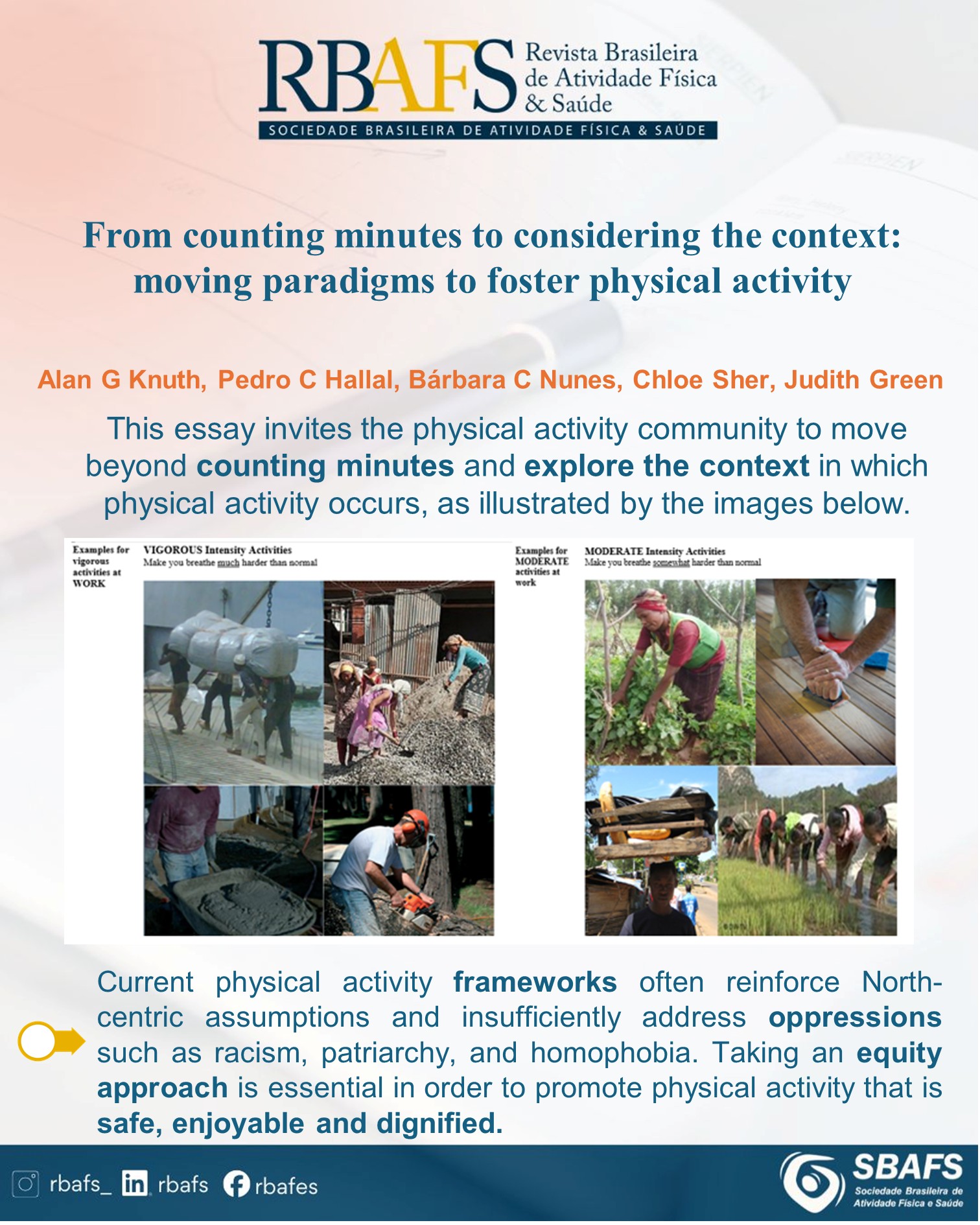
Introduction: This analytical essay invites the physical activity community to move beyond counting minutes and explore the context in which physical activity occurs. Objective: To advocate for a recontextualization of research frameworks and guidelines. Current frameworks - habitual, ecological, and structural - often reinforce North-centric assumptions and insufficiently address oppressions such as racism, patriarchy, and homophobia. Development: This essay advocates for the need to confront systemic power structures in the pursuit of a more nuanced understanding of physical activity within frameworks and guidelines, particularly by incorporating knowledge from the Global South and addressing the domain issue. Final considerations: Ultimately, this essay calls for an equity approach to physical activity and health, one that addresses the systemic barriers that have historically excluded marginalized groups from engaging in physical activity that is safe, enjoyable, and dignified.
Downloads
References
1. Collins P, Bilge S. Intersectionality. 1.ed. – São Paulo: Boitempo, 2021.
2. Knuth AG, Leite GS, Dos Santos SFDS, Crochemore-Silva I. Is It possible to decolonize the field of physical activity and health? J Phys Act Health. 2024; 24;21(7):633-5. DOI: https://doi.org/10.1123/jpah.2024-0135
3. Salvo D, Jáuregui A, Adlakha D, Sarmiento OL, Reis RS. When moving is the only option: the role of necessity versus choice for understanding and promoting physical activity in low- and middle-income countries. Annu Rev Public Health. 2023;44:151–69. DOI: https://doi.org/10.1146/annurev-publhealth-071321-042211
4. Ramirez Varela A, Hallal PC. Does every move really count towards better health? Lancet Glob Health. 2024;12(8):e1215-e1216. DOI: https://doi.org/10.1016/S2214-109X(24)00173-6
5. World Health Organization. Global Action Plan on Physical Activity 2018–2030: More Active People for a Healthier World. 2018. Available from: <https://www.who.int/publications/i/item/9789241514187> [2025 June].
6. Physical activity guidelines: UK Chief Medical Officers' report. 2019. Available from: <https://assets.publishing.service.gov.uk/media/5d839543ed915d52428dc134/uk-chief-medical-officers-physical-activity-guidelines.pdf> [2025 May].
7. U.S. Department of Health and Human Services. Physical Activity Guidelines for Americans, 2nd edition. Washington, DC: U.S. Department of Health and Human Services; 2018. Available from: <https://odphp.health.gov/sites/default/files/2019-09/Physical_Activity_Guidelines_2nd_edition.pdf> [2025 July].
8. Holtermann A, Krause N, van der Beek AJ, Straker L. The physical activity paradox: six reasons why occupational physical activity (OPA) does not confer the cardiovascular health benefits that leisure time physical activity does. Br J Sports Med. 2018; 52:149–50. DOI: https://doi.org/10.1136/bjsports-2017-097965
9. Loch MR, Augusto NA, Souza BLS, Rufino JV, Carvalho FFB. Association between physical activity domains and depressive symptoms among Brazilian adults: does every move count? Cad Saude Publica. 2024;40(3):e00095723. DOI: https://doi.org/10.1590/0102-311xpt095723
10. Werneck AO, Schuch FB, Vancampfort D, Stubbs B, Lotufo PA, Benseñor I, et al. Physical activity domains and incident clinical depression: A 4-year follow-up analysis from the ELSA-Brasil cohort. J Affect Disord. 2023:329:385-93. DOI: https://doi.org/10.1016/j.jad.2023.02.080
11. Florindo AA, Goulardins GS, Andrade DA, Knebel MTG, Santos MP, Hallal PC, et al. Em defesa da caminhada e do uso de bicicleta como deslocamento no Brasil [In defense of walking and cycling as a means of transportation in Brazil]. Cad Saude Publica. 2025;41(2):e00099324. DOI: https://doi.org/10.1590/0102-311xpt099324
12. Verplanken B, Melkevik O. Predicting habit: The case of physical exercise. Psych Sport Exerc. 2008;9(1):15-26. DOI: https://doi.org/10.1016/j.psychsport.2007.01.002
13. Hirvensalo M, Lintunen, T. Life-course perspective for physical activity and sports participation. Europ Rev Aging and Phys Act. 2011;8(1):13–22. DOI: https://doi.org/10.1007/s11556-010-0076-3
14. Kassman A, Kneck Å. Doing childhood, doing gender, but not doing sports: Unorganized girls’ reflections on leisure time from a relational perspective. Childhood. 2022;29(2):172-86. DOI: https://doi.org/10.1177/09075682221088183
15. Slater A, Tiggemann M. “Uncool to do sport”: A focus group study of adolescent girls’ reasons for withdrawing from physical activity. Psycho Sport Exerc. 2010;11(6):619-26. DOI: https://doi.org/10.1016/j.psychsport.2010.07.006
16. Tremblay MS, Bryan SN, Pérez CE, Ardern CI, Katzmarzyk PT. Physical activity and immigrant status. Canad J Public Health. 2006;97(4):277–82. DOI: https://doi.org/10.1007/BF03405603
17. Wieland ML, Tiedje K, Meiers SJ, Mohamed AA, Formea CM, Ridgeway JL, et al. Perspectives on physical activity among immigrants and refugees to a small urban community in Minnesota. J Immigr Minor Health. 2015;17(1):263–75. DOI: https://doi.org/10.1007/s10903-013-9917-2
18. Government of Canada. Physical activity and your health. Public Health Agency of Canada. 2013. Available from: <https://www.canada.ca/en/public-health/services/being-active/physical-activity-your-health.html> [2025 May].
19. Cockerham WC. Health lifestyle theory and the convergence of agency and structure. J Health Soc Behav. 2005;46(1):51–67. DOI: https://doi.org/10.1177/002214650504600105
20. Beckfield, J. Political sociology and the people’s health. Oxford University Press, 2018 DOI: https://doi.org/10.1093/oso/9780190492472.001.0001
21. Caperchione CM, Kolt GS, Mummery WK. Physical activity in culturally and linguistically diverse migrant groups to Western Society. Sports Med. 2009;39(3):167–77. DOI: https://doi.org/10.2165/00007256-200939030-00001
22. Duncan DT, Kawachi I, White K, Williams DR. The geography of recreational open space: influence of neighborhood racial composition and neighborhood poverty. J Urban Health. 2013;90(4):618–31. DOI: https://doi.org/10.1007/s11524-012-9770-y
23. Standing G. The Precariat: The New Dangerous Class. Bloomsbury Publishing, 2011. DOI: https://doi.org/10.5040/9781849664554
24. Wu C, Qian Y, Wilkes R. Anti-Asian discrimination and the Asian-white mental health gap during COVID-19. Ethnic Racial Stud. 2021;44(5):819–35. DOI: https://doi.org/10.1080/01419870.2020.1851739
25. Suminski RR, Poston WSC, Petosa RL, Stevens E, Katzenmoyer, L.M. Features of the neighborhood environment and walking by US adults. Am J Prev Med. 2005; 28(2): 149–55. DOI: https://doi.org/10.1016/j.amepre.2004.09.009
26. Sallis JF, Glanz K. The role of built environments in physical activity, eating, and obesity in childhood. Future Child. 2006;16(1):89-108. DOI: https://doi.org/10.1353/foc.2006.0009
27. Koshoedo SA, Paul-Ebhohimhen VA, Jepson RG, Watson MC. Understanding the complex interplay of barriers to physical activity amongst black and minority ethnic groups in the United Kingdom: a qualitative synthesis using meta-ethnography. BMC Public Health. 2015;15:643. DOI: https://doi.org/10.1186/s12889-015-1893-0
28. Joseph RP, Ainsworth BE, Keller C, Dodgson JE. Barriers to physical activity among African American women: an integrative review of the literature. Women Health. 2015; 55(6):679-99. DOI: https://doi.org/10.1080/03630242.2015.1039184
29. Bernardino-Costa J, Maldonado-Torres N, Grosfoguel R. Decolonialidade e pensamento afrodiaspórico. 2. Ed: Belo Horizonte, Autêntica, 2023.
30. Ricardo LIC, Wendt A, Costa CDS, Mielke GI, Brazo-Sayavera J, Khan A, et al. Gender inequalities in physical activity among adolescents from 64 Global South countries. J Sport Health Sci. 2022;11(4):509-20. DOI: https://doi.org/10.1016/j.jshs.2022.01.007
31. Breilh J. Epidemiologia crítica e a saúde dos povos: ciência ética e corajosa em uma civilização doentia. Hucitec: São Paulo, 2023.
32. Ballestrin L. América Latina e o giro decolonial. Rev Bras Cienc Polit. 2013;11:89-117. DOI: https://doi.org/10.1590/S0103-33522013000200004
33. Quijano A, Ennis M. Coloniality of power, Eurocentrism and Latin America. Nepantla: Views F South. 2000;1(3):533-80. DOI: https://doi.org/10.1177/0268580900015002005
34. Palma A, Araújo MFS, Rodrigues PAF. Pesquisa em atividade física e saúde: a urgência de uma epistemologia decolonial. Rev Bras Cienc Esp. 2023;45:e20230053. DOI: https://doi.org/10.1590/rbce.45.e20230053
35. Maldonado-Torres N. Analysis of coloniality and decoloniality: some basic dimensions. In: Bernardino-Costa J, Maldonado-Torres N, Grosfoguel R. Decolonialidade e pensamento afrodiaspórico. 2. Ed – Belo Horizonte, Autêntica, 2023.
36. Mielke GI, Malta DC, Nunes BP, Cairney J. All are equal, but some are more equal than others: social determinants of leisure time physical activity through the lens of intersectionality. BMC Public Health. 2022;6;22(1):36. DOI: https://doi.org/10.1186/s12889-021-12428-7
37. Lee EY, Airton L, Lim H, Jung E. An Urgent Need for Quantitative Intersectionality in Physical Activity and Health Research. J Phys Act Health. 2023;12;20(2):97-9. DOI: https://doi.org/10.1123/jpah.2022-0639
38. Paiva GB, Araújo MF, Rodrigues PA. Associations between intersectional relationships of oppression and domains of physical activity in the Vigitel study (2016-2020). Rev Bras Cienc Esp. 2024;46:e20240044. DOI: https://doi.org/10.1590/rbce.46.e20240044
39. Sher C, Wu C. Race, immigrant status, and inequality in physical activity: An intersectional and life course approach. Canad Rev Soc. 2023;(4):763-800. DOI: https://doi.org/10.1111/cars.12451
40. Bento C. Pacto da Branquitude. São Paulo: Companhia das Letras, 2022.
41. Saunders L E, Green JM, Petticrew MP, Steinbach R, Roberts H. What are the health benefits of active travel? A systematic review of trials and cohort studies. PloS one. 2013;8(8):e69912. DOI: https://doi.org/10.1371/journal.pone.0069912
42. Kroesen M, De Vos J. Does active travel make people healthier, or are healthy people more inclined to travel actively? J Transp Health. 2020;16:100844. DOI: https://doi.org/10.1016/j.jth.2020.100844
43. Sheller M. Racialized mobility transitions in Philadelphia: connecting urban sustainability and transport justice. City Soc. 2015; 27(1):70-91. DOI: https://doi.org/10.1111/ciso.12049
44. Steinbach R, Green J, Datta J, Edwards P. Cycling and the city: A case study of how gendered, ethnic and class identities can shape healthy transport choices. Social Sci Med. 2011;72(7):1123-30. DOI: https://doi.org/10.1016/j.socscimed.2011.01.033
45. De Chardon CM. The contradictions of bike-share benefits, purposes and outcomes. Transp Res Part A Policy Prac. 2019;121:401-19. DOI: https://doi.org/10.1016/j.tra.2019.01.031
46. Ram T, Green J, Steinbach R, Edwards P. Pedestrian injuries in collisions with pedal cycles in the context of increased active travel: Trends in England, 2005–2015. J Transp Health. 2022; 24, 101340. DOI: https://doi.org/10.1016/j.jth.2022.101340
47. Malhotra SK, White H, Dela Cruz NAO, Saran A, Eyers J, John D, et al. Studies of the effectiveness of transport sector interventions in low‐and middle‐income countries: An evidence and gap map. Campbell Syst Rev. 2021;17(4):e1203. DOI: https://doi.org/10.1002/cl2.1203
48. Foley L, Brugulat-Panés A, Woodcock J, Govia I, Hambleton I, Turner-Moss E, et al. Socioeconomic and gendered inequities in travel behaviour in Africa: mixed-method systematic review and meta-ethnography. Soc Science Med. 2022;292:114545. DOI: https://doi.org/10.1016/j.socscimed.2021.114545
49. Le Gouais A, Govia I, Guell C. Challenges for creating active living infrastructure in a middle-income country: a qualitative case study in Jamaica. Cities Health. 2023;7(1):81-92. DOI: https://doi.org/10.1080/23748834.2020.1767950
50. Chaufan C, Yeh J, Ross L, Fox P. You can’t walk or bike yourself out of the health effects of poverty: active school transport, child obesity, and blind spots in the public health literature. Crit. Public Health. 2015;25(1):32-47. DOI: https://doi.org/10.1080/09581596.2014.920078
51. Bostock L. Pathways of disadvantage? Walking as a mode of transport among low‐income mothers. Health Soc Care Community. 2001;9(1):11-8. DOI: https://doi.org/10.1046/j.1365-2524.2001.00275.x
52. Strain T, Wijndaele K, Garcia L, Cowan M, Guthold R, Brage S, et al. Levels of domain-specific physical activity at work, in the household, for travel and for leisure among 327 789 adults from 104 countries. Br J Sports Med. 2020; 54(24):1488-97. DOI: https://doi.org/10.1136/bjsports-2020-102601
53. Chaabane S, Chaabna K, Doraiswamy S, Mamtani R, Cheema S. Barriers and Facilitators Associated with Physical Activity in the Middle East and North Africa Region: A Systematic Overview. Int J Environ Res Public Health. 2021;18(4):1647. DOI: https://doi.org/10.3390/ijerph18041647
54. Joshi-Reddy K, Kamble V, Kunte P, Hardy-Johnson P, Fall CH, Barker M, et al. Adolescent diet and physical activity in the context of economic, social and nutrition transition in rural Maharashtra, India: a qualitative study. Public Health Nutr. 2021;24(16):5299-08. DOI: https://doi.org/10.1017/S1368980020002220
Downloads
Published
How to Cite
Issue
Section
License
Copyright (c) 2026 Alan Goularte Knuth, Pedro Curi Hallal, Bárbara Coelho Nunes, Chloe Sher, Judith Green

This work is licensed under a Creative Commons Attribution 4.0 International License.
When submitting a manuscript to the Revista Brasileira de Atividade Física & Saúde, the authors retain the copyright to the article and authorize the Revista Brasileira de Atividade Física & Saúde to publish the manuscript under the Creative Commons Attribution 4.0 License and identify it as the original publication source.