Changes in physical activity and sitting time during covid-19 in Brazil: EPICOVID 2.0 study
DOI:
https://doi.org/10.12820/rbafs.31e0451Keywords:
Covid-19, Physical activity, Sedentary behavior, Sociodemographic factorsAbstract
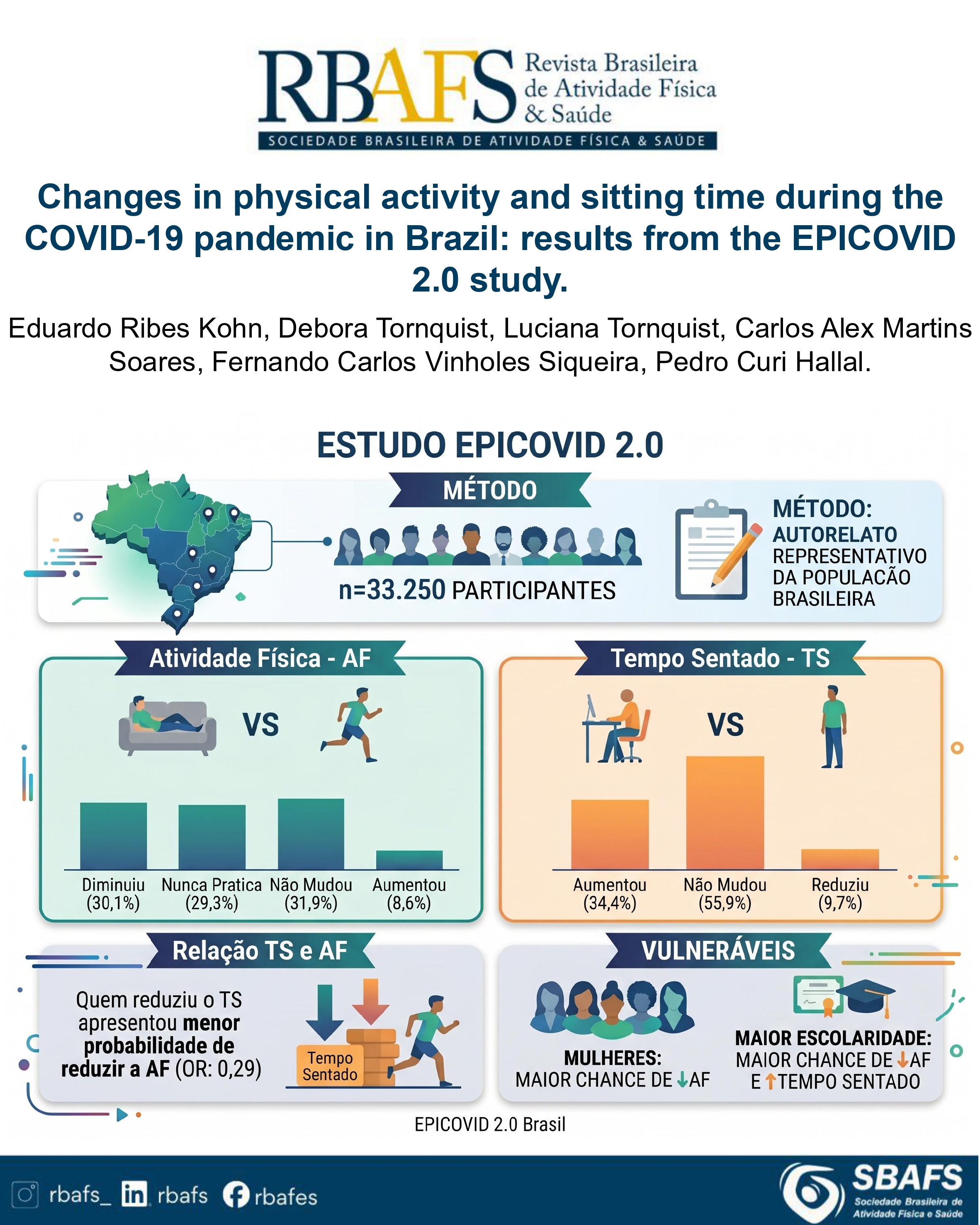
Introduction: The covid-19 pandemic led to substantial disruptions in daily routines worldwide, with potential impacts on physical activity and sedentary behavior. Objective: This study evaluated self-reported changes in physical activity (PA) and sitting time (ST) during the covid 19 pandemic in Brazil and examined sociodemographic correlates of these behaviors. Methods: Data were obtained from the nationwide EPICOVID 2.0 survey, which included 33,250 participants. Changes in PA and ST were self-reported, and weighted multinomial logistic regression analyses were conducted. Results: Overall, 29.3% (95% CI: 28.8 – 29.8) reported never practicing PA, 30.1% (95% CI: 29.6 – 30.7) reported decreased PA, 8.6% (95% CI: 8.3 – 8.9) increased PA, and 31.9% (95% CI: 31.5 – 32.5) no change. Regarding ST, 34.4% (95% CI: 33.8 – 34.9) reported an increase, 9.7% (95% CI: 9.4 – 10.1) a reduction, and 55.9% (95% CI: 55.4 – 56.5) no change. Participants reporting a decrease in ST had lower odds of reporting a decrease in PA (OR = 0.29; 95% CI: 0.22 – 0.40). Women had higher odds of decreased PA than men, with no gender differences observed for ST. Higher education was associated with higher odds of decreased PA and increased ST. Conclusion: These findings indicate that the pandemic affected PA and ST differently across population subgroups, with sociodemographic factors playing a key role. Targeted public health strategies are needed to promote PA and reduce ST, particularly among vulnerable groups.
Downloads
References
1. Wu F, Zhao S, Yu B, Chen YM, Wang W, Song ZG, et al. A new coronavirus associated with human respiratory disease in China. Nature. 2020;579(7798):265–9. DOI: https://doi.org/10.1038/s41586-020-2008-3
2. Shah SGS, Farrow A. A commentary on “World Health Organization declares global emergency: A review of the 2019 novel Coronavirus (COVID-19).” Int J Surg. 2020;76:128–9. DOI: https://doi.org/10.1016/j.ijsu.2020.03.001
3. World Health Organization. WHO Director-General’s opening remarks at the media briefing on COVID-19 - 11 March 2020. 2020. Available from: <https://www.who.int/director-general/speeches/detail/who-director-general-s-opening-remarks-at-the-media-briefing-on-covid-19---11-march-2020> [2025 July].
4. Lotfi M, Hamblin MR, Rezaei N. COVID-19: Transmission, prevention, and potential therapeutic opportunities. Clin Chim Acta. 2020;508:254–66. DOI: https://doi.org/10.1016/j.cca.2020.05.044
5. World Health Organization. Risk Communication and Community Engagement Guidance for Physical and Social Distancing - World | ReliefWeb. 2020. Available from: <https://reliefweb.int/report/world/risk-communication-and-community-engagement-guidance-physical-and-social-distancing> [2025 July].
6. Silva LLS da, Lima AFR, Polli DA, Razia PFS, Pavão LFA, Cavalcanti MAF de H, et al. Social distancing measures in the fight against COVID-19 in Brazil: description and epidemiological analysis by state. Cad Saúde Pública. 2020;36:e00185020. DOI: https://doi.org/10.1590/0102-311x00185020
7. Caroppo E, Mazza M, Sannella A, Marano G, Avallone C, Claro AE, et al. Will Nothing Be the Same Again?: Changes in Lifestyle during COVID-19 Pandemic and Consequences on Mental Health. Int J Environ Res Public Health. 2021;18(16):8433. DOI: https://doi.org/10.3390/ijerph18168433
8. Mazo GZ, Fank F, Franco PS, Capanema B da SV, Pereira F da S. Impact of Social Isolation on Physical Activity and Factors Associated With Sedentary Behavior in Older Adults During the COVID-19 Pandemic. Aging Phys Act. 2022;30(1):148-52. DOI: https://doi.org/10.1123/japa.2020-0456
9. Sañudo B, Fennell C, Sánchez-Oliver AJ. Objectively-Assessed Physical Activity, Sedentary Behavior, Smartphone Use, and Sleep Patterns Pre- and during-COVID-19 Quarantine in Young Adults from Spain. Sustainability. 2020;12(15):5890. DOI: https://doi.org/10.3390/su12155890
10. Caputo EL, Reichert FF. Studies of Physical Activity and COVID-19 During the Pandemic: A Scoping Review. J Phys Act Health. 2020;17(12):1275-84. doi: https://doi.org/10.1123/jpah.2020-0445 DOI: https://doi.org/10.1123/jpah.2020-0406
11. Bauman AE, Petersen CB, Blond K, Rangul V, Hardy LL. The Descriptive Epidemiology of Sedentary Behaviour. In: Leitzmann MF, Jochem C, Schmid D, editors. Sedentary Behaviour Epidemiology. Cham: Springer International Publishing; 2018. p. 73–106. DOI: https://doi.org/10.1007/978-3-319-61552-3_4
12. Koyanagi A, Stubbs B, Vancampfort D. Correlates of sedentary behavior in the general population: A cross-sectional study using nationally representative data from six low- and middle-income countries. PLoS One. 2018;13(8):e0202222. DOI: https://doi.org/10.1371/journal.pone.0202222
13. Guthold R, Stevens GA, Riley LM, Bull FC. Worldwide trends in insufficient physical activity from 2001 to 2016: a pooled analysis of 358 population-based surveys with 1·9 million participants. The Lancet Global Health. 2018;6(10):e1077–86. DOI: https://doi.org/10.1016/S2214-109X(18)30357-7
14. Guthold R, Stevens GA, Riley LM, Bull FC. Global trends in insufficient physical activity among adolescents: a pooled analysis of 298 population-based surveys with 1·6 million participants. Lancet Child Adolesc Health. 2020;4(1):23–35. DOI: https://doi.org/10.1016/S2352-4642(19)30323-2
15. Lakerveld J, Loyen A, Schotman N, Peeters CFW, Cardon G, van der Ploeg HP, et al. Sitting too much: A hierarchy of socio-demographic correlates. Prev Med. 2017;101:77–83. DOI: https://doi.org/10.1016/j.ypmed.2017.05.015
16. Loyen A, Ploeg HP van der, Bauman A, Brug J, Lakerveld J. European Sitting Championship: Prevalence and Correlates of Self-Reported Sitting Time in the 28 European Union Member States. PLoS One. 2016;11(3):e0149320. DOI: https://doi.org/10.1371/journal.pone.0149320
17. Leite GS, Alves CPL, Leão OAA, Crochemore-Silva I. Gender, Ethnicity, and Socioeconomic Inequalities in Physical Activity Throughout the Life Course: A Systematic Review of Cohort Studies. J Phys Act Health. 2024;21(12):1276-85. DOI: https://doi.org/10.1123/jpah.2024-0313
18. Brito LMS, Boguszewski MC da S, Souza MTR de, Martins F, Mota J, Leite N. Indoor physical activities, eating and sleeping habits among school adolescents during COVID-19 pandemic. Rev. Bras. Ativ. Fís. Saúde. 2020;25:1–6. DOI: https://doi.org/10.12820/rbafs.25e0117
19. Botero JP, Farah BQ, Correia M de A, Lofrano-Prado MC, Cucato GG, Shumate G, et al. Impact of the COVID-19 pandemic stay at home order and social isolation on physical activity levels and sedentary behavior in Brazilian adults. Einstein (São Paulo). 2021;19:eAE6156. DOI: https://doi.org/10.31744/einstein_journal/2021AE6156
20. Rocha BMS, Souto MFO, Mendes VCN, Ferreira JVB, Azevedo E de O, Cunha ALLPE, et al. Factors associated with the practice of physical activity among university students in social isolation during the covid-19 pandemic. Rev bras cineantropom desempenho hum. 2023;25:e90191. DOI: https://doi.org/10.1590/1980-0037.2023v25e90191
21. Leite Miranda F, Fernandes CH, Myiamoto Meirelles L, Faloppa F, Ejnisman B, Cohen M. The Impact of COVID-19 Social Isolation on Physical Activity and Sedentary Behavior in Brazilian Children and Adolescents. Rev bras ortop. 2025;60:s00441800941. DOI: https://doi.org/10.1055/s-0044-1800941
22. Ammar A, Brach M, Trabelsi K, Chtourou H, Boukhris O, Masmoudi L, et al. Effects of COVID-19 Home Confinement on Eating Behaviour and Physical Activity: Results of the ECLB-COVID19 International Online Survey. Nutrients. 2020;12(6):1583. DOI: https://doi.org/10.3390/nu12061583
23. Dunton GF, Do B, Wang SD. Early effects of the COVID-19 pandemic on physical activity and sedentary behavior in children living in the U.S. BMC Public Health. 2020;20(1):1351. DOI: https://doi.org/10.1186/s12889-020-09429-3
24. Silva DRP da, Werneck AO, Malta DC, Souza Júnior PRB de, Azevedo LO, Barros MB de A, et al. Changes in the prevalence of physical inactivity and sedentary behavior during COVID-19 pandemic: a survey with 39,693 Brazilian adults. Cad Saúde Pública. 2021;37:e00221920. DOI: https://doi.org/10.1590/0102-311x00221920
25. Faria TMTR, Silva AG da, Claro RM, Malta DC. Time trends and COVID-19 post-pandemic changes in physical activity and sedentary behavior prevalence among Brazilian adults between 2006 and 2021. Rev bras epidemiol. 2023;26:e230011. DOI: https://doi.org/10.1590/1980-549720230011.supl.1
26. Caputo EL, Feter N, Leite JS, Doring IR, Cassuriaga J, Delpino FM, et al. Physical activity trajectory in the first 10 months of the COVID-19 pandemic in Southern Brazil: a follow-up study. BMC Sports Sci Med Rehabil. 2022;14(1):58. DOI: https://doi.org/10.1186/s13102-022-00450-0
27. López-Bueno R, Calatayud J, Andersen LL, Balsalobre-Fernández C, Casaña J, Casajús JA, et al. Immediate Impact of the COVID-19 Confinement on Physical Activity Levels in Spanish Adults. Sustainability. 2020;12(14):5708. DOI: https://doi.org/10.3390/su12145708
28. Smith L, Jacob L, Butler L, Schuch F, Barnett Y, Grabovac I, et al. Prevalence and correlates of physical activity in a sample of UK adults observing social distancing during the COVID-19 pandemic. BMJ Open Sport Exerc Med. 2020;6(1):e000850. DOI: https://doi.org/10.1136/bmjsem-2020-000850
29. Meyer J, McDowell C, Lansing J, Brower C, Smith L, Tully M, et al. Changes in Physical Activity and Sedentary Behavior in Response to COVID-19 and Their Associations with Mental Health in 3052 US Adults. Int J Environ Res Public Health. 2020;17(18):6469. DOI: https://doi.org/10.3390/ijerph17186469
30. Rocha R, Atun R, Massuda A, Rache B, Spinola P, Nunes L, et al. Effect of socioeconomic inequalities and vulnerabilities on health-system preparedness and response to COVID-19 in Brazil: a comprehensive analysis. Lancet Glob Health. 2021;9(6):e782–92. DOI: https://doi.org/10.1016/S2214-109X(21)00081-4
31. Bambra C, Riordan R, Ford J, Matthews F. The COVID-19 pandemic and health inequalities. J Epidemiol Community Health. 2020;74(11):964–8. DOI: https://doi.org/10.1136/jech-2020-214401
32. Baqui P, Bica I, Marra V, Ercole A, Schaar M van der. Ethnic and regional variations in hospital mortality from COVID-19 in Brazil: a cross-sectional observational study. Lancet Glob Health. 2020;8(8):e1018-e1026. DOI: https://doi.org/10.1016/S2214-109X(20)30285-0
33. Strain T, Flaxman S, Guthold R, Semenova E, Cowan M, Riley LM, et al. National, regional, and global trends in insufficient physical activity among adults from 2000 to 2022: a pooled analysis of 507 population-based surveys with 5·7 million participants. Lancet Glob Health. 2024;12(8):e1232-e1243.
34. Craig L, Churchill B. Dual‐earner parent couples’ work and care during COVID‐19. Gend Work Organ. 2021;28(Suppl 1):66–79. DOI: https://doi.org/10.1111/gwao.12497
35. CDC. Underlying Conditions and the Higher Risk for Severe COVID-19. 2025. Available from: <https://www.cdc.gov/covid/hcp/clinical-care/underlying-conditions.html> [2025 August].
36. Paterson DC, Ramage K, Moore SA, Riazi N, Tremblay MS, Faulkner G. Exploring the impact of COVID-19 on the movement behaviors of children and youth: A scoping review of evidence after the first year. J Sport Health Sci. 2021;10(6):675–89. DOI: https://doi.org/10.1016/j.jshs.2021.07.001
37. Xiang M, Zhang Z, Kuwahara K. Impact of COVID-19 pandemic on children and adolescents’ lifestyle behavior larger than expected. Prog Cardiovasc Dis. 2020;63(4):531–2. DOI: https://doi.org/10.1016/j.pcad.2020.04.013
38. Bauman AE, Reis RS, Sallis JF, Wells JC, Loos RJ, Martin BW. Correlates of physical activity: why are some people physically active and others not? The Lancet. 2012;380(9838):258–71. DOI: https://doi.org/10.1016/S0140-6736(12)60735-1
39. Knell G, Robertson MC, Dooley EE, Burford K, Mendez KS. Health Behavior Changes During COVID-19 Pandemic and Subsequent “Stay-at-Home” Orders. Int J Environ Res Public Health. 2020;17(17):6268. DOI: https://doi.org/10.3390/ijerph17176268
40. Stockwell S, Trott M, Tully M, Shin J, Barnett Y, Butler L, et al. Changes in physical activity and sedentary behaviours from before to during the COVID-19 pandemic lockdown: a systematic review. BMJ Open Sport Exerc Med. 2021; 7(1):e000960. DOI: https://doi.org/10.1136/bmjsem-2020-000960
Downloads
Published
How to Cite
Issue
Section
License
Copyright (c) 2026 Eduardo Ribes Kohn, Debora Tornquist, Luciana Tornquist, Carlos Alex Martins Soares, Fernando Carlos Vinholes Siqueira, Pedro Curi Hallal

This work is licensed under a Creative Commons Attribution 4.0 International License.
When submitting a manuscript to the Revista Brasileira de Atividade Física & Saúde, the authors retain the copyright to the article and authorize the Revista Brasileira de Atividade Física & Saúde to publish the manuscript under the Creative Commons Attribution 4.0 License and identify it as the original publication source.