Discriminatory capacity of the Brief Physical Activity Assessment Tool
DOI:
https://doi.org/10.12820/rbafs.31e0449Keywords:
Exercise, Fitness trackers, Validation studyAbstract
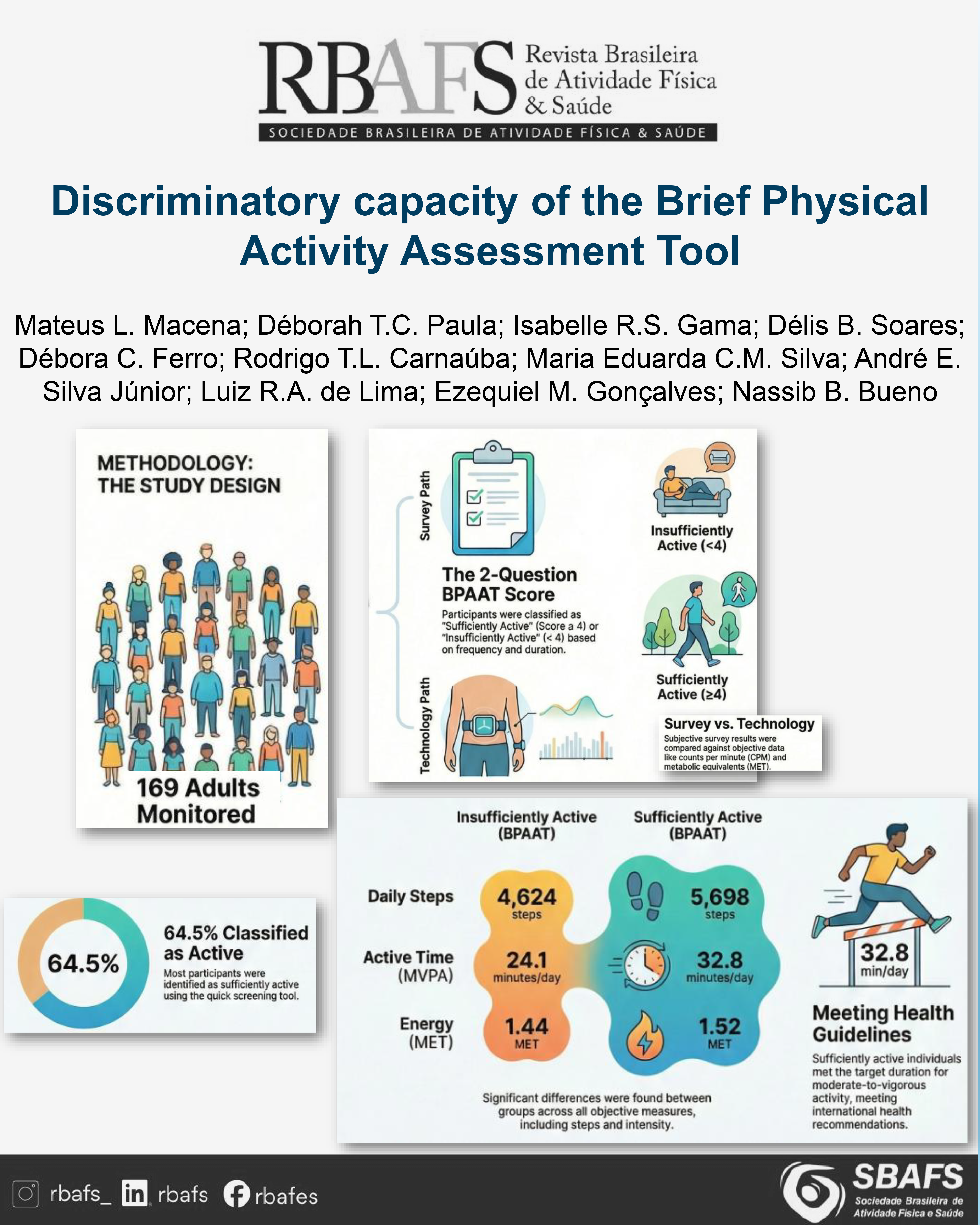
Introduction: Assessing physical activity (PA) levels in individuals using most subjective questionnaires is difficult, mainly because of their length and complexity. Objective: To evaluate the discriminatory capacity of the Brief Physical Activity Assessment Tool (BPAAT) classifications in relation to objectively measured PA parameters. Methods: Adult individuals (18-59 years) were included. The discriminatory capacity of the BPAAT was objectively compared using triaxial accelerometers worn for five consecutive days. Results: Of the 385 individuals screened for eligibility, 169 individuals were evaluated. The BPAAT was able to categorize participants in the study as sufficiently and insufficiently active for the objective accelerometry variables of counts per minute (cpm), metabolic equivalent of task (MET), and number of steps (Cohen’s d values = -0.57 [-0.89; -0.25]; -0.59 [-0.91; -0.27]; -0.52 [-0.84; -0.20], respectively). The same was observed for the times in the different PA classifications. Conclusion: The classifications obtained through BPAAT demonstrated the ability to objectively discriminate individuals in accelerometry-derived measures, such as cpm, MET, time at different intensities of PA, and number of steps.
Downloads
References
1. Guthold R, Stevens GA, Riley LM, Bull FC. Worldwide trends in insufficient physical activity from 2001 to 2016: a pooled analysis of 358 population-based surveys with 1·9 million participants. Lancet Glob Health. 2018;6(10):e1077-e1086. DOI: https://doi.org/10.1016/S2214-109X(18)30357-7
2. Strain T, Flaxman S, Guthold R, Semenova E, Cowan M, Riley LM, et al. National, regional, and global trends in insufficient physical activity among adults from 2000 to 2022: a pooled analysis of 507 population-based surveys with 5·7 million participants. Lancet Glob Health. 2024;12(8):e1232-e1243.
3. Barboza LLS, Pierangeli Costa A, de Oliveira Araujo RH, Barbosa OGS, Leitão JLAESP, de Castro Silva M, et al. Comparative analysis of temporal trends of obesity and physical inactivity in Brazil and the USA (2011-2021). BMC Public Health. 2023;23(1):2505. DOI: https://doi.org/10.1186/s12889-023-17257-4
4. de Rezende LF, Rodrigues Lopes M, Rey-López JP, Matsudo VK, Luiz Odo C. Sedentary behavior and health outcomes: an overview of systematic reviews. PLoS One. 2014;9(8):e105620. DOI: https://doi.org/10.1371/journal.pone.0105620
5. Dollman J, Okely AD, Hardy L, Timperio A, Salmon J, Hills AP. A hitchhiker's guide to assessing young people's physical activity: Deciding what method to use. J Sci Med Sport. 2009;12(5):518-25. DOI: https://doi.org/10.1016/j.jsams.2008.09.007
6. Ainslie P, Reilly T, Westerterp K. Estimating human energy expenditure: a review of techniques with particular reference to doubly labelled water. Sports Med. 2003;33(9):683-98. DOI: https://doi.org/10.2165/00007256-200333090-00004
7. Bel-Serrat S, Huybrechts I, Thumann BF, Hebestreit A, Abuja PM, de Henauw S, et al. Inventory of surveillance systems assessing dietary, physical activity and sedentary behaviours in Europe: a DEDIPAC study. Eur J Public Health. 2017;27(4):747-55. DOI: https://doi.org/10.1093/eurpub/ckx023
8. Ho CS, Chang CH, Hsu YJ, Tu YT, Li F, Jhang WL, et al. Feasibility of the Energy Expenditure Prediction for Athletes and Non-Athletes from Ankle-Mounted Accelerometer and Heart Rate Monitor. Sci Rep. 2020;10(1):8816. DOI: https://doi.org/10.1038/s41598-020-65713-7
9. Puig-Ribera A, Martín-Cantera C, Puigdomenech E, Real J, Romaguera M, Magdalena-Belio JF, et al. Cómo identificar la inactividad física en atención primaria: validación de las versiones catalana y española de 2 cuestionarios breves [How to identify physical inactivity in primary care: validation of the Catalan and Spanish versions of 2 short questionnaires]. Aten Primaria. 2012;44(8):485-93. DOI: https://doi.org/10.1016/j.aprim.2012.01.005
10. Wu WJ, Yu HB, Tai WH, Zhang R, Hao WY. Validity of Actigraph for Measuring Energy Expenditure in Healthy Adults: A Systematic Review and Meta-Analysis. Sensors (Basel). 2023;23(20):8545. DOI: https://doi.org/10.3390/s23208545
11. Baranowski T. Validity and Reliability of Self Report Measures of Physical Activity: An Information-Processing Perspective. Res. Q. Exerc. Sport. 1988;59(4):314–27. DOI: https://doi.org/10.1080/02701367.1988.10609379
12. Sember V, Meh K, Sorić M, Starc G, Rocha P, Jurak G. Validity and Reliability of International Physical Activity Questionnaires for Adults across EU Countries: Systematic Review and Meta Analysis. Int J Environ Res Public Health. 2020;17(19):7161. DOI: https://doi.org/10.3390/ijerph17197161
13. Matsudo S, Araújo T, Matsudo V, Andrade D, Andrade E, Oliveira LC, et al. Questionário internacional de atividade física (IPAQ): estudo de validade e reprodutibilidade no brasil. Rev. Bras. Ativ. Fís. Saúde. 2001;6(2):5-18.
14. Prabhu SS, Thakur AM. Reliability and validity of the Hindi version of international physical activity questionnaire-long-form (IPAQ-LF). Hong Kong Physiother J. 2023;43(1):33-41. DOI: https://doi.org/10.1142/S1013702523500026
15. Kim Y, Park I, Kang M. Convergent validity of the international physical activity questionnaire (IPAQ): meta-analysis. Public Health Nutr. 2013;16(3):440-52. DOI: https://doi.org/10.1017/S1368980012002996
16. Cleland C, Ferguson S, Ellis G, Hunter RF. Validity of the International Physical Activity Questionnaire (IPAQ) for assessing moderate-to-vigorous physical activity and sedentary behaviour of older adults in the United Kingdom. BMC Med Res Methodol. 2018;18(1):176. DOI: https://doi.org/10.1186/s12874-018-0642-3
17. Marshall AL, Smith BJ, Bauman AE, Kaur S. Reliability and validity of a brief physical activity assessment for use by family doctors. Br J Sports Med. 2005;39(5):294-7. DOI: https://doi.org/10.1136/bjsm.2004.013771
18. Macena ML, Ferro DC, Silva MECM, Rocha MVC, Paula DTC, Silva Júnior AE, et al. Tradução da “Brief Physical Activity Assessment Tool” para o Português Brasileiro. Rev. Bras. Ativ. Fís. Saúde. 2024;29:1-8. DOI: https://doi.org/10.12820/rbafs.29e0345
19. Migueles JH, Cadenas-Sanchez C, Ekelund U, Delisle Nyström C, Mora-Gonzalez J, Löf M, et al. Accelerometer data collection and processing criteria to assess physical activity and other outcomes: A systematic review and practical considerations. Sports Med. 2017;47(9):1821–45. DOI: https://doi.org/10.1007/s40279-017-0716-0
20. Sasaki J, Coutinho A, Santos C, Bertuol C, Minatto G, Berria J,et al. Orientações para utilização de acelerômetros no Brasil. Rev. Bras. Ativ. Fís. Saúde. 2017;22(2):110-26. DOI: https://doi.org/10.12820/rbafs.v.22n2p110-126
21. Tcymbal A, Messing S, Mait R, Perez RG, Akter T, Rakovac I, et al. Validity, reliability, and readability of single-item and short physical activity questionnaires for use in surveillance: A systematic review. PLoS One. 2024;19(3):e0300003. DOI: https://doi.org/10.1371/journal.pone.0300003
22. Herrmann SD, Willis EA, Ainsworth BE, Barreira TV, Hastert M, Kracht CL, et al. 2024 Adult Compendium of Physical Activities: A third update of the energy costs of human activities. J Sport Health Sci. 2024;13(1):6-12. DOI: https://doi.org/10.1016/j.jshs.2023.10.010
23. Sedentary Behaviour Research Network. Letter to the editor: standardized use of the terms "sedentary" and "sedentary behaviours". Appl Physiol Nutr Metab. 2012;37(3):540-2. DOI: https://doi.org/10.1139/h2012-024
24. Troiano RP, Berrigan D, Dodd KW, Mâsse LC, Tilert T, McDowell M. Physical activity in the United States measured by accelerometer. Med Sci Sports Exerc. 2008;40(1):181-8. DOI: https://doi.org/10.1249/mss.0b013e31815a51b3
25. Yngve A, Nilsson A, Sjostrom M, Ekelund U. Effect of monitor placement and of activity setting on the MTI accelerometer output. Med Sci Sports Exerc. 2003;35(2):320-6. DOI: https://doi.org/10.1249/01.MSS.0000048829.75758.A0
26. Swartz AM, Strath SJ, Bassett DR Jr, O'Brien WL, King GA, Ainsworth BE. Estimation of energy expenditure using CSA accelerometers at hip and wrist sites. Med Sci Sports Exerc. 2000;32(9 Suppl):S450–6. DOI: https://doi.org/10.1097/00005768-200009001-00003
27. Kang M, Marshall SJ, Barreira TV, Lee JO. Effect of pedometer-based physical activity interventions: a meta-analysis. Res Q Exerc Sport. 2009;80:648–55. DOI: https://doi.org/10.5641/027013609X13088500160000
28. Ferrero-Hernández P, Farías-Valenzuela C, Jofré-Saldía E, Marques A, Kovalskys I, Gómez G, et al. Physical activity and daily steps cut offs points for overweight/obesity prevention among eight Latin American countries. Sci Rep. 2022;12(1):18827. DOI: https://doi.org/10.1038/s41598-022-23586-y
29. Mayorga-Vega D, Casado-Robles C, Viciana J, López-Fernández I. Daily Step-Based Recommendations Related to Moderate-to-Vigorous Physical Activity and Sedentary Behavior in Adolescents. J Sports Sci Med. 2019;19;18(4):586-95.
30. Tudor-Locke C, Schuna JM Jr, Han H, Aguiar EJ, Larrivee S, Hsia DS, et al. Cadence (steps/min) and intensity during ambulation in 6-20 year olds: the CADENCE-kids study. Int J Behav Nutr Phys Act. 2018;15(1):20. DOI: https://doi.org/10.1186/s12966-018-0651-y
31. Bull FC, Al-Ansari SS, Biddle S, Borodulin K, Buman MP, Cardon G, et al. World Health Organization 2020 guidelines on physical activity and sedentary behaviour. Br J Sports Med. 2020;54:1451-62. DOI: https://doi.org/10.1136/bjsports-2020-102955
32. Puig-Ribera A, Martín-Cantera C, Puigdomenech E, Real J, Romaguera M, Magdalena-Belio JF, et al. Screening Physical Activity in Family Practice: Validity of the Spanish Version of a Brief Physical Activity Questionnaire. PLoS One. 2015;10(9):e0136870. DOI: https://doi.org/10.1371/journal.pone.0136870
33. Lopes S, Mesquita-Bastos J, Garcia C, Figueiredo D, Carvalho P, Oliveira J, et al. Are subjective measures the answer to assess physical inactivity on a daily basis in patients with resistant hypertension?. J Hum Hypertens. 2021;35(12):1180-2. DOI: https://doi.org/10.1038/s41371-021-00579-4
34. Cruz J, Jácome C, Oliveira A, Paixão C, Rebelo P, Flora S, et al. Construct validity of the brief physical activity assessment tool for clinical use in COPD. Clin Respir J. 2021;15(5):530-9. DOI: https://doi.org/10.1111/crj.13333
35. Helmerhorst HJ, Brage S, Warren J, Besson H, Ekelund U. A systematic review of reliability and objective criterion-related validity of physical activity questionnaires. Int J Behav Nutr Phys Act. 2012;9:103. DOI: https://doi.org/10.1186/1479-5868-9-103
36. Milton K, Clemes S, Bull F. Can a single question provide an accurate measure of physical activity?. Br J Sports Med. 2013;47(1):44-8. DOI: https://doi.org/10.1136/bjsports-2011-090899
Downloads
Published
How to Cite
Issue
Section
License
Copyright (c) 2026 Mateus de Lima Macena, Déborah Tenório da Costa Paula, Isabelle Rodrigues de Souza Gama, Délis Barbosa Soares, Débora Cavalcante Ferro, Rodrigo Tenório Lins Carnaúba, Maria Eduarda de Carvalho Macário da Silva, André Eduardo da Silva Júnior, Luiz Rodrigo Augustemak de Lima, Ezequiel Moreira Gonçalves, Nassib Bezerra Bueno

This work is licensed under a Creative Commons Attribution 4.0 International License.
When submitting a manuscript to the Revista Brasileira de Atividade Física & Saúde, the authors retain the copyright to the article and authorize the Revista Brasileira de Atividade Física & Saúde to publish the manuscript under the Creative Commons Attribution 4.0 License and identify it as the original publication source.