Physical activity patterns and functional performance among low-income older adults
DOI:
https://doi.org/10.12820/rbafs.31e0450Keywords:
Motor activity, Physical functional performance, Healthy lifestyle, AgingAbstract
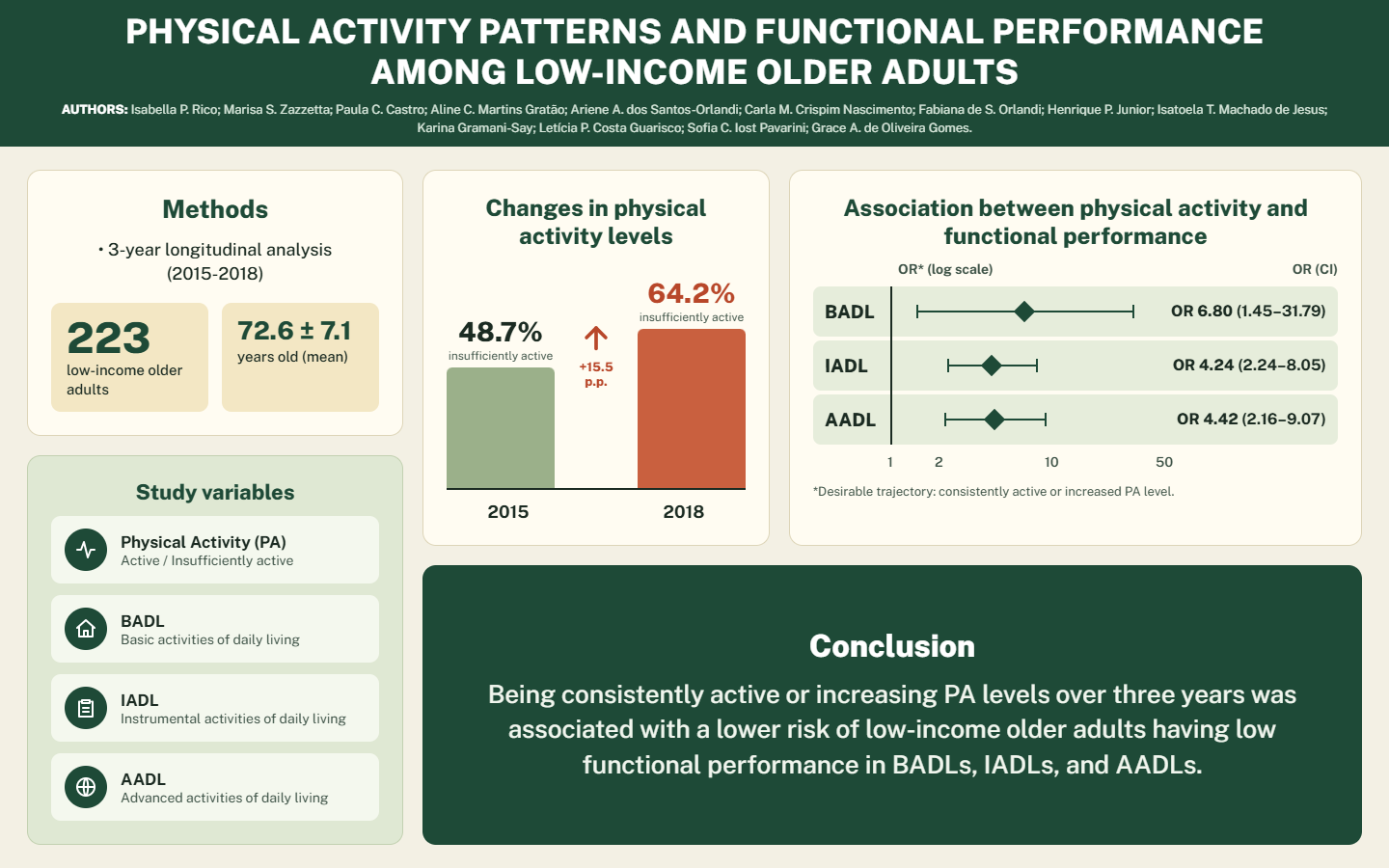
Introduction: Physical inactivity may be associated with lower levels of functional independence; however, this relationship is not fully yet understood among low-income older adults. Objective: To analyze the association between physical activity (PA) trajectories and functional independence in low-income older adults over a three-year period. Methods: This was a longitudinal and prospective study including older adults registered at primary healthcare units located in a socioeconomically vulnerable area. Sociodemographic data, PA levels, and functional independence in basic (BADL), instrumental (IADL), and advanced activities of daily living (AADL) were assessed using the Katz Index, Lawton and Brody scale, and Reuben and Solomon scale, respectively. Data collection was conducted at participants’ homes by previously trained evaluators, following all ethical standards for research involving human subjects. Crude and adjusted logistic regression analyses were performed to assess associations, considering p<0.05. Results: Among the 223 older adults (mean age: 72.6 ± 7.1 years), 48.7% were classified as insufficiently active in 2015, increasing to 55.6% in 2018. A desirable PA trajectory (participants who were active in both 2015 and 2018, or those who transitioned from insufficiently active in 2015 to active in 2018) was associated with better functional independence in BADLs (OR: 6.80; 95% CI: 1.45 – 31.79), IADLs (OR: 4.24; 95% CI: 2.24 – 8.05), and AADLs (OR: 4.42; 95% CI: 2.16 – 9.07). Conclusion: Being consistently active or presenting increasing PA levels over a three-year period was associated with a lower risk of functional decline in BADLs, IADLs, and AADLs, among low-income older adults.
Downloads
References
1.Taguchi CK, Menezes PL, Melo ACS, Santana LS, Conceição WRS, Souza GF, et al. Síndrome de fragilidade e riscos de queda na comunidade idosa. Codas. 2022;34(6):e20210025. DOI: https://doi.org/10.1590/2317-1782/20212021025pt
2. Wang X, Hu J, Wu D. Risk factors for frailty in older adults. Medicine (Baltimore). 2022;101(34):e30169. DOI: https://doi.org/10.1097/MD.0000000000030169
3. Rosalem L, da Cunha M. Socioeconomic Vulnerabilities and Population Aging in Brazil: a Longitudinal Study. Population Ageing. 2025;18:569–94. DOI: https://doi.org/10.1007/s12062-025-09476-x
4. Trintinaglia V, Bonamigo AW, Azambuja MS. Public health policies for healthy aging in Latin America: an integrative review. Rev Bras Promoç Saúde. 2022;35(1):15. DOI: https://doi.org/10.5020/18061230.2022.11762
5. Du Z, Sato K, Tsuji T, Kondo K, Kondo N. Sedentary behavior and the combination of physical activity associated with dementia, functional disability, and mortality: a cohort study of 90,471 older adults in Japan. Prev Med. 2024:107879. DOI: https://doi.org/10.1016/j.ypmed.2024.107879
6. Wang L, Chen H, Zhu H, Hu Z, Zhou C, Hu X. Physical activity as a predictor of activities of daily living in older adults: a longitudinal study in China. Front Public Health. 2024;12:1444119. DOI: https://doi.org/10.3389/fpubh.2024.1444119
7. Campbell E, Rocha FP, Welsh P, Morales CC, Pell JP, Ho FK, et al. The effect of exercise on quality of life and activities of daily life in frail older adults: a systematic review of randomized controlled trials. Exp Gerontol. 2021;147:111287. DOI: https://doi.org/10.1016/j.exger.2021.111287
8. Cunningham C, O’Sullivan R, Caserotti P, Tully MA. Consequences of physical inactivity in older adults: a systematic review of reviews and meta‑analyses. Scand J Med Sci Sports. 2020;30(5):816–27. DOI: https://doi.org/10.1111/sms.13616
9. Brasil. Ministério da Saúde. Secretaria de Atenção Primária à Saúde. Departamento de Promoção da Saúde. Guia de Atividade Física para a População Brasileira [Internet]. Brasília: Ministério da Saúde; 2021. Disponível em: https://bvsms.saude.gov.br/bvs/publicacoes/guia_atividade_fisica_populacao_brasileira.pdf. [2026 Janeiro].
10. Meneguci CAG, Meneguci J, Sasaki JE, Tribess S, Júnior JSV. Physical activity, sedentary behavior and functionality in older adults: a cross‑sectional path analysis. PLoS One. 2021;16(1):e0246275. DOI: https://doi.org/10.1371/journal.pone.0246275
11. Spiteri K, Broom D, Bekhet AH, de Caro JX, Laventure B, Grafton K. Barreiras e motivadores da participação na atividade física em adultos de meia‑idade e idosos: uma revisão sistemática. J Aging Phys Act. 2019;27(4):929–44. DOI: https://doi.org/10.1123/japa.2018-0343
12. Lounassalo I, Salin K, Kankaanpää A, Hirvensalo M, Palomäki S, Tolvanen A, et al. Distinct trajectories of physical activity and related factors during the life course in the general population: a systematic review. BMC Public Health. 2019;19(1):1–12. DOI: https://doi.org/10.1186/s12889-019-6513-y
13. Gomes GAO, Brown WJ, Codogno JS, Mielke GI. Twelve‑year trajectories of physical activity and health costs in mid‑age Australian women. Int J Behav Nutr Phys Act. 2020;17(1):1–9. DOI: https://doi.org/10.1186/s12966-020-01006-6
14. Aggio D, Papachristou E, Papacosta O, Lennon LT, Ash S, Whincup PH, et al. Trajetórias de vinte anos de tipos de atividade física da meia‑idade à velhice. Med Sci Sports Exerc. 2019;51(3):481–89. DOI: https://doi.org/10.1249/MSS.0000000000001802
15. Chen T, Honda T, Chen S, Narazaki K, Kumagai S. Dose–response association between accelerometer‑assessed physical activity and incidence of functional disability in older Japanese adults: a 6‑year prospective study. J Gerontol A Biol Sci Med Sci. 2020;75:1763–70. DOI: https://doi.org/10.1093/gerona/glaa046
16. Kurita S, Doi T, Tsutsumimoto K, Nakakubo S, Kim M, Ishii H, et al. Association of physical activity and cognitive activity with disability: a 2‑year prospective cohort study. Phys Ther. 2020;100:1289–95. DOI: https://doi.org/10.1093/ptj/pzaa052
17. Ikegami ÉM, Souza LA, Tavares DMDS, Rodrigues LR. Functional capacity and physical performance of community‑dwelling elderly: a longitudinal study. Science Public Health. 2020;25:1083–90. DOI: https://doi.org/10.1590/1413-81232020253.18512018
18. Brucki SMD, Nitrini R, Caramelli P, Bertolucci PHF, Okamoto IH. Suggestions for utilization of the mini‑mental state examination in Brazil. Arq Neuropsiquiatr. 2003;61(3B):777–81. DOI: https://doi.org/10.1590/S0004-282X2003000500014
19. Katz S, Ford AB, Moskowitz RW, Jackson BA, Jaffe MW. Studies of illness in the aged: the index of ADL: a standardized measure of biological and psychosocial function. JAMA. 1963;185(12):914–19. DOI: https://doi.org/10.1001/jama.1963.03060120024016
20. Lino VTS, Pereira SRM, Camacho LAB, Ribeiro Filho ST, Buksman S. Cross‑cultural adaptation of the independence scale in activities of daily living (Katz Scale). Cad Saude Publica. 2008;24(1):103–12. DOI: https://doi.org/10.1590/S0102-311X2008000100010
21. Lawton MP, Brody MH. Assessment of older people: self‑maintaining and instrumental activities of daily living. Gerontologist. 1969;9:179–86. DOI: https://doi.org/10.1093/geront/9.3_Part_1.179
22. Dos Santos JS, Virtuoso J. Reliability of the Brazilian version of the instrumental activities of daily living scale. RBPS. 2018;21(4):290–96. DOI: https://doi.org/10.5020/575
23. Reuben DB, Solomon DH. Assessment in geriatrics: of caveats and names. J Am Geriatr Soc. 1989;37(6):570–72. DOI: https://doi.org/10.1111/j.1532-5415.1989.tb05691.x
24. Benedetti TRB, Antunes PC, Rodriguez‑Añez CR, Mazo GZ, Petroski EL. Reprodutibilidade e validade do Questionário Internacional de Atividade Física (IPAQ) em homens idosos. Rev Bras Med Esporte. 2007;13(1):11–6. DOI: https://doi.org/10.1590/S1517-86922007000100004
25. Wleklik M, Uchmanowicz I, Jankowska EA, Vitale C, Lisiak M, Drozd M, et al. Multidimensional approach to frailty. Front Psychol. 2020;11:564. DOI: https://doi.org/10.3389/fpsyg.2020.00564
26. Harris D, Dlima SD, Gluchowski A, Hall A, Elliott E, Munford L. The effectiveness and acceptability of physical activity interventions amongst older adults with lower socioeconomic status: a mixed methods systematic review. Int J Behav Nutr Phys Act. 2024;21(1). DOI: https://doi.org/10.1186/s12966-024-01666-8
27. Aggio D, Papachristou E, Papacosta O, et al. Trajectories of self‑reported physical activity and predictors during the transition to old age: a 20‑year cohort study of British men. Int J Behav Nutr Phys Act. 2018;15(1):14. DOI: https://doi.org/10.1186/s12966-017-0642-4
28. Moreno‑Agostino D, et al. The impact of physical activity on healthy ageing trajectories: evidence from eight cohort studies. Int J Behav Nutr Phys Act. 2020;17(1):92. DOI: https://doi.org/10.1186/s12966-020-00995-8
29. Zhu Z, Chen S, Chen S, Chen X, Liang Y, Sun S, et al. Interaction between physical activity and deficit-based frailty on all-cause mortality in older adults: a prospective study of five population-based cohorts. Lancet Reg Health West Pac. 2026;66:101780. DOI: https://doi.org/10.1016/j.lanwpc.2025.101780
30. Huang L, Liang Z, Chen H. Association between physical activity and frailty transitions in middle-aged and older adults: a nationwide longitudinal study. Int J Behav Nutr Phys Act. 2025;22(1):31. DOI: https://doi.org/10.1186/s12966-025-01725-8
Downloads
Published
How to Cite
Issue
Section
License
Copyright (c) 2026 Isabella Pereira Rico, Marisa Silvana Zazzetta, Aline Cristina Martins Gratão, Ariene Angeline dos Santos-Orlandi, Carla Manuela Crispim Nascimento, Fabiana de Souza Orlandi, Henrique Pott Junior, Isabela Thaís Machado de Jesus, Karina Gramani-Say, Letícia Pimenta Costa Guarisco, Paula Costa Castro, Sofia Costa Iost Pavarini, Grace Angélica de Oliveira Gomes

This work is licensed under a Creative Commons Attribution 4.0 International License.
When submitting a manuscript to the Revista Brasileira de Atividade Física & Saúde, the authors retain the copyright to the article and authorize the Revista Brasileira de Atividade Física & Saúde to publish the manuscript under the Creative Commons Attribution 4.0 License and identify it as the original publication source.