Translation, cross-cultural adaptation, and psychometric properties of the screen-based media use Questionnaire (ScreenQ) for Brazilian toddlers and preschoolers
DOI:
https://doi.org/10.12820/rbafs.30e0418Keywords:
Validation, Questionnaire, Children, Screen-based mediaAbstract
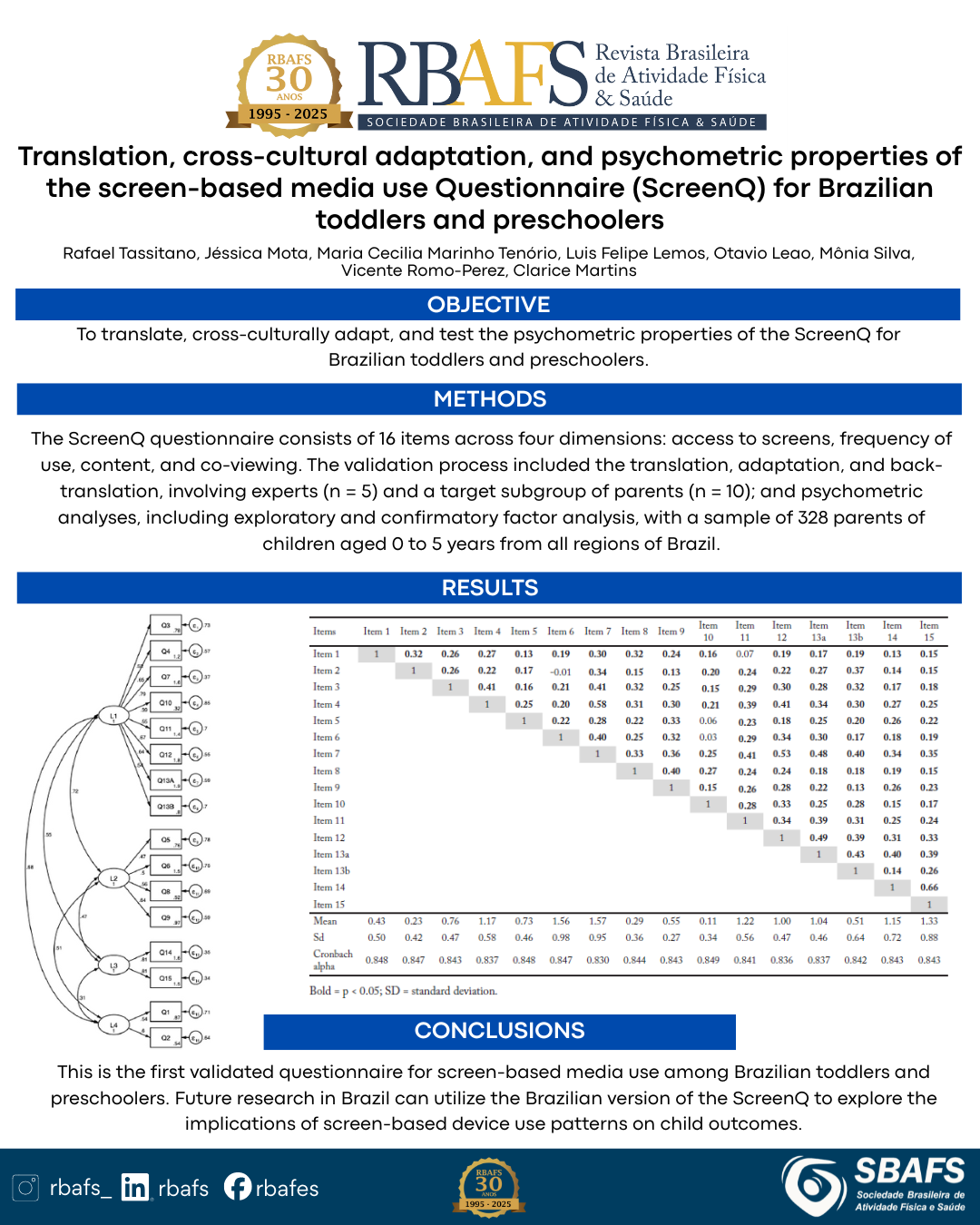
Introduction: Beyond the time spent on screen-based devices, understanding the context, the content, and patterns of use among children is crucial for developing specific guidance for families, caregivers, and childcare providers. Recently, a questionnaire (i.e., ScreenQ) incorporating these contexts and patterns of use was developed and validated. Objetive: To translate, cross culturally adapt, and test the psychometric properties of the ScreenQ for Brazilian toddlers and preschoolers. Methods: The ScreenQ questionnaire consists of 16 items across four dimensions: access to screens, frequency of use, content, and co-viewing. The validation process included the translation, adaptation, and back-translation, involving experts (n = 5) and a target subgroup of parents (n = 10); and psychometric analyses, including exploratory and confirmatory factor analysis, with a sample of 328 parents of children aged 0 to 5 years from all regions of Brazil. Results: The semantic, idiomatic, and conceptual equivalence of the final version were satisfactory. The psychometric analysis demonstrated acceptable results, with Cronbach’s alpha values ranging from 0.836 to 0.849 and fit indices for the confirmatory factor analysis model being acceptable (Comparative Fit Index = 0.912; Root Mean Squared Error of Approximation = 0.062; 95% CI: 0.051 - 0.073). Conclusion: This is the first validated questionnaire for screen-based media use among Brazilian toddlers and preschoolers. Future research in Brazil can utilize the Brazilian version of the ScreenQ to explore the implications of screen-based device use patterns on child outcomes.
Downloads
References
1. UNICEF. The state of the world’s children 2017: children in a digital world. New York (NY): United Nations Children’s Fund; 2017. Available from: <https://www.unicef.org/media/48581/file/SOWC_2017_ENG.pdf> [2024 May].
2. World Health Organization. Guidelines on physical activity, sedentary behaviour and sleep for children under 5 years of age. Geneva: WHO; 2020. Available from: <https://apps.who.int/iris/handle/10665/311664 > [2024 May].
3. McArthur BA, Volkova V, Tomopoulos S, Madigan S. Global prevalence of meeting screen time guidelines among children 5 years and younger: a systematic review and meta-analysis. JAMA Pediatr. 2022;176(4):373–83. DOI: https://doi.org/10.1001/jamapediatrics.2021.6386
4. AAP Council on Communications and Media. Media and young minds. Pediatrics. 2016;138(5):e20162591. DOI: https://doi.org/10.1542/peds.2016-2591
5. Perez O, Garza T, Hindera O, Beltran A, Musaad SM, Dibbs T, et al. Validated assessment tools for screen media use: a systematic review. PLoS One. 2023;18(4):e0283714. DOI: https://doi.org/10.1371/journal.pone.0283714
6. Hutton JS, Huang G, Sahay RD, DeWitt T, Ittenbach RF. A novel, composite measure of screen-based media use in young children (ScreenQ) and associations with parenting practices and cognitive abilities. Pediatr Res. 2020;87(7):1211–8. DOI: https://doi.org/10.1038/s41390-020-0765-1
7. Williams KT. Expressive Vocabulary Test. 2nd ed. Minneapolis (MN): Pearson Assessments; 2007. DOI: https://doi.org/10.1037/t15094-000
8. Monteiro R, Fernandes S, Hutton JS, Huang G, Ittenbach RF, Rocha NB. Psychometric properties of the ScreenQ for measuring digital media use in Portuguese young children. Acta Paediatr. 2022;111(10):1950–5. DOI: https://doi.org/10.1111/apa.16439
9. Mertens DM. Research and evaluation in education and psychology: integrating diversity with quantitative, qualitative, and mixed methods. 5th ed. Thousand Oaks (CA): Sage Publications; 2019.
10. Leighton K, Kardong-Edgren S, Schneidereith T, FoisyDoll C. Using social media and snowball sampling as an alternative recruitment strategy for research. Clin Simul Nurs. 2021;55:37–42. DOI: https://doi.org/10.1016/j.ecns.2021.03.006
11. Aiken LR, Groth-Marnat G. Psychological testing and assessment. 12th ed. Boston (MA): Pearson; 2005.
12. Popping R. Introduction to interrater agreement for nominal data. Cham: Springer; 2019. DOI: https://doi.org/10.1007/978-3-030-11671-2
13. Lai SK, Chang CM. The application of Aiken content validity coefficient and homogeneity reliability coefficient in enterprise business risks scale for hot-spring hotel industries. J Manag Pract Princ. 2007;1(2):64–75.
14. Asparouhov T, Muthén B. Exploratory structural equation modeling. Struct Equ Model. 2009;16(3):397–438. DOI: https://doi.org/10.1080/10705510903008204
15. Bentler P. Quantitative methods in psychology. Psychol Bull. 1990;107(2):238–46. DOI: https://doi.org/10.1037//0033-2909.107.2.238
16. Tucker RL, Lewis C. A reliability coefficient for maximum likelihood factor analysis. Psychometrika. 1973;38(1):1–10. DOI: https://doi.org/10.1007/BF02291170
17. Sörbom D, Jöreskog KG. The use of structural equation models in evaluation research. Uppsala: Univ., Department of Statistics; 1981.
18. Hu LT, Bentler PM. Cutoff criteria for fit indexes in covariance structure analysis: conventional criteria versus new alternatives. Struct Equ Model. 1999;6(1):1–55. DOI: https://doi.org/10.1080/10705519909540118
19. Hair JF, Black WC, Babin BJ, Anderson RE, Tatham RL. Análise multivariada de dados. Porto Alegre: Bookman Editora; 2009.
20. Valentini F, Damásio BF. Average variance extracted and composite reliability: reliability coefficients. Psicol Teor Pesqui. 2016;32(2):1–7.
21. Bagozzi RP, Yi Y. On the evaluation of structural equation models. J Acad Mark Sci. 1988;16:74–94. DOI: https://doi.org/10.1007/BF02723327
22. Bandeira Morais M, Swart J, Jordaan JA. Economic complexity and inequality: does regional productive structure affect income inequality in Brazilian states? Sustainability. 2021;13(2):1006. DOI: https://doi.org/10.3390/su13021006
23. Kumar S, Kroon J, Lalloo R. A systematic review of the impact of parental socio-economic status and home environment
characteristics on children’s oral health-related quality of life. Health Qual Life Outcomes. 2014;12:41. DOI: https://doi.org/10.1186/1477-7525-12-41
24. Lorentzen JC, Georgellis A, Albin M, Jonsson M. Residential overcrowding in relation to children’s health, environment and schooling: a qualitative study. Scand J Public Health. 2023;51(6):653–61.
Downloads
Published
How to Cite
Issue
Section
License
Copyright (c) 2025 Rafael Miranda Tassitano, Jéssica Mota, Maria Cecilia Marinho Tenório, Luis Felipe Lemos, Otavio Leao, Monia Silva, Vicente Romo-Perez, Clarice Martins

This work is licensed under a Creative Commons Attribution 4.0 International License.
When submitting a manuscript to the Revista Brasileira de Atividade Física & Saúde, the authors retain the copyright to the article and authorize the Revista Brasileira de Atividade Física & Saúde to publish the manuscript under the Creative Commons Attribution 4.0 License and identify it as the original publication source.