Equity, diversity, and inclusion in the presidential rhetorical agenda on physical activity promotion
DOI:
https://doi.org/10.12820/rbafs.31e0446Keywords:
Diversity, equity, inclusion, Physical activity, Health promotionAbstract
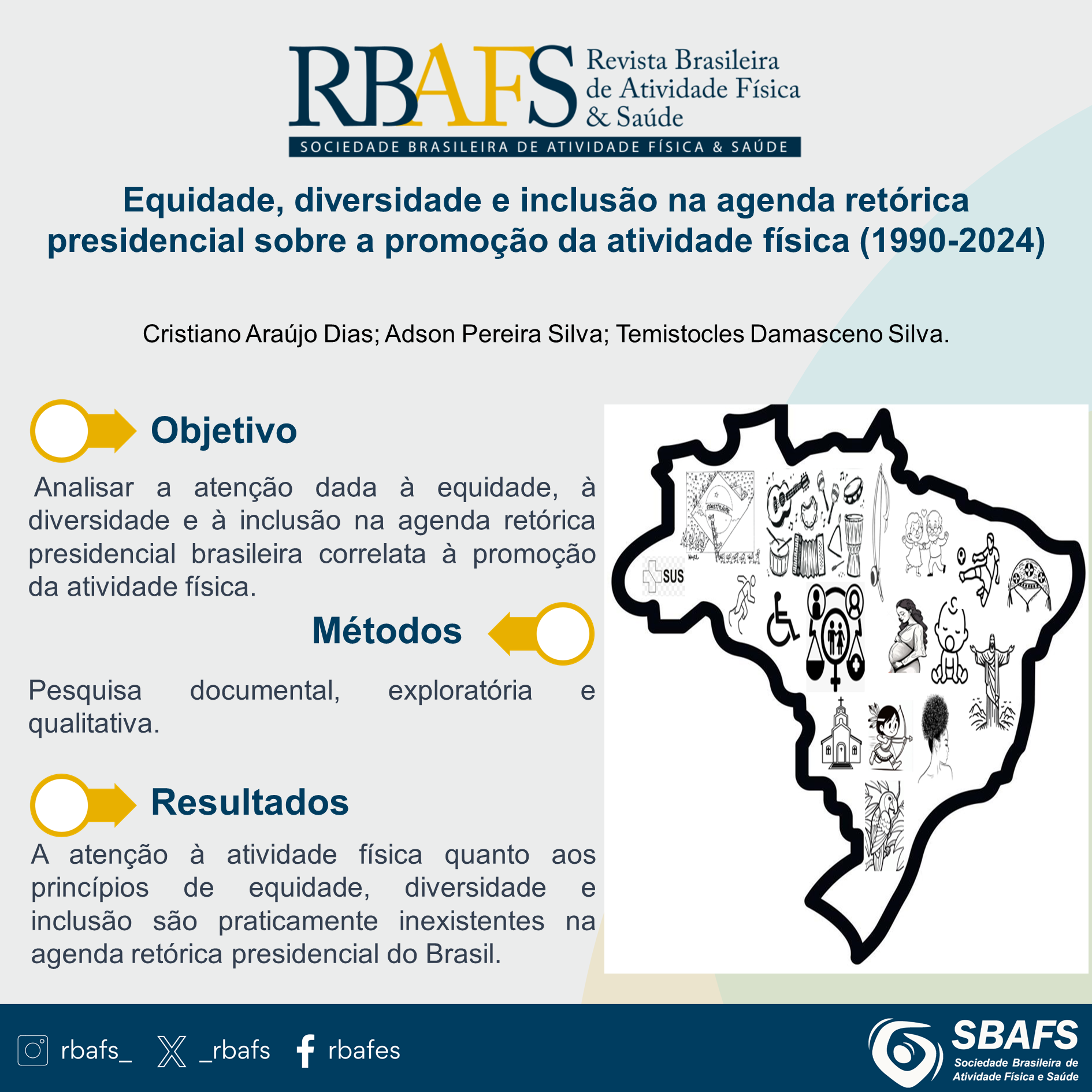
Introduction: Physical activity should be recognized as a strategic axis for health promotion, grounded in the principles of universality, equity, comprehensiveness, and community participation. However, low population adherence to regular practice remains one of the main challenges to the effective implementation of these guidelines on a global scale. Objective: To analyze the attention given to equity, diversity, and inclusion in the Brazilian presidential rhetorical agenda related to the promotion of physical activity from 1990 to 2024. Methods: This is a retrospective, exploratory, and documentary study with a mixed (quantitative-qualitative) approach. Data were collected from the government plans of elected presidential candidates, inauguration speeches, and annual presidential messages sent to the National Congress. Results: The findings indicate that the presence of physical activity in the Brazilian presidential rhetorical agenda between 1990 and 2024 is limited and irregular, with a small number of mentions in the analyzed documents and virtually none in government plans and inauguration speeches. The identified references are mostly concentrated in the presidential messages sent to the National Congress, although they remain sporadic and weakly articulated with the principles of equity, diversity, and inclusion. Conclusion: It is concluded that both the attention to physical activity and to the principles of equity, diversity, and inclusion are practically absent from the rhetorical agenda, revealing low prioritization and a lack of consistent commitment to these issues in the analyzed documents. Therefore, further studies are needed to examine the presence of physical activity in other public policy agendas in Brazil.
Downloads
References
1. Kohl HW, Craig CL, Lambert EV, Inoue S, Alkandari JR, Leetongin G, et al. The pandemic of physical inactivity: global action for public health. Lancet. 2012;380:294-305. DOI: https://doi.org/10.1016/S0140-6736(12)60898-8
2. Hallal PC, Andersen LB, Bull FC, Guthold R, Haskell W, Ekelund U, et al. Global physical activity levels: surveillance progress, pitfalls, and prospects. Lancet. 2012;380:247-57. DOI: https://doi.org/10.1016/S0140-6736(12)60646-1
3. Mielke GI, Hallal PC, Rodrigues GBA, Szwarcwald CL, Santos FV, Malta DC. Prática de atividade física e hábito de assistir à televisão entre adultos no Brasil: Pesquisa Nacional de Saúde 2013. Epidemiol Serv Saúde. 2015;24:277-86. DOI: https://doi.org/10.5123/S1679-49742015000200010
4. Elshahat S, O’Rorke M, Adlakha D. Built environment correlates of physical activity in low- and middle-income countries: A systematic review. PLoS One. 2020;15(3): e0230454. DOI: https://doi.org/10.1371/journal.pone.0230454
5. Ding D, Lawson K, Kolbe-Alexander T, Finkelstein E, Katzmarzyk P, Mechelen W, et al. The economic burden of physical inactivity: A global analysis of major non-communicable diseases. Lancet. 2016;388. DOI: https://doi.org/10.1016/S0140-6736(16)30383-X
6. Codella R, Chirico A. Physical Inactivity and Depression: The Gloomy Dual with Rising Costs in a Large-Scale Emergency. Int J Environ Res Public Health. 2023;20(2):1603. DOI: https://doi.org/10.3390/ijerph20021603
7. Machado PG, Florindo AA, Knuth AG, Varela AR, Malta DC, Kohn ER, et al. Progress in Physical Activity Surveillance, Research, Policy, and Gender Equity in Brazil: Results From the Global Observatory for Physical Activity. J Phys Act Health. 2025;22(7):819-26. DOI: https://doi.org/10.1123/jpah.2024-0375
8. Romero LCP. O Sistema único de saúde–um capítulo à parte. Disponível em: <https://www12.senado.leg.br/publicacoes/estudos-legislativos/tipos-de-estudos/outras-publicacoes/volume-v-constituicao-de-1988-o-brasil-20-anos-depois.-os-cidadaos-na-carta-cidada/seguridade-social-o-sistema-unico-de-saude-um-capitulo-a-parte/@@download/file/3-LuisCarlosRomero.pdf> [2025 abril].
9. Foratori-Junior GA, De Souza JMS. A importância do Sistema Único de Saúde para o Brasil. Facit Business and Technology Journal, 2021;1(28):151-7.
10. Brasil. Lei 8.142, 28 de dezembro de 1990. Dispõe sobre a participação da comunidade na gestão do Sistema Único de Saúde (SUS) e sobre as transferências intergovernamentais de recursos financeiros na área da saúde e dá outras providências, Brasília, 1990a. Disponível em: <https://www.planalto.gov.br/ccivil_03/leis/l8142.htm> [2025 abril]. Acesso em: 05 de abr. de 2025.
11. Malta DC, Castro AM, Gosch CS, Cruz DKA, Bressan A, Nogueira JD, et al. A Política Nacional de Promoção da Saúde e a agenda da atividade física no contexto do SUS. Epidemiol Serv Saúde. 2009;18(1):79-86. DOI: https://doi.org/10.5123/S1679-49742009000100008
12. Buziquia SP, Tertuliano GC, Fischer Loeck J. A trajetória de um grupo de trabalho interinstitucional para a promoção da equidade em saúde na gestão municipal. Interações. 2021;22(3):1001–12. Disponível em: <https://interacoes.ucdb.br/interacoes/article/view/2993> [2025 abril]. DOI: https://doi.org/10.20435/inter.v22i3.2993
13. Siqueira SAV, Hollanda E, Motta JIJ. Políticas de Promoção de Equidade em Saúde para grupos vulneráveis: o papel do Ministério da Saúde. Ciênc. saúde colet. 2017;22 (5): 1397-1406. DOI: https://doi.org/10.1590/1413-81232017225.33552016
14. Lee-Foon N, Reid RJ, Brown, A. Fairness for Whom? Learning Health Systems’ Approach to Equity in Healthcare. Healthc Policy. 2023;19(2):15-20. DOI: https://doi.org/10.12927/hcpol.2023.27237
15. Sengstock B. Diversity, equity and inclusion in the workplace. J. Paramed. Pract. 2024;16(1). DOI: https://doi.org/10.12968/jpar.2024.16.1.16
16. Arora K, Wolbring, G. Kinesiology, Physical Activity, Physical Education, and Sports through an Equity/Equality, Diversity, and Inclusion (EDI) Lens: A Scoping Review. Sports. 2022;10(4):55. DOI: https://doi.org/10.3390/sports10040055
17. Sherman BW, Dankwa-Mullan I. For the Commercially Insured, Equitable Health Benefits Begin with Equitable Health Insurance Design. Am J Health Promot. 2022;36(4):745-51. DOI: https://doi.org/10.1177/08901171211073408b
18. Bantham A, Ross SET, Sebastião E, Hall G. Overcoming barriers to physical activity in underserved populations. Prog Cardiovasc Dis. 2021;64:64-71. DOI: https://doi.org/10.1016/j.pcad.2020.11.002
19. Cohen JE. The president ́s legislative policy agenda, 1789-2002. New York: Cambridge University Press, 2012. DOI: https://doi.org/10.1017/CBO9780511998515
20. Proetti S. As pesquisas qualitativa e quantitativa como métodos de investigação científica: um estudo comparativo e objetivo. Revista Lumen. 2017;2(4). DOI: https://doi.org/10.32459/revistalumen.v2i4.60
21. Baumgartner FR, Jones BD. Agendas and Instability in American Politics. Chicago: University of Chicago Press, 1993.
22. Baumgartner FR, Jones BD. “Punctuated Equilibrium Theory: Explaining stability and change in American policymaking”. In Sabatier PA. (ed.). Theories of The Policy Process. Oxford, Westview Press. pp. 97-116, 1999.
23. Baumgartner FR, Jones BD. The politics of information: Problem definition and the course of public policy in America. Chicago, IL: University of Chicago Press; 2015.
24. Brasil. Ministério da Saúde. Secretaria de Vigilância em Saúde. Secretaria de Atenção à Saúde. Política Nacional de Promoção da Saúde (PNPS). Brasília, 2006.5.
25. Brasil. Ministério da Saúde. Portaria GM Nº 2.446, de 11 de novembro de 2014. Redefine a Política Nacional de Promoção da Saúde (PNPS).
26. Conselho Nacional de Saúde (CNS). Atividades físicas e práticas corporais. Criação de Política Nacional de Práticas Corporais e Atividades Físicas. Disponível em: <https://www.gov.br/conselho-nacional-de-saude/pt-br/assuntos/noticias/2024/agosto/criacao-de-politica-nacional-de-praticas-corporais-e-atividades-fisicas> [2025 abril].
27. Nicões CR, Silva ICM, Knuth AG. O apagamento do termo “práticas corporais” em ações do Ministério da Saúde: uma análise do período 2019-2021. Rev. Didát. Sist. 2024;25(1):120–35. DOI: https://doi.org/10.14295/rds.v25i1.15113
28. Colégio Brasileiro de Ciências do Esporte (CBCE). O Colégio Brasileiro de Ciências do Esporte na luta pela valorização das Práticas Corporais/Atividades Físicas no SUS. Disponível em: <https://www.cbce.org.br/noticia/o-colegio-brasileiro-de-ciencias-do-esporte-na-luta-pela-valorizacao-das-praticas-corporais---atividades-fisicas-no-sus> [2025 abril].
29. Silva ACB, Silva ILF, Souza NBS, Dias CA, Silva TD. O esporte universitário na agenda retórica presidencial brasileira (1930-2022). Coleção Pesquisa em Educação Física. 2023;22(3):79-88.
30. Brasil FG, Capella ACN. Agenda governamental brasileira: uma análise da capacidade e diversidade nas prioridades em políticas públicas no período de 2003 a 2014. Cad. Gest. Pública Cid. 2019;24(78). DOI: https://doi.org/10.12660/cgpc.v24n78.76950
31. Souza SS, Silva TD, Starepravo FA, Yarid SD. A promoção da saúde na agenda retórica presidencial brasileira (2006-2023). Cien Saude Colet. 2025;30(5). DOI: https://doi.org/10.1590/1413-81232025305.10302023
32. Tribunal Superior Eleitoral. Lula de novo com a força do povo. 2006. Disponível em: <http://www.tse.jus.br/eleicoes/eleicoes-2006/propostas-de-candidatos> [2025 abril].
33. Capella ACN. Formulação de políticas públicas. Enap: Brasília/DF. 2018.
34. Brasil. Lei 8.842 04 de janeiro de 1994. Dispõe sobre a política nacional do idoso, cria o Conselho Nacional do Idoso e dá outras providências. Disponível em: <https://sbgg.org.br/wp-content/uploads/2014/10/politica-nacional-do-idoso.pdf> [2025 abril].
35. American Heart Association. Committee on Exercise. Exercise testing and training of apparently healthy individuals: a handbook for physicians. Michigan (EUA): American Heart Association; 2007.
36. Ramirez A, Martins RC, Hallal PC. Observatório Global de Atividade Física: monitoramento de uma pandemia no século XXI. Rev Bras Ativ Fis e Saúde. 2015; 20(4):209-328 DOI: https://doi.org/10.12820/rbafs.v.20n4p327
Downloads
Published
How to Cite
Issue
Section
License
Copyright (c) 2026 Cristiano Araujo Dias, Adson Pereira Silva, Temistocles Damasceno Silva

This work is licensed under a Creative Commons Attribution 4.0 International License.
When submitting a manuscript to the Revista Brasileira de Atividade Física & Saúde, the authors retain the copyright to the article and authorize the Revista Brasileira de Atividade Física & Saúde to publish the manuscript under the Creative Commons Attribution 4.0 License and identify it as the original publication source.