Barriers and facilitators to physical activity among LGBT+ High School students in Pelotas
DOI:
https://doi.org/10.12820/rbafs.31e0436Keywords:
Sedentary behavior, Gender perspectives, Adolescence, Barriers to access of health servicesAbstract
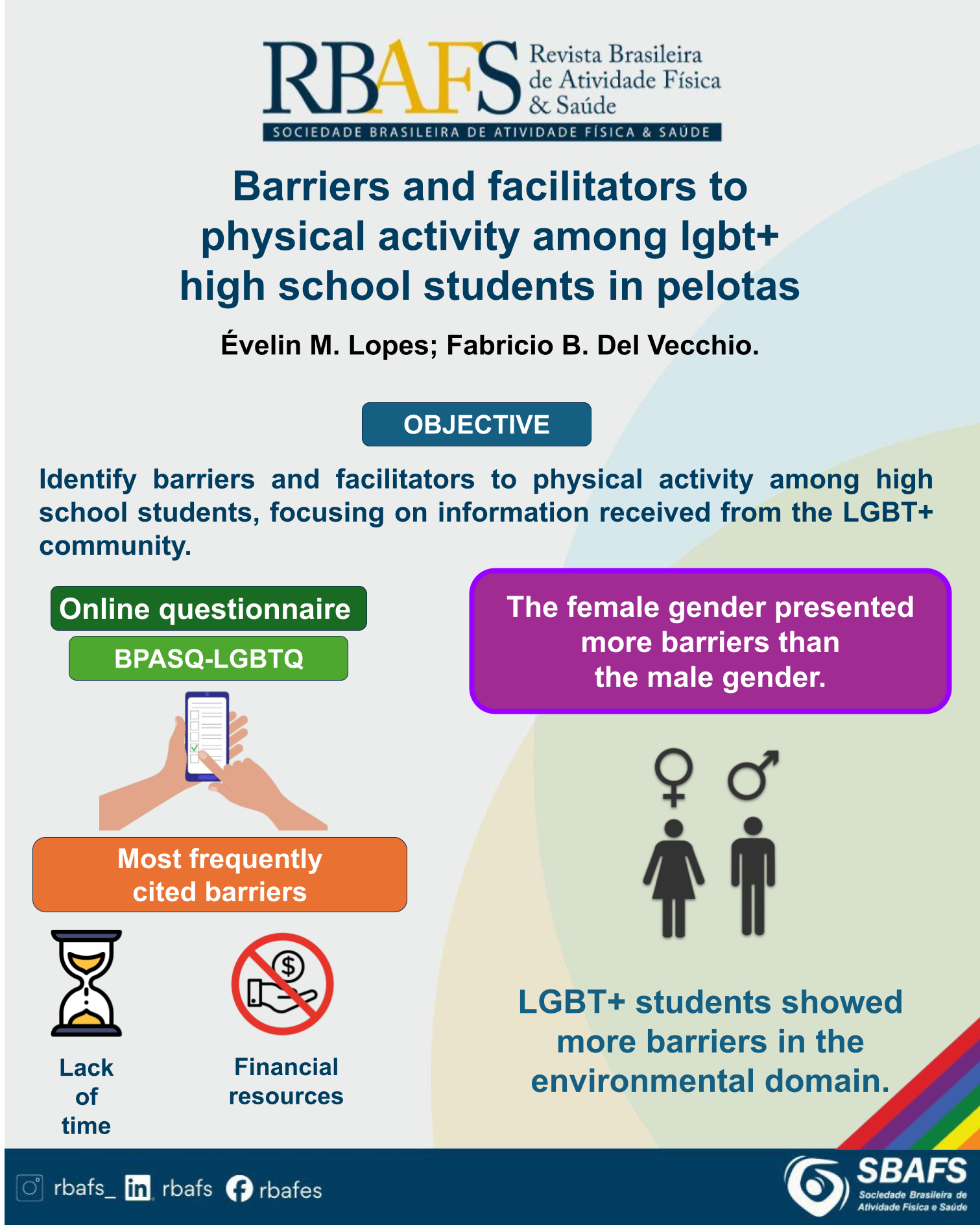
Introduction: Regular physical activity (PA) is crucial for physical and mental health, especially during adolescence. However, most young people worldwide do not meet recommended PA levels, and participation tends to decline in this age group. The LGBT+ community, although representing a significant portion of the Brazilian population, often faces limited attention to their unique needs and experiences regarding PA. Objective: This exploratory-descriptive study with a convergent mixed methods approach aimed to identify barriers and facilitators for PA among LGBT+ high school students in Pelotas, Rio Grande do Sul, Brazil. Methods: Fifty students (15 identifying as LGBT+), aged 18 or older, responded to an online questionnaire. Quantitative data were analyzed using the Poisson binomial test for proportions, while qualitative data were examined through Bardin’s content analysis. Results: The most commonly reported barriers included lack of time and financial resources. Among LGBT+ students, environmental factors were the predominant barriers, whereas non-LGBT+ students mainly cited perceived lack of safety. Concerning gender, female participants reported a higher mean barrier score (26.1 ± 9.2) compared to males (13.8 ± 13.7) (p = 0.028). Interpersonal factors were the most frequently cited facilitators by LGBT+ students, with humor being particularly noted. Furthermore, LGBT+ participants expressed a stronger preference for individual physical activities. Conclusion: The presence of interpersonal facilitators and the supportive role of school Physical Education emphasize the need for inclusive educational environments. These findings underscore the importance of developing interventions aimed at ensuring equitable access to PA opportunities for adolescents of all gender identities and sexual orientations.
Downloads
References
1. Spizzirri G, Eufrásio R, Lima MCP, Carvalho Nunes HR, Kreukels BPC, Steensma TD, et al. Proportion of people identified as transgender and non-binary gender in Brazil. Sci. Rep. 2021;15(2):123-37. DOI: https://doi.org/10.1038/s41598-021-81411-4
2. Úbeda-Colomer J, Gil-Quintana J, Pereira-García S, López-Cañada E, Pérez-Samaniego V, Devís-Devís J. Development and validation of the Barriers to Physical Activity and Sport Questionnaire for lesbian, gay, bisexual, transgender and queer/questioning persons. Public Health. 2020;185:202–8. DOI: https://doi.org/10.1016/j.puhe.2020.05.020
3. Pereira E, Silva A. “Apresentação”. In: Pereira, Erik; Silva, Alan (Orgs.). Educação Física, Esporte e Queer: sexualidades em movimento. Curitiba: Appris, 2019, p. 9-11.
4. Polo MC, Olivar JM, Tavares G. Práticas corporais e população LGBTI+ na Educação Física: uma revisão de escopo. Conexões. 2022;20:e022007. DOI: https://doi.org/10.20396/conex.v20i00.8666520
5. Warburton DER, Bredin SSD. Health benefits of physical activity: a systematic review. Curr Opin Cardiol. 2017 Sep;32(5):541-556. DOI: https://doi.org/10.1097/HCO.0000000000000437
6. Brown HE, Pearson N, Braithwaite RE, Brown WJ, Biddle SJH. Physical activity interventions and depression in children and adolescents: a systematic review and meta-analysis. Sports Med. 2013;43(3):195–206. DOI: https://doi.org/10.1007/s40279-012-0015-8
7. The Lancet Child & Adolescent Health. Recommendations for physical activity in children and adolescents. Lancet Child Adolesc Health. 2022;6(7):562-8. DOI: https://doi.org/10.1016/S2352-4642(22)00318-2
8. World Health Organization (WHO). Global status report on physical activity and health. Geneva: WHO; 2022.
9. Azevedo MR, Araújo CL, Silva MC, Hallal PC. Tracking of physical activity from adolescence to adulthood: a population-based study. Rev. Saúde Pública. 2007;41(1):69–75. DOI: https://doi.org/10.1590/S0034-89102007000100010
10. Strong WB, Malina RM, Blimkie CJ, Daniels SR, Dishman RK, Gutin B, et al. Evidence based physical activity for school-age youth. J Pediatr. 2005;146(6):732-7. DOI: https://doi.org/10.1016/j.jpeds.2005.01.055
11. Hallal, PC, Victora, CG, Azevedo, MR, Wells, JC. Adolescent physical activity and health: a systematic review. Sports Med. 2006;36(12):1019–30. DOI: https://doi.org/10.2165/00007256-200636120-00003
12. Brodersen NH, Steptoe A, Boniface DR, Wardle J. Trends in physical activity and sedentary behaviour in adolescence: ethnic and socioeconomic differences. Br J Sports Med. 2007;41(3):140-4. DOI: https://doi.org/10.1136/bjsm.2006.031138
13. Müller WA, Silva MC. Barreiras à prática de atividades físicas de adolescentes escolares da zona rural do sul do Rio Grande do Sul. Rev. Bras. Ativ. Fís. Saúde. 18(3):344-53. DOI: https://doi.org/10.12820/rbafs.v.18n3p344
14. Hammerschmidt P, Tackett W, Golzynski M, Golzynski D. Barriers to and facilitators of healthful eating and physical activity in low-income schools. J Nutr Educ Behav. 2011;43(1):63-8. DOI: https://doi.org/10.1016/j.jneb.2009.11.008
15. Hsu YW, Chou CP, Nguyen-Rodriguez ST, McClain AD, Belcher BR, Spruijt-Metz D. Influences of social support, perceived barriers, and negative meanings of physical activity on physical activity in middle school students. J Phys Act Health. 2011;8(2):210-9. DOI: https://doi.org/10.1123/jpah.8.2.210
16. Dishman RK, Heath GW, Lee IM. Physical activity epidemiology. Champaign: 2ª ed Human Kinetics; Illinois, EUA, 2013.
17. Bauman AE, Reis RS, Sallis JF, Wells JC, Loos RJ, Martin BW; Lancet Physical Activity Series Working Group. Correlates of physical activity: why are some people physically active and others not?. Lancet. 2012;380(9838):258-71. DOI: https://doi.org/10.1016/S0140-6736(12)60735-1
18. Tergerson JL, King KA. Do perceived cues, benefits, and barriers to physical activity differ between male and female adolescents?. J Sch Health. 2002;72(9):374-80. DOI: https://doi.org/10.1111/j.1746-1561.2002.tb03562.x
19. Gordon-Larsen P, Griffiths P, Bentley ME, et al. Barriers to physical activity: qualitative data on caregiver-daughter perceptions and practices. Am J Prev Med. 2004;27(3):218-23. DOI: https://doi.org/10.1016/S0749-3797(04)00116-3
20. Kimm SY, Glynn NW, McMahon RP, Voorhees CC, Striegel-Moore RH, Daniels SR. Self-perceived barriers to activity participation among sedentary adolescent girls. Med Sci Sports Exerc. 2006;38(3):534-40. DOI: https://doi.org/10.1249/01.mss.0000189316.71784.dc
21. Pandolfo KCM, Minuzzi T, Machado RR, Lopes LFD, Azambuja CR, Santos DL. Barreiras percebidas à prática de atividades físicas em escolares do ensino médio. Rev Bras Cineantropom Desempenho Hum. 2016;18(5):567-76. DOI: https://doi.org/10.5007/1980-0037.2016v18n5p567
22. Dambros DD, Lopes LFD, dos Santos DL. Barreiras percebidas e hábitos de atividade física de adolescentes escolares de uma cidade do sul do Brasil. Rev Bras Cineantropom Desempenho Hum. 2011;13(6):422–8. DOI: https://doi.org/10.5007/1980-0037.2011v13n6p422
23. Espinoza SM, Brown C, Gower AL, Eisenberg ME, McPherson LE, Rider GN. Sport and Physical Activity Among Transgender, Gender Diverse, and Questioning Adolescents. J Adolesc Health. 2023;72(2):303-306. DOI: https://doi.org/10.1016/j.jadohealth.2022.09.020
24. Lindström M, Rosvall M. Sexual identity and low leisure-time physical activity: a population-based study. Public Health. 2020;182:77-9. DOI: https://doi.org/10.1016/j.puhe.2020.02.003
25. Santos MS, Fermino RC, Reis RS, Cassou AC, Añez CRR. Barreiras para a prática de atividade física em adolescentes: um estudo por grupos focais. Rev Bras Cineantropom Desempenho Hum. 2010;12(3):137–43. DOI: https://doi.org/10.5007/1980-0037.2010v12n3p137
26. Godoy AS. Introdução à pesquisa qualitativa e suas possibilidades. Rev Adm Emp. 1995;35(2):57–63. DOI: https://doi.org/10.1590/S0034-75901995000200008
27. Brasil. Ministério da Educação. Gênero e diversidade na escola: formação de professores/es em gênero, sexualidade, orientação sexual e relações étnico-raciais. Brasília: MEC; 2009.
28. Martins M, Petroski EL. Mensuração da percepção de barreiras para a prática de atividades físicas: uma proposta de instrumento. Rev Bras Cineantropom Desempenho Hum. 2000;2(1):58–65.
29. Camargo E, Paiva H, Pacheco H, Campos W. Facilitadores para a prática de atividade física no lazer em adolescentes. Rev Bras Ativ Fís Saúde. 2018;22(6):561–7. DOI: https://doi.org/10.12820/rbafs.v.22n6p561-567
30. Bardin L. Análise de conteúdo. Lisboa: Edições 70; 2011.
31. Christofoletti M, Inês Streit IA, Garcia LMT, Mendonça G, Benedetti TRB, Papini CB, et al. Barreiras e facilitadores para a prática de atividade física em diferentes domínios no Brasil: uma revisão sistemática. Cien Saude Colet. 2022;27(9):3487–502. DOI: https://doi.org/10.1590/1413-81232022279.04902022
32. Rech CR, Camargo EM, Araujo PAB, Loch MR, Reis RS. Perceived barriers to leisure-time physical activity in the brazilian population. Rev. Bras. Med. Esporte. 2018;24(4):303–9. DOI: https://doi.org/10.1590/1517-869220182404175052
33. Vasquez T, Fernandez A, Haya-Fisher J, Kim S, Beck AL. A Qualitative Exploration of Barriers and Facilitators to Physical Activity Among Low-Income Latino Adolescents. Hisp Health Care Int. 2021;19(2):86-94. DOI: https://doi.org/10.1177/1540415320956933
34. Copetti J, Neutzling MB, Silva MC. Barreiras à prática de atividades físicas em adolescentes de uma cidade do sul do Brasil. Rev Bras Ativ Fís Saúde. 2010;15(2):88–94.
35. Peterson KT, Frederick GM, Bopp M. LGBTQ+ college students report more barriers, less benefits to physical activity and sport participation: A quantitative and qualitative study. J Am Coll Health. 2025;73(5):2046-53. DOI: https://doi.org/10.1080/07448481.2025.2511936
36. Rosselli M, Ermini E, Tosi B, Boddi M, Stefani L, Toncelli L, Modesti PA. Gender differences in barriers to physical activity among adolescents. Nutr Metab Cardiovasc Dis. 2020;30(9):1582-1589. DOI: https://doi.org/10.1016/j.numecd.2020.05.005
37. Corr M, McSharry J, Murtagh EM. Adolescent Girls' Perceptions of Physical Activity: A Systematic Review of Qualitative Studies. Am J Health Promot. 2019;33(5):806-19. DOI: https://doi.org/10.1177/0890117118818747
38. Soares CL, et al. Metodologia do ensino de Educação Física. São Paulo: Cortez; 1992.
39. Pizani J, Barbosa-Rinaldi IP, Miranda ACM, Vieira LF. (Des)motivação na educação física escolar: uma análise a partir da teoria da autodeterminação. Rev Bras Ciênc Esporte. 2016;38(3):259–6. DOI: https://doi.org/10.1016/j.rbce.2015.11.010
Downloads
Published
How to Cite
Issue
Section
License
Copyright (c) 2026 Évelin Moraes Lopes, Fabricio Boscolo Del Vecchio

This work is licensed under a Creative Commons Attribution 4.0 International License.
When submitting a manuscript to the Revista Brasileira de Atividade Física & Saúde, the authors retain the copyright to the article and authorize the Revista Brasileira de Atividade Física & Saúde to publish the manuscript under the Creative Commons Attribution 4.0 License and identify it as the original publication source.