Barriers to sports and physical activities among schoolchildren with Intellectual Disabilities and Autism Spectrum Disorder: a cross-sectional study in a municipality of Southern Brazil
DOI:
https://doi.org/10.12820/rbafs.30e0414Keywords:
Schoolchildren, Physical and sports activity, Barriers and facilitators, Intellectual Disability, Autism Spectrum DisorderAbstract
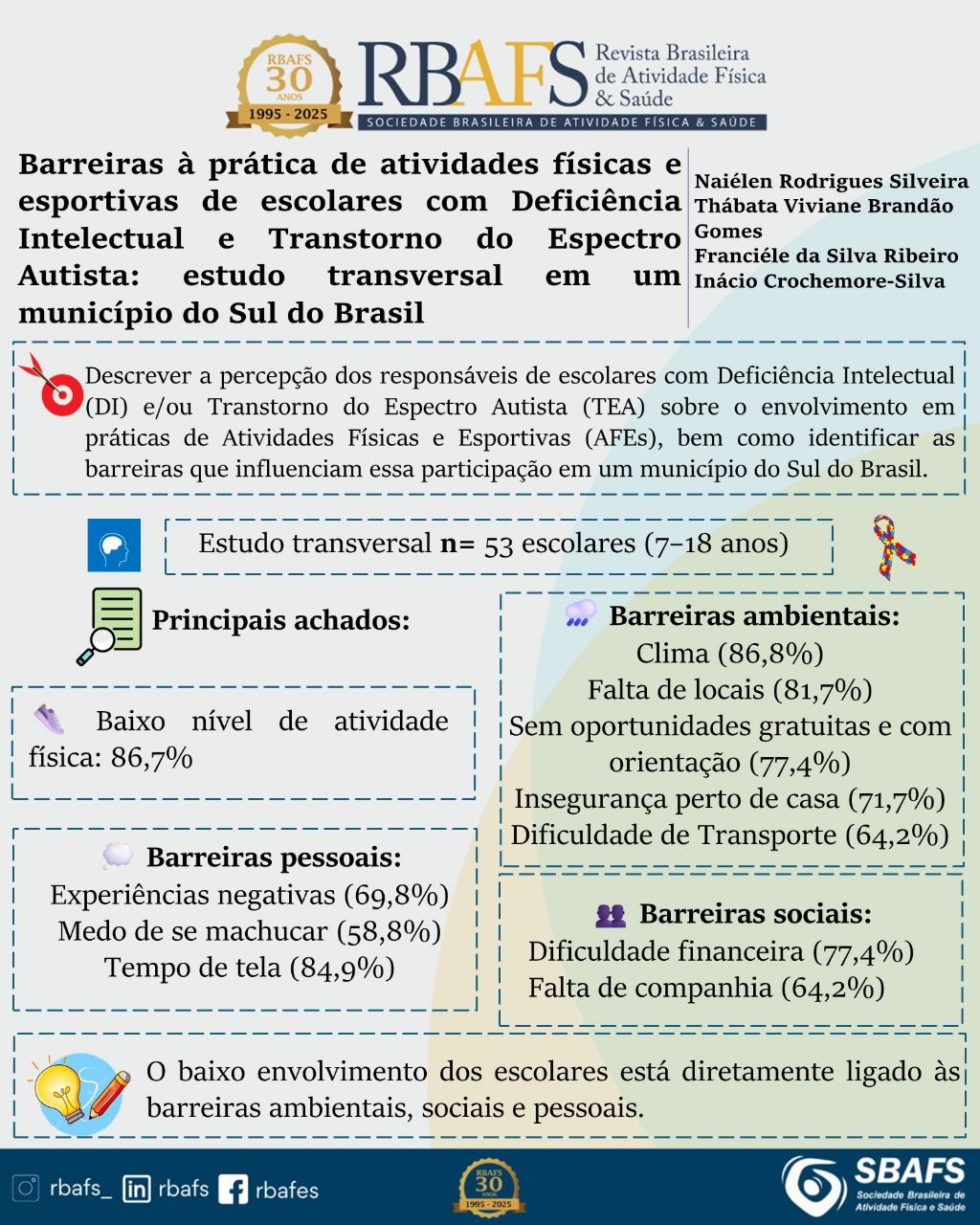
Objective: To describe the perception of caregivers of schoolchildren with Intellectual Disability (ID) and/ or Autism Spectrum Disorder (ASD) regarding their involvement in sports and physical activities, as well as to identify the barriers that influence this participation, in a municipality in Southern Brazil. Methods: This is a descriptive cross-sectional study. Inclusion criteria considered schoolchildren diagnosed with an ID and/or ASD, aged between seven and 18 years, enrolled in regular or special schools in the municipality, totaling a sample of 53 students. Data collection was carried out through a structured questionnaire administered by researchers and answered by the caregivers, either in person at the schools or online via telephone. Results: 86.7% of the schoolchildren presented low levels of physical activity and little engagement in sports and physical activities during leisure time. Among the barriers identified, environmental factors predominated, such as the region’s climate (86.8%), lack of adequate spaces for practice (81.7%), absence of free opportunities with professional guidance (77.4%), lack of safety near their residence (71.7%), and difficulties with transportation (64.2%). Regarding social barriers, financial difficulties (77.4%) and lack of friends to accompany them (64.2%) were highlighted. In terms of personal barriers, fear of injury (58.8%) and negative past experiences (69.8%) stood out. Conclusion: According to the perception of the careggivers, the low engagement of schoolchildren with an ID and/or ASD in sports and physical activities is directly related to the environmental, social, and personal barriers identified in this study.
Downloads
References
1. United Nations. Disability and development report 2024: accelerating the realization of the Sustainable Development Goals [Internet]. 2024. Disponível em: <https://indico.un.org/event/1010238/attachments/20948/59724/DDR%202024%20Full%20report%20-%20Unedited.pdf> [2025, setembro].
2. Instituto Brasileiro de Geografia e Estatística (IBGE). Censo Demográfico 2022: pessoas com deficiência e pessoas diagnosticadas com transtorno do espectro autista: resultados preliminares da amostra / IBGE [Internet]. Rio de Janeiro: IBGE; 2025. Disponível em: https://biblioteca.ibge.gov.br/visualizacao/livros/liv102178.pdf. [2025, set].
3. Instituto Brasileiro de Geografia e Estatística (IBGE). Censo Demográfico 2022: resultados preliminares sobre deficiência no Rio Grande do Sul [Internet]. Rio de Janeiro: IBGE; 2023. Disponível em: https://www.ibge.gov.br. [2025, setembro].
4. American Psychiatric Association. Diagnostic and statistical manual of mental disorders: DSM-5. 5th ed. Arlington: American Psychiatric Publishing; 2013. DOI: https://doi.org/10.1176/appi.books.9780890425596
5. Brasil. Lei nº 13.146, de 6 de julho de 2015. Institui a Lei Brasileira de Inclusão da Pessoa com Deficiência (Estatuto da Pessoa com Deficiência) [Internet]. Brasília, DF; 2015. Disponível em: <https://www.planalto.gov.br/ccivil_03/_ato2015-2018/2015/lei/l13146.htm> [2025, setembro].
6. Frederico JCC, Laplane ALF. Sobre a Participação Social da Pessoa com Deficiência Intelectual. Rev. bras. educ. espec. 2020;26(3):465–80. DOI: https://doi.org/10.1590/1980-54702020v26e0156
7. Programa das Nações Unidas para o Desenvolvimento (PNUD). Relatório de desenvolvimento humano nacional - Movimento é vida: atividades físicas e esportivas para todas as pessoas [Internet]. Brasília: PNUD; 2017. Disponível em: <https://www.undp.org/pt/brazil/publications/movimento-e-vida-atividades-fisicas-e-esportivas-para-todas-pessoas-relatorio-nacional-de-desenvolvimento-humano-do-brasil-2017>. [2025, maio].
8. McGarty AM, Downs SJ, Melville CA, Harris L. A systematic review and meta-analysis of interventions to increase physical activity in children and adolescents with intellectual disabilities. J Intellect Disabil Res. 2018;62(4):312–29. DOI: https://doi.org/10.1111/jir.12467
9. Yang W, Liang X, Sit CHP. Physical activity and mental health in children and adolescents with intellectual disabilities: a meta-analysis using the RE-AIM framework. Int J Behav Nutr Phys Act. 2022;19(1):80. DOI: https://doi.org/10.1186/s12966-022-01312-1
10. Machado CF, Gomes TVB, Ortigas PR, Benda RN. Desempenho motor em crianças e adolescentes com Transtorno do Espectro Autista (TEA): uma revisão integrativa da literatura. Res. Soc. Dev. 2022;11(4):e1011426692. DOI: https://doi.org/10.33448/rsd-v11i4.26692
11. Machado CF, Flôres F, Gomes TVB, Ortigas PR, Cordovil R, Benda RN. Motor Affordances of Children with Autism Spectrum Disorder in Southern Brazil. Phys Occup Ther Pediatr. 2025;1–15. DOI: https://doi.org/10.1080/01942638.2025.2522749
12. Jia M, Zhang J, Pan J, Hu F, Zhu Z. Benefits of exercise for children and adolescents with autism spectrum disorder: a systematic review and meta-analysis. Front Psychiatry. 2024;15:1462601. DOI: https://doi.org/10.3389/fpsyt.2024.1462601
13. Kou R, Li Z, Li M, Zhou R, Zhu F, Ruan W, et al. Comparative effectiveness of physical exercise interventions on sociability and communication in children and adolescents with autism: a systematic review and network meta-analysis. BMC psychology. 2024;12(1):712. DOI: https://doi.org/10.1186/s40359-024-02210-w
14. Xing Y, Wu X. Effects of Motor Skills and Physical Activity Interventions on Motor Development in Children with Autism Spectrum Disorder: A Systematic Review. Healthcare (Basel). 2025;13(5):489. DOI: https://doi.org/10.3390/healthcare13050489
15. Rivera RA, Robertson MC, McCleery JP. Exercise Interventions for Autistic People: An Integrative Review of Evidence from Clinical Trials. Curr Psychiatry Rep. 2025;27(5):286-306. DOI: https://doi.org/10.1007/s11920-025-01597-6
16. Tao R, Yang Y, Wilson M, Chang JR, Liu C, Sit CHP. Comparative effectiveness of physical activity interventions on cognitive functions in children and adolescents with Neurodevelopmental Disorders: a systematic review and network meta-analysis of randomized controlled trials. Int J Behav Nutr Phys Act. 2025;22(1):6. DOI: https://doi.org/10.1186/s12966-024-01702-7
17. Teixeira AM, Susane Graup, Copetti J. Barreiras para a atividade física de escolares com deficiência intelectual na percepção dos pais/responsáveis. Rev. Sapiência. 2022;11(1):136–50. DOI: https://doi.org/10.31668/revsap.v11i1.11585
18. krüger, GR. Atividade física: níveis e barreiras para prática em crianças com autismo de Pelotas [Dissertação de Mestrado]. Pelotas: Universidade Federal de Pelotas, Rio Grande do Sul; 2015.
19. Yuan Y, Wang M, Zhang Q, Zhang Y, Wang X, Hou X, et al. Physical activity levels of children and adolescents with intellectual disabilities in Northern China. J Appl Res Intellect Disabil. 2022;35(3):752-60. DOI: https://doi.org/10.1111/jar.12976
20. Pan CY, Tsai CL, Chu CH, Sung MC, Ma WY, Huang CY. Objectively Measured Physical Activity and Health-Related Physical Fitness in Secondary School-Aged Male Students With Autism Spectrum Disorders. Phys Ther. 2016;96(4):511-20 DOI: https://doi.org/10.2522/ptj.20140353
21. Jacinto M, Vitorino AS, Palmeira D, Antunes R, Matos R, Ferreira JP, et al. Perceived Barriers of Physical Activity Participation in Individuals with Intellectual Disability—A Systematic Review. Healthcare (Basel). 2021;9(11):1521. DOI: https://doi.org/10.3390/healthcare9111521
22. Yu S, Wang T, Zhong T, Qian Y, Qi J. Barriers and Facilitators of Physical Activity Participation among Children and Adolescents with Intellectual Disabilities: A Scoping Review. Healthcare (Basel). 2022;10(2):233. DOI: https://doi.org/10.3390/healthcare10020233
23. Bossink LWM, van der Putten AA, Vlaskamp C. Understanding low levels of physical activity in people with intellectual disabilities: A systematic review to identify barriers and facilitators. Res Dev Disabil. 2017;68:95–110. DOI: https://doi.org/10.1016/j.ridd.2017.06.008
24. McGarty AM, Melville CA. Parental perceptions of facilitators and barriers to physical activity for children with intellectual disabilities: A mixed methods systematic review. Res Dev Disabil. 2018;73:40–57. DOI: https://doi.org/10.1016/j.ridd.2017.12.007
25. Obrusnikova I, Miccinello DL. Parent Perceptions of Factors Influencing After-School Physical Activity of Children with Autism Spectrum Disorders. Adapt Phys Activ Q. 2012;29(1):63–80. DOI: https://doi.org/10.1123/apaq.29.1.63
26. Ministério da Educação (Brasil). Base Nacional Comum Curricular: educação é a base [Internet]. Brasília, DF: MEC; 2017. Disponível em: <http://basenacionalcomum.mec.gov.br>. [2025, julho].
27. World Health Organization. Guidelines on physical activity and sedentary behaviour [Internet]. Geneva: WHO; 2020. Disponível em: <https://www.who.int/publications/i/item/9789240015128>. [2025, julho].
28. Esentürk OK. Parents’ perceptions on physical activity for their children with autism spectrum disorders during the novel Coronavirus outbreak. Int J Dev Disabil. 2020;67(6):446-57. DOI: https://doi.org/10.1080/20473869.2020.1769333
29. Papadopoulos NV, Whelan M, Skouteris H, Williams K, McGinley J, Shih STF, et al. An Examination of Parent-Reported Facilitators and Barriers to Organized Physical Activity Engagement for Youth With Neurodevelopmental Disorders, Physical, and Medical Conditions. Front Psychol. 2020;11:568723. DOI: https://doi.org/10.3389/fpsyg.2020.568723
30. Gregor S, Bruni N, Grkinic P, Schwartz L, McDonald A, Thille P, et al. Parents’ perspectives of physical activity participation among Canadian adolescents with Autism Spectrum Disorder. Res Autism Spectr Disord. 2018;48:53–62. DOI: https://doi.org/10.1016/j.rasd.2018.01.007
31. Leivas, PSL. Percepção dos professores de Educação Física sobre a inclusão de crianças e jovens com transtorno do espectro autista (TEA) no ambiente escolar [Dissertação de Mestrado]. Pelotas: Universidade Federal de Pelotas, Rio Grande do Sul; 2022.
32. Base Nacional Comum Curricular - Educação é a Base [Internet]. Mec.gov.br. 2025. Disponível em: <https://basenacionalcomum.mec.gov.br/abase/>. [2025, junho].
33. HAX, GP. Estilo de Vida de Adolescentes com Transtorno Autista [Dissertação de mestrado]. Pelotas: Universidade Federal de Pelotas, Pelotas, Rio Grande do Sul; 2012.
34. Li Y, Feng Y, Zhong J, Zou Z, Lan W, Shen Y, et al. The Effects of Physical Activity Interventions in Children with Autism Spectrum Disorder: a Systematic Review and Network Meta-analysis. Rev J Autism Dev Disord. 2023. DOI: https://doi.org/10.1007/s40489-023-00418-x
35. Gonçalves WRD, Graup S, Balk RDS, Da Cunha ÁLA, Ilha PV. Barreiras e facilitadores para a prática de atividades físicas em crianças e adolescentes com Transtorno do Espectro Autista de Uruguaiana - RS. Rev. Assoc. Bras. Ativ. Mot. Adapt. 2019;20(1). DOI: https://doi.org/10.36311/2674-8681.2019.v20n1.02.p17
36. Ferreira RW, Varela AR, Monteiro LZ, Häfele CA, Santos SJ, Wendt A, et al. Desigualdades sociodemográficas na prática de atividade física de lazer e deslocamento ativo para a escola em adolescentes: Pesquisa Nacional de Saúde do Escolar (PeNSE 2009, 2012 e 2015). Cad Saúde Pública. 2018;34(4). DOI: https://doi.org/10.1590/0102-311x00037917
37. Knuth AG, Antunes PC. Práticas corporais/atividades físicas demarcadas como privilégio e não escolha: análise à luz das desigualdades brasileiras. Saude soc [Internet]. 2021;30(2):e200363. DOI: https://doi.org/10.1590/s0104-12902021200363
38. Seron BB, Arruda GA, Greguol M. Facilitadores e barreiras percebidas para a prática de atividade física por pessoas com deficiência motora. Rev. Bras. Ciênc. Esporte. 2015;37(3):214–21. DOI: https://doi.org/10.1016/j.rbce.2013.09.003
39. Silva RM. Diagmóstico de opções práticas para pessoas com autismo. Revista Ciência da Sabedoria (RCS–FaCiência). 2021;1(3).
Downloads
Published
How to Cite
Issue
Section
License
Copyright (c) 2025 Naiélen Rodrigues Silveira, Thábata Viviane Brandão Gomes, Franciéle da Silva Ribeiro, Inácio Crochemore-Silva

This work is licensed under a Creative Commons Attribution 4.0 International License.
When submitting a manuscript to the Revista Brasileira de Atividade Física & Saúde, the authors retain the copyright to the article and authorize the Revista Brasileira de Atividade Física & Saúde to publish the manuscript under the Creative Commons Attribution 4.0 License and identify it as the original publication source.