Insufficient physical activity in Brazil: Sex inequities throughout the 21st century
DOI:
https://doi.org/10.12820/rbafs.31e0439Keywords:
Physical activity, Social inequality, Health inequalitiesAbstract
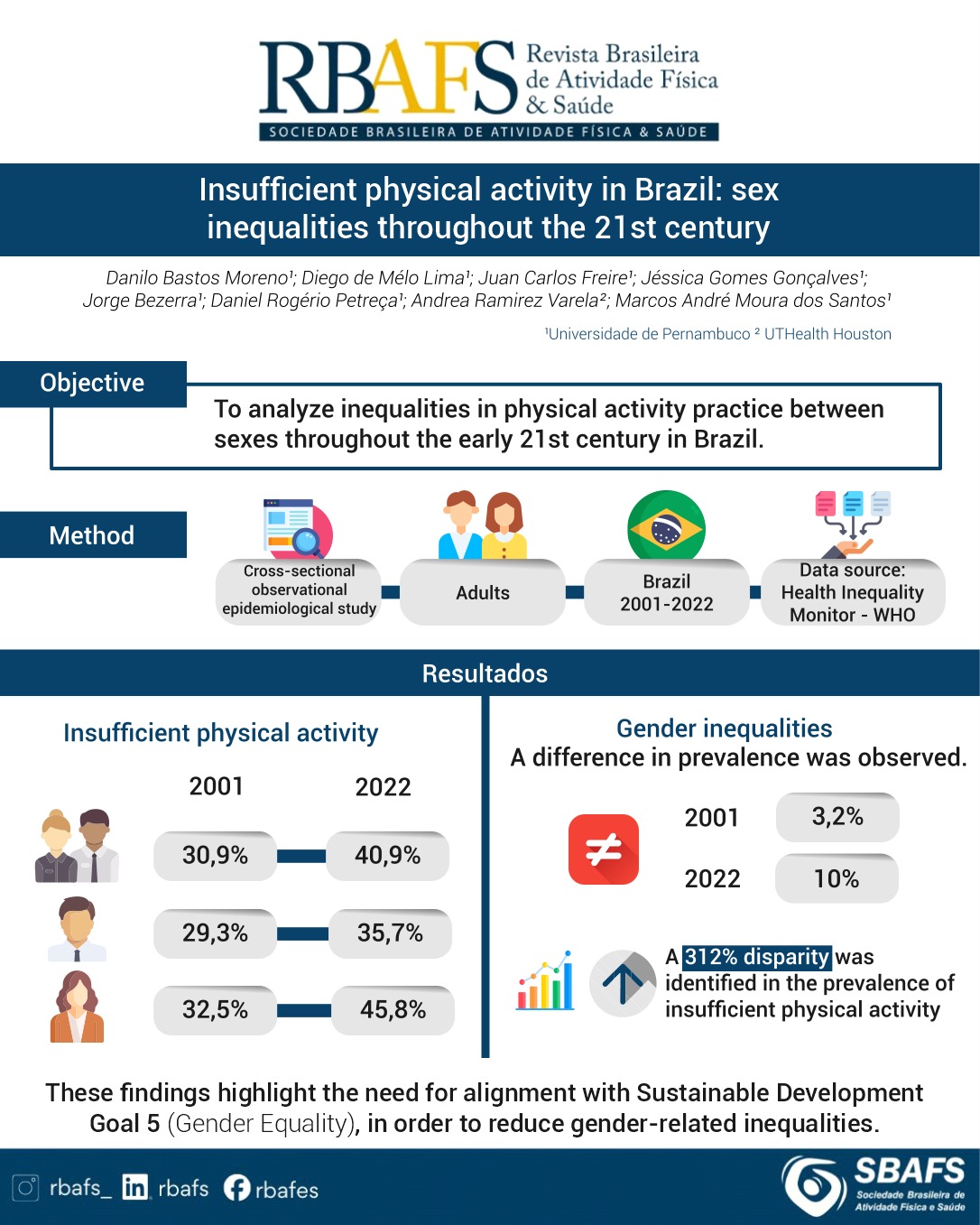
Introduction: Insufficient physical activity is considered a risk factor for the development of noncommunicable chronic diseases. However, this behavior is unequally distributed among population groups, and regional and social disparities have been revealed in Brazil. Objective: To analyze inequalities in physical activity practice between sexes throughout the early 21st century in Brazil. Methods: This is a cross-sectional observational epidemiological study using secondary open-access data from the Health Inequality Data Repository, available in the World Health Organization’s Health Inequality Monitor toolkit. Data from Brazil, ranging from 2001 to 2022, were analyzed. Results: The data indicate that inequalities in physical activity persist, especially among women, with 30.9% of the general population engaging in insufficient physical activity in 2001 (Male - 29.3%; Female - 32.5%) and 40.9% in 2022 (Male - 35.7%; Female - 45.8%) (95% CI: 32.4% to 59.9%). Conclusion: Reducing inequalities in the access to and practice of physical activity requires investment in surveillance and monitoring of disparities, as well as strengthening of intersectoral actions. It is essential that public policies consider the social determinants of health and promote more equitable and active environments.
Downloads
References
1. Murray CJ, Aravkin AY, Zheng P, Abbafati C, Abbas KM, Abbasi-Kangevari M, et al. Global burden of 87 risk factors in 204 countries and territories, 1990–2019: a systematic analysis for the Global Burden of Disease Study 2019. Lancet. 2020;396(10258):1223–49. DOI: https://doi.org/10.1016/S0140-6736(20)30752-2
2. World Health Organization. More active people for a healthier world. Global Action Plan on Physical Activity 2018–2030. Geneva: WHO; 2018. Disponível em: <https://apps.who.int/iris/bitstream/handle/10665/272722/9789241514187-eng.pdf> [2025 abril].
3. World Health Organization. Seventy-first World Health Assembly. Physical activity for health. Geneva: WHO; 2018. Disponível em: <https://apps.who.int/gb/ebwha/pdf_files/WHA71/A71_18-en.pdf> [2025 abril].
4. Brasil. Ministério da Saúde. Secretaria de Atenção Primária à Saúde. Departamento de Promoção da Saúde. Guia de atividade física para a população brasileira [recurso eletrônico]. Brasília: Ministério da Saúde; 2021. 54 p. Disponível em: <http://bvsms.saude.gov.br/bvs/publicacoes/guia_atividade_fisica_populacao_brasileira.pdf > [2025 abril].
5. Guthold R, Stevens GA, Riley LM, Bull FC. Worldwide trends in insufficient physical activity from 2001 to 2016: a pooled analysis of 358 population-based surveys. Lancet Glob Health. 2018;6(10):e1077–86. DOI: https://doi.org/10.1016/S2214-109X(18)30357-7
6. Mielke GI, Hallal PC, Malta DC, Lee IM. Leisure time physical activity among Brazilian adults: National Health Survey 2013 and 2019. Rev Bras Epidemiol. 2021;24(Suppl 2):e210008. DOI: https://doi.org/10.1590/1980-549720210008.supl.2
7. Waters EA, Hawkins E. Awareness of health outcomes associated with insufficient physical activity and associations with physical activity intentions and behavior. J Health Commun. 2018;1–9. DOI: https://doi.org/10.1080/10810730.2018.1500658
8. Crochemore-Silva I, Knuth AG, Wendt A, Hallal PC. Promoção de atividade física e as políticas públicas no combate às desigualdades: reflexões a partir da Lei dos Cuidados Inversos e hipótese da equidade inversa. Cad Saúde Pública. 2020;36(6):e00155119. DOI: https://doi.org/10.1590/0102-311x00155119
9. Strain T, Flaxman S, Guthold R, Semenova E, Cowan M, Riley LM, et al. National, regional, and global trends in insufficient physical activity among adults from 2000 to 2022: A pooled analysis of 507 population-based surveys with 5·7 million participants. Lancet Glob Health. 2024;12(8):e1232–43.
10. González S, Lozano Ó, Ramírez A, Grijalba C. Niveles de actividad física de la población colombiana: desigualdades por sexo y condición socioeconómica. Biomédica. 2014;34(3):447–59. DOI: https://doi.org/10.7705/biomedica.v34i3.2258
11. Yahia N, Wang D, Rapley M, Dey R. Assessment of weight status, dietary habits, physical activity, and nutritional knowledge among university students. Perspect Public Health. 2016;136(4):231–44. DOI: https://doi.org/10.1177/1757913915609945
12. IBGE. Panorama do Censo 2022. Rio de Janeiro: IBGE; 2022. Disponível em: <https://censo2022.ibge.gov.br/panorama/> [2025 abril].
13. Hosseinpoor AR, Bergen N, Schlotheuber A, Grove J, Boerma T. Health Equity Assessment Toolkit Plus (HEAT Plus): software for exploring and comparing health inequalities. Glob Health Action. 2018;11(Suppl 1):20–30. DOI: https://doi.org/10.1080/16549716.2018.1440783
14. Kirkby K, Hosseinpoor AR, Boerma T. Health Equity Assessment Toolkit (HEAT and HEAT Plus): exploring inequalities in the COVID-19 pandemic era. Int J Equity Health. 2022;21(Suppl 3):172. DOI: https://doi.org/10.1186/s12939-022-01765-7
15. World Health Organization. Health Equity Assessment Toolkit (HEAT and HEAT Plus). 2023. Disponível em: <https://www.who.int/data/inequality-monitor/assessment_toolkit> [2025 abril].
16. Matsudo SM, Araújo TL, Matsudo VKR, Andrade DR, Oliveira LC, Braggion G. Nível de atividade física da população do Estado de São Paulo: Análise de acordo com o gênero, idade, nível socioeconômico, distribuição geográfica e de conhecimento. Rev Bras Cien Mov. 2002;10(4):41–50.
17. Figueiredo TKF, Turi-Lynch BC, Barbosa AR, Florindo AA, Parra DC, Rech CR. Changes in total physical activity, leisure and commuting in the largest city in Latin America, 2003–2015. Rev Bras Epidemiol. 2021;24:e210030. DOI: https://doi.org/10.1590/1980-549720210030
18. Bicalho PG, Hallal PC, Gazzinelli A, Knuth AG, Velásquez-Meléndez G. Atividade física e fatores associados em adultos de área rural em Minas Gerais, Brasil. Rev Saúde Pública. 2010;44(5):884-93. DOI: https://doi.org/10.1590/S0034-89102010005000023
19. El Ansari W, Khalil K, Ssewanyana D, Stock C. Physical activity and associated socio-demographic factors among university students in Libya. Cent Eur J Public Health. 2014;22(4):220-7. DOI: https://doi.org/10.21101/cejph.a4011
20. Henkemaier KCM, Hino AAF, Santos GM, Souza IRS, Lorenzi LJ, Ribeiro Junior JF, Gomes GAO, Guerra PH. Estado civil e prática de atividade física em adultos brasileiros: uma revisão sistemática. Rev Interdiscip Prom Saúde. 2024;7(3):35-48. DOI: https://doi.org/10.17058/rips.v7i3.18821
21. Gerovasili V, Agaku IT, Vardavas CI, Filippidis FT. Levels of physical activity among adults 18–64 years old in 28 European countries. Prev Med. 2015;81:87–91. DOI: https://doi.org/10.1016/j.ypmed.2015.08.005
22. Nikitara K, Odani S, Demenagas N, Rachiotis G, Symvoulakis EK, Tzatzarakis MN, et al. Prevalence and correlates of physical inactivity in adults across 28 European countries. Eur J Public Health. 2021;31(4):840–5. DOI: https://doi.org/10.1093/eurpub/ckab067
23. Guthold R, Cowan MJ, Autenrieth CS, Kann L, Riley LM. Physical activity in 22 African countries: results from WHO STEPs. Am J Prev Med. 2011;41(1):52–60. DOI: https://doi.org/10.1016/j.amepre.2011.03.008
24. Lee I-M, Shiroma EJ, Lobelo F, Puska P, Blair SN, Katzmarzyk PT. Effect of physical inactivity on major non-communicable diseases worldwide: an analysis of burden of disease and life expectancy. Lancet. 2012;380(9838):219–29. DOI: https://doi.org/10.1016/S0140-6736(12)61031-9
25. Altmann H, Ayoub E, Garcia EF, Rico ER, Polydoro SAJ. Gênero e cultura corporal de movimento: práticas e percepções de meninas e meninos. Rev Estud Fem. 2018;26(1):e44074. DOI: https://doi.org/10.1590/1806-9584.2018v26n144074
26. Biroli F. Divisão Sexual do Trabalho e Democracia. Dados. 2016;59(3):719–54. DOI: https://doi.org/10.1590/00115258201690
27. Liu W, Dostdar-Rozbahani A, Tadayon-Zadeh F, Akbarpour-Beni M, Pourkiani M, Sadat-Razavi F, Barfi V, Shahedi V. Insufficient level of physical activity and its effect on health costs in low- and middle-income countries. Front Public Health. 2022;10:937196. DOI: https://doi.org/10.3389/fpubh.2022.937196
28. Bull FC, Al-Ansari SS, Biddle S, et al. World Health Organization 2020 guidelines on physical activity and sedentary behaviour. Br J Sports Med. 2020;54:1451–62. DOI: https://doi.org/10.1136/bjsports-2020-102955
29. Mok A, Khaw KT, Luben R, Wareham N, Brage S. Physical activity trajectories and mortality: population based cohort study. BMJ. 2019;365:l2323. DOI: https://doi.org/10.1136/bmj.l2323
30. Hao M, Fang Y, Yan W, Gu J, Hao Y, Wu C. Relationship between body dissatisfaction, insufficient physical activity, and disordered eating behaviors among university students in southern China. BMC Public Health. 2022;22(1):2054. DOI: https://doi.org/10.1186/s12889-022-14515-9
31. Savage MJ, Procter EL, Magistro D, Hennis PJ, Donaldson J, Leslie-Walker A, Jones BA, James RM. Characterising the activity, lifestyle behaviours and health outcomes of UK university students: an observational cohort study with a focus on gender and ethnicity. BMC Public Health. 2024;24(1):3501. DOI: https://doi.org/10.1186/s12889-024-20911-0
32. Malta DC, Silva AG, Lima CM, Morais Neto OL. O SUS e a Política Nacional de Promoção da Saúde: resultados e desafios. Cien Saude Colet. 2018;23(6):1799–809. DOI: https://doi.org/10.1590/1413-81232018236.04782018
33. Carvalho FFB, Guerra PH, Silva DB, Vieira LA. Oferta e participação nas práticas corporais e atividades físicas na atenção primária no Brasil: análise de 2014 a 2022. Cien Saude Colet. 2025;30(1):e09492023. DOI: https://doi.org/10.1590/1413-81232025301.09492023
34. ISPAH – International Society for Physical Activity and Health. Brazil Country Card – 2nd Global Physical Activity Almanac. Global Observatory for Physical Activity – GoPA! 2021. Disponível em: <https://new.globalphysicalactivityobservatory.com/New%20Translation%20of%20country%20cards/Brazil%20trad.pdf> [2025 abril].
Downloads
Published
How to Cite
Issue
Section
License
Copyright (c) 2026 Danilo Bastos Moreno, Diego de Mélo Lima, Juan Carlos Freire, Jéssica Gomes Gonçalves, Jorge Bezerra, Daniel Rogério Petreça, Andrea Ramirez Varela, Marcos André Moura dos Santos

This work is licensed under a Creative Commons Attribution 4.0 International License.
When submitting a manuscript to the Revista Brasileira de Atividade Física & Saúde, the authors retain the copyright to the article and authorize the Revista Brasileira de Atividade Física & Saúde to publish the manuscript under the Creative Commons Attribution 4.0 License and identify it as the original publication source.