Resistance training volume and nutrient intake on lean mass and strength in young women
DOI:
https://doi.org/10.12820/rbafs.30e0419Keywords:
Strength training, Weight lifting, Exercise volume, Muscle growth, Muscle hypertrophy, ProteinAbstract
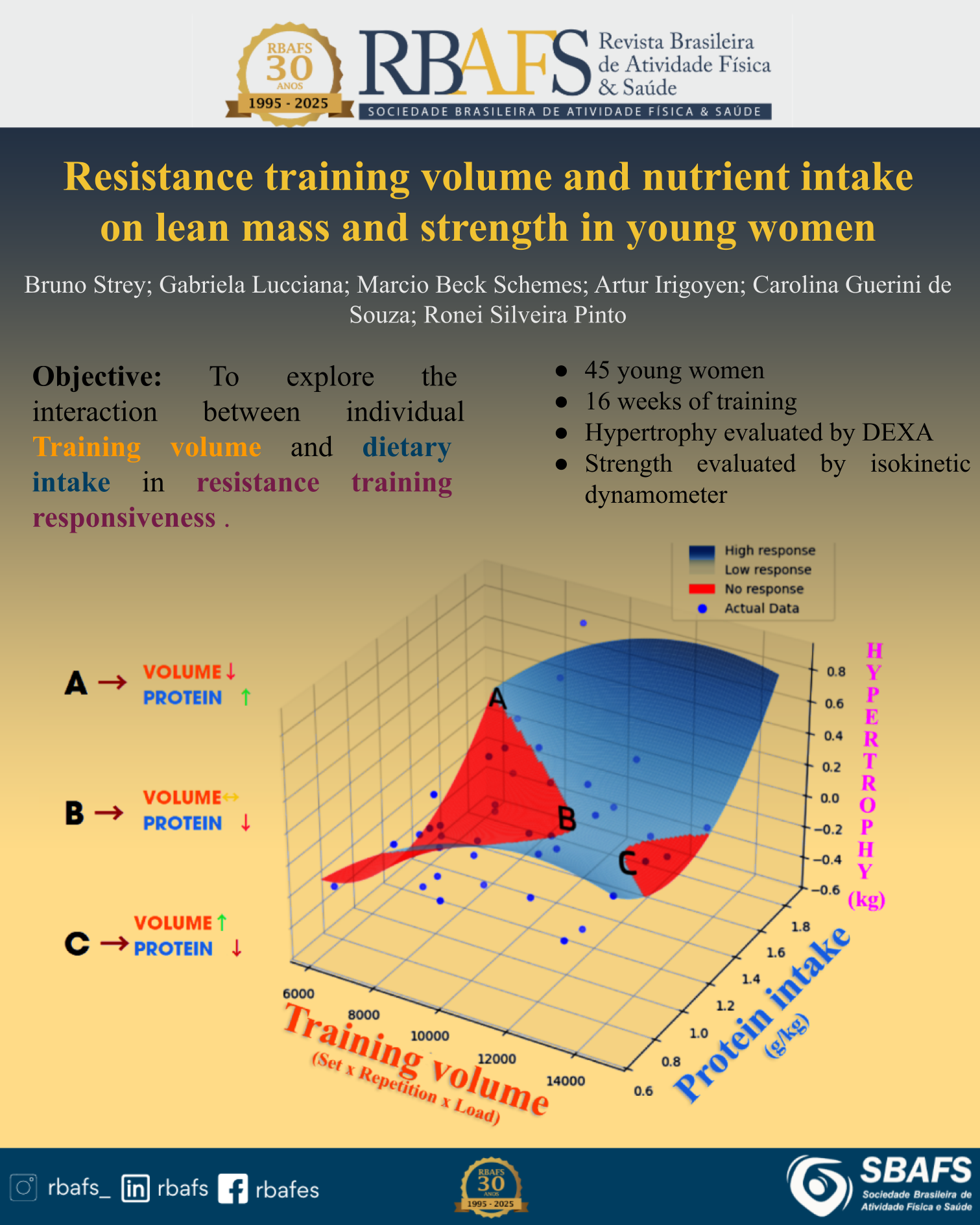
Introduction: Skeletal muscle plays a central role in resistance training adaptations and overall health, with hypertrophy and strength gains influenced by both genetic and external factors, including training volume (VT), protein intake and energy balance. Objective: This study aimed to explore the interplay effect of individual VT and dietary intake on muscle hypertrophy and strength responsiveness from resistance training. Methods: Forty-five untrained women including strict vegetarians (n = 25; 28.7 ± 4.6 years; 162.3 ± 9.3 cm) and non-vegetarians (n = 20; 30.7 ± 6.6 years; 162.7 ± 9.2 cm) performed a 16-week exercise intervention. Macronutrient intake was assessed through dietary record while individual VT was calculated by the sum of each exercise volume load (sets × repetitions × load). Muscular hypertrophy was estimated based on lower limb lean soft tissue (△ LST) measured via DXA, while strength gains were evaluated through maximal knee extension and flexion peak torque (△ SUM PT) at 60º/s using isokinetic dynamometry. The interaction between VT and macronutrient intake with hypertrophy and strength gains was evaluated using multiple polynomial regressions analyses. Results: The interaction between VT and protein intake (g/kg) significantly explained changes in △ LST (p = 0.034; R² = 0.28), while the interaction between VT and energy intake (kcal/kg) significantly explained changes in △ SUM PT (p = 0.031; R² = 0.29). Conclusion: Individual VT appeared to elicit greater effect on muscle hypertrophy when accompanied by protein intake exceeding 1.5 g/kg. High individual VT combined with low energy intake (15–20 kcal/kg) led to strength loss, whereas higher energy intake (35–45 kcal/kg) associated with greater VT supported more pronounced strength gains.
Downloads
References
1. Karstoft K, Pedersen BK. Skeletal muscle as a gene regulatory endocrine organ. Curr Opin Clin Nutr Metab Care. 2016;19:270–5. DOI: https://doi.org/10.1097/MCO.0000000000000283
2. Thomas ACQ, Brown A, Hatt AA, Manta K, Costa‐Parke A, Kamal M, et al. Short‐term aerobic conditioning prior to resistance training augments muscle hypertrophy and satellite cell content in healthy young men and women. FASEB J. 2022;36:e22500. DOI: https://doi.org/10.1096/fj.202200398RR
3. Damas F, Phillips S, Vechin FC, Ugrinowitsch C. A Review of Resistance Training-Induced Changes in Skeletal Muscle Protein Synthesis and Their Contribution to Hypertrophy. Sports Med. 2015;45:801–7. DOI: https://doi.org/10.1007/s40279-015-0320-0
4. Hingst JR, Bruhn L, Hansen MB, Rosschou MF, Birk JB, Fentz J, et al. Exercise-induced molecular mechanisms promoting glycogen supercompensation in human skeletal muscle. Mol Metab. 2018;16:24–34. DOI: https://doi.org/10.1016/j.molmet.2018.07.001
5. MacDougall JD, Ward GR, Sale DG, Sutton JR. Biochemical adaptation of human skeletal muscle to heavy resistance training and immobilization. J Appl Physiol. 1977;43:700–3. DOI: https://doi.org/10.1152/jappl.1977.43.4.700
6. Roberts MD, McCarthy JJ, Hornberger TA, Phillips SM, Mackey AL, Nader GA, et al. Mechanisms of mechanical overload-induced skeletal muscle hypertrophy: current understanding and future directions. Physiol Rev. 2023;103:2679–757. DOI: https://doi.org/10.1152/physrev.00039.2022
7. Pearcey GEP, Alizedah S, Power KE, Button DC. Chronic resistance training: is it time to rethink the time course of neural contributions to strength gain? Eur J Appl Physiol. 2021;121:2413–22. DOI: https://doi.org/10.1007/s00421-021-04730-4
8. Kraemer WJ, Looney DP. Underlying Mechanisms and Physiology of Muscular Power. Strength Cond J. 2012;34:13–9. d DOI: https://doi.org/10.1519/SSC.0b013e318270616d
9. Bamman MM, Petrella JK, Kim J, Mayhew DL, Cross JM. Cluster analysis tests the importance of myogenic gene expression during myofiber hypertrophy in humans. J Appl Physiol. 2007;102:2232–9. DOI: https://doi.org/10.1152/japplphysiol.00024.2007
10. Roberts MD, Haun CT, Mobley CB, Mumford PW, Romero MA, Roberson PA, et al. Physiological Differences Between Low Versus High Skeletal Muscle Hypertrophic Responders to Resistance Exercise Training: Current Perspectives and Future Research Directions. Front Physiol. 2018;9:834. DOI: https://doi.org/10.3389/fphys.2018.00834
11. Schoenfeld B, Fisher J, Grgic J, Haun C, Helms E, Phillips S, et al. Resistance training recommendations to maximize muscle hypertrophy in an athletic population: Position stand of the IUSCA. Int J Strength Cond. 2021;1. DOI: https://doi.org/10.47206/ijsc.v1i1.81
12. Currier BS, Mcleod JC, Banfield L, Beyene J, Welton NJ, D’Souza AC, et al. Resistance training prescription for muscle strength and hypertrophy in healthy adults: a systematic review and Bayesian network meta-analysis. Br J Sports Med. England. 2023;57:1211–20. DOI: https://doi.org/10.1136/bjsports-2023-106807
13. Schoenfeld BJ, Ogborn D, Krieger JW. Dose-response relationship between weekly resistance training volume and increases in muscle mass: A systematic review and meta-analysis. J Sports Sci. Taylor & Francis. 2017;35:1073–82. DOI: https://doi.org/10.1080/02640414.2016.1210197
14. Schoenfeld BJ, Grgic J, Ogborn D, Krieger JW. Strength and Hypertrophy Adaptations Between Low- vs. High-Load Resistance Training: A Systematic Review and Meta-analysis. J Strength Cond Res. 2017;31:3508–23. DOI: https://doi.org/10.1519/JSC.0000000000002200
15. Comfort P, Haff GG, Suchomel TJ, Soriano MA, Pierce KC, Hornsby WG, et al. National Strength and Conditioning Association Position Statement on Weightlifting for Sports Performance. J Strength Cond Res. 2023;37:1163–90. DOI: https://doi.org/10.1519/JSC.0000000000004476
16. Tagawa R, Watanabe D, Ito K, Ueda K, Nakayama K, Sanbongi C, et al. Dose–response relationship between protein intake and muscle mass increase: a systematic review and meta-analysis of randomized controlled trials. Nutr Rev. 2021;79:66–75. DOI: https://doi.org/10.1093/nutrit/nuaa104
17. Nunes EA, Colenso‐Semple L, McKellar SR, Yau T, Ali MU, Fitzpatrick‐Lewis D, et al. Systematic review and meta‐analysis of protein intake to support muscle mass and function in healthy adults. J Cachexia Sarcopenia Muscle. 2022;13:795–810. DOI: https://doi.org/10.1002/jcsm.12922
18. tagawa r, watanabe d, ito k, otsuyama t, nakayama k, sanbongi c, et al. synergistic effect of increased total protein intake and strength training on muscle strength: a dose-response meta-analysis of randomized controlled trials. sports med - open. 2022;8:110. DOI: https://doi.org/10.1186/s40798-022-00508-w
19. Murphy C, Koehler K. Energy deficiency impairs resistance training gains in lean mass but not strength: A meta‐analysis and meta‐regression. Scand J Med Sci Sports. 2022;32:125–37. DOI: https://doi.org/10.1111/sms.14075
20. Lixandrão ME, Bamman M, Vechin FC, Conceicao MS, Telles G, Longobardi I, et al. Higher resistance training volume offsets muscle hypertrophy nonresponsiveness in older individuals. J Appl Physiol. 2024;136:421–9. DOI: https://doi.org/10.1152/japplphysiol.00670.2023
21. Nunes JP, Pina FLC, Ribeiro AS, Cunha PM, Kassiano W, Costa BDV, et al. Responsiveness to muscle mass gain following 12 and 24 weeks of resistance training in older women. Aging Clin Exp Res. 2021;33:1071–8. DOI: https://doi.org/10.1007/s40520-020-01587-z
22. Schemes MB, Bach SDA, Machado CLF, Neske RR, Schneider CD, Pinto RS. Relationship Between Dual-Energy X-Ray Absorptiometry, Ultrasonography, and Anthropometry Methods to Estimate Muscle Mass and Muscle Quality in Older Adults. J Aging Phys Act. 2023;31:68–74. DOI: https://doi.org/10.1123/japa.2021-0460
23. Veeck F, Lopez P, Grazioli R, Machado CLF, Wilhelm EN, Cadore EL, et al. dissociation between fatigued power output and traditional peak torque for isokinetic hamstring:quadriceps ratios in professional soccer players. sport sci health. 2022;18:967–73. DOI: https://doi.org/10.1007/s11332-021-00881-1
24. Schoenfeld B, Grgic J. Evidence-Based Guidelines for Resistance Training Volume to Maximize Muscle Hypertrophy. Strength Cond J. 2018;40. DOI: https://doi.org/10.1519/SSC.0000000000000363
25. Bailey RL. Overview of dietary assessment methods for measuring intakes of foods, beverages, and dietary supplements in research studies. Curr Opin Biotechnol. 2021;70:91–6. DOI: https://doi.org/10.1016/j.copbio.2021.02.007
26. Brysbaert M. How Many Participants Do We Have to Include in Properly Powered Experiments? A Tutorial of Power Analysis with Reference Tables. J Cogn. 2019;2:16. DOI: https://doi.org/10.5334/joc.72
27. Neter J, Wassermann W, Kutner MH. Applied linear regression models. Homewood, Ill: Irwin; 1983.
28. Hopkins WG. Measures of Reliability in Sports Medicine and Science: Sports Med. 2000;30:1–15. d DOI: https://doi.org/10.2165/00007256-200030010-00001
29. Koo TK, Li MY. A Guideline of Selecting and Reporting Intraclass Correlation Coefficients for Reliability Research. J Chiropr Med. 2016;15:155–63. DOI: https://doi.org/10.1016/j.jcm.2016.02.012
30. Ugurlu D, Gülü M, Yapici H, Yagin FH, Comertpay E, Eroglu O, et al. Dose-response effects of 8-week resistance training on body composition and muscular performance in untrained young women: A quasi-experimental design. Medicine (Baltimore). 2024;103:e40322. DOI: https://doi.org/10.1097/MD.0000000000040322
31. Weiler M, Hertzler SR, Dvoretskiy S. Is It Time to Reconsider the U.S. Recommendations for Dietary Protein and Amino Acid Intake? Nutrients. 2023;15:838. DOI: https://doi.org/10.3390/nu15040838
32. Schoenfeld BJ, Contreras B, Krieger J, Grgic J, Delcastillo K, Belliard R, et al. Resistance Training Volume Enhances Muscle Hypertrophy but Not Strength in Trained Men. Med Sci Sports Exerc. 2019;51:94–103. DOI: https://doi.org/10.1249/MSS.0000000000001764
33. Vieira AF, Umpierre D, Teodoro JL, Lisboa SC, Baroni BM, Izquierdo M, et al. Effects of Resistance Training Performed to Failure or Not to Failure on Muscle Strength, Hypertrophy, and Power Output: A Systematic Review With Meta-Analysis. J Strength Cond Res. 2021;35:1165–75. DOI: https://doi.org/10.1519/JSC.0000000000003936
34. Grgic J, Schoenfeld BJ, Orazem J, Sabol F. Effects of resistance training performed to repetition failure or non-failure on muscular strength and hypertrophy: A systematic review and meta-analysis. J Sport Health Sci. 2022;11:202–11. DOI: https://doi.org/10.1016/j.jshs.2021.01.007
35. Nakamura Y, Walker BR, Ikuta T. Systematic review and meta-analysis reveals acutely elevated plasma cortisol following fasting but not less severe calorie restriction. Stress. 2016;19:151–7. DOI: https://doi.org/10.3109/10253890.2015.1121984
36. Racette SB, Rochon J, Uhrich ML, Villareal DT, Das SK, Fontana L, et al. Effects of Two Years of Calorie Restriction on Aerobic Capacity and Muscle Strength. Med Sci Sports Exerc. 2017;49:2240–9. DOI: https://doi.org/10.1249/MSS.0000000000001353
37. Nicklas BJ, Chmelo E, Delbono O, Carr JJ, Lyles MF, Marsh AP. Effects of resistance training with and without caloric restriction on physical function and mobility in overweight and obese older adults: a randomized controlled trial. Am J Clin Nutr. 2015;101:991–9. DOI: https://doi.org/10.3945/ajcn.114.105270
38. Marx JO, Ratamess NA, Nindl BC, Gotshalk LA, Volek JS, Dohi K, et al. Low-volume circuit versus high-volume periodized resistance training in women: Med Sci Sports Exerc. 2001;33:635–43. DOI: https://doi.org/10.1097/00005768-200104000-00019
39. Gupta A, Stead TS, Ganti L. Determining a Meaningful R-squared Value in Clinical Medicine. Acad Med Surg. 2024. DOI: https://doi.org/10.62186/001c.125154
40. Morán-Navarro R, Pérez CE, Mora-Rodríguez R, de la Cruz-Sánchez E, González-Badillo JJ, Sánchez-Medina L, et al. Time course of recovery following resistance training leading or not to failure. Eur J Appl Physiol. Springer; 2017;117:2387–99. DOI: https://doi.org/10.1007/s00421-017-3725-7
41. Damas F, Phillips SM, Libardi CA, Vechin FC, Lixandrão ME, Jannig PR, et al. Resistance training‐induced changes in integrated myofibrillar protein synthesis are related to hypertrophy only after attenuation of muscle damage. J Physiol. 2016;594:5209–22. DOI: https://doi.org/10.1113/JP272472
42. Pareja-Blanco F, Rodríguez-Rosell D, Aagaard P, Sánchez-Medina L, Ribas-Serna J, Mora-Custodio R, et al. Time Course of Recovery From Resistance Exercise With Different Set Configurations. J Strength Cond Res. 2020;34:2867–76. DOI: https://doi.org/10.1519/JSC.0000000000002756
Downloads
Published
How to Cite
Issue
Section
License
Copyright (c) 2025 Bruno Marques Strey, Gabriela Lucianna Martini, Marcio Beck Schemes, Artur Irigoyen, Carolina Guerini de Souza, Ronei Silveira Pinto

This work is licensed under a Creative Commons Attribution 4.0 International License.
When submitting a manuscript to the Revista Brasileira de Atividade Física & Saúde, the authors retain the copyright to the article and authorize the Revista Brasileira de Atividade Física & Saúde to publish the manuscript under the Creative Commons Attribution 4.0 License and identify it as the original publication source.