Public transport and walking in commuting in São Paulo during the COVID-19 pandemic
DOI:
https://doi.org/10.12820/rbafs.30e0412Keywords:
Urban mobility, Walking, Physical activity, CommutingAbstract
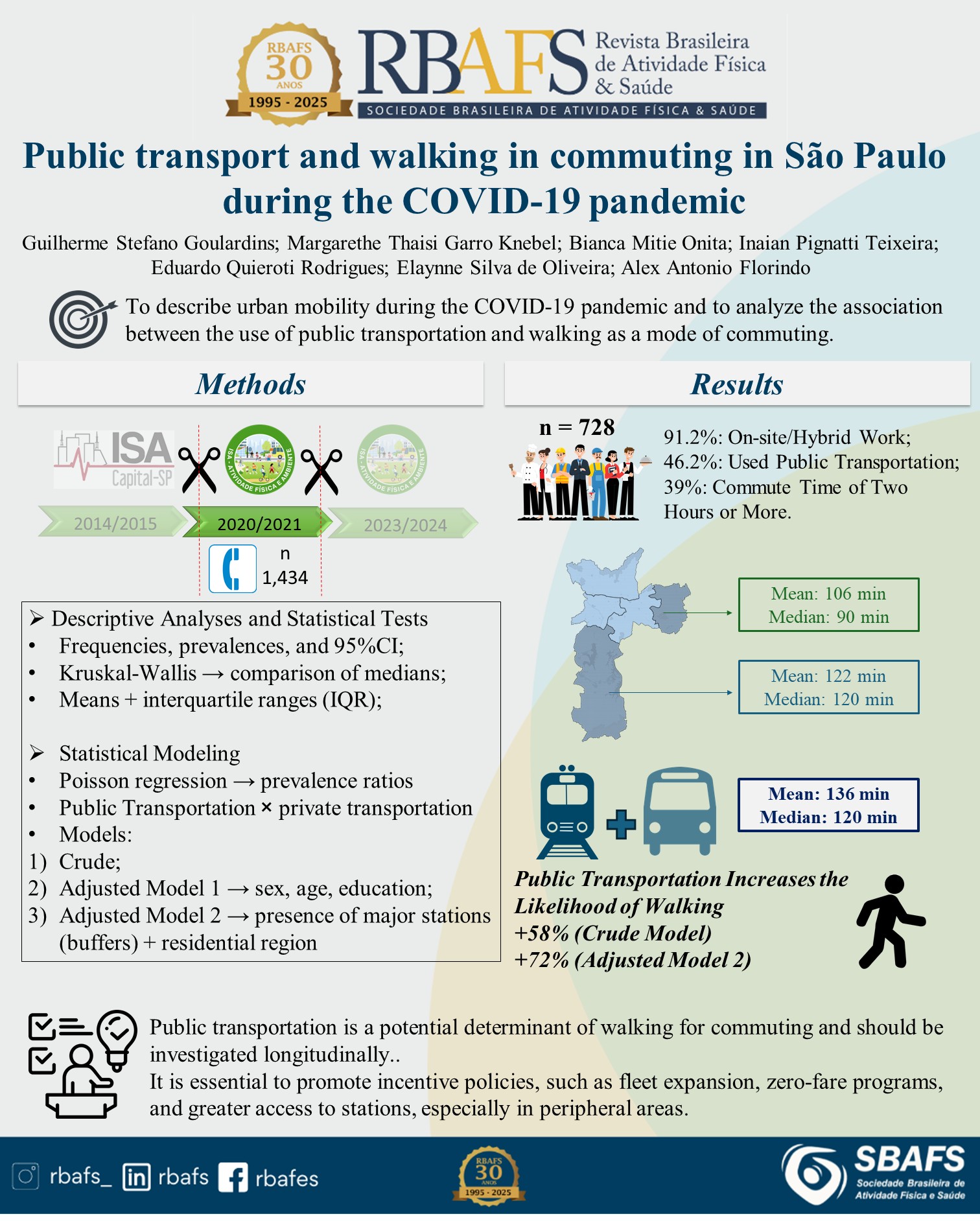
Objective: Describe urban mobility during the COVID-19 pandemic among adults in São Paulo and to analyze the association between the use of public transportation and walking as a mode of commuting. Methods: The study was conducted in São Paulo, Brazil. This is a cross-sectional study using data from the second wave of the Health Survey (ISA) on Physical Activity and Environment, collected through telephone interviews between October 2020 and February 2021, with 1,434 adults. Urban mobility for work was assessed through questions regarding exposure to the home office model, commuting time to wo rk, and the primary mode of transportation used. Walking as a mode of commuting was measured using the long version of the International Physical Activity Questionnaire. Descriptive statistics and Poisson regression were performed to examine the association between the use of public transportation and walking. The models were adjusted for sex, age, education level, presence of public transportation stations, and residential region according to the health coordination department. Results: The main findings indicate that, among workers interviewed during the COVID-19 pandemic, the majority worked in-person and primarily used public transportation for commuting. Furthermore, a statistically significant association was found between being a public transportation user and walking as a mode of commuting, both in the crude and adjusted models. Conclusion: During the COVID-19 pandemic, the use of public transportation was associated with walking for commuting among adults.
Downloads
References
1. Brasil. Ministério das Cidades. Política Nacional de Mobilidade Urbana Sustentável. Brasília, v. 6, p. 13, [s.n.], 2004.
2. Galindo EP, Lima Neto VC. Mobilidade Urbana e Desenvolvimento Econômico: Uma Análise para o Brasil. Texto para Discussão (TD). Brasília: IPEA; 2011. Documento nº 2468. Disponível em: <https://portalantigo.ipea.gov.br/agencia/images/stories/PDFs/TDs/td_2468.pdf> [2024 setembro].
3. Rede Nossa São Paulo (São Paulo). Viver em São Paulo: Mobilidade Urbana. São Paulo: Ibope Inteligência, 2020. 60 p.
4. Pereira RH, Schwanen T. Mobilidade Urbana e Desenvolvimento Econômico: Uma Análise para o Brasil. Texto para Discussão (TD). Brasília: IPEA; 2011. Documento nº 1813. ISSN 1415-4765. CDD 330.908. Disponível em: <https://repositorio.ipea.gov.br/bitstream/11058/958/1/TD_1813.pdf> [2024 setembro].
5. Pereira RH, Banister D, Schwanen T, Wessel N. Distributional effects of transport policies on inequalities in access to opportunities in Rio de Janeiro. J Transp Land Use. 2019;12(1):741-64. DOI: https://doi.org/10.5198/jtlu.2019.1523
6. Guerra PH, Carvalho FF, Oliveira RB, Souza HAS, Loch MR. Free-fare policy and physical activity promotion: itinerary and initial reflections [Internet]. SciELO Preprints; 2024.
7. Forouzanfar MH, Alexander L, Anderson HR, Bachman VF, Biryukov S, Brauer M, et al. Global, regional, and national comparative risk assessment of 79 behavioural, environmental and occupational, and metabolic risks or clusters of risks in 188 countries, 1990-2013: a systematic analysis for the Global Burden of Disease Study 2013. Lancet. 2015;386(10010):2287-323. DOI: https://doi.org/10.1016/S0140-6736(15)00128-2
8. Giles-Corti B, Moudon AV, Lowe M, Adlakha D, Cerin E, Boeing G, et al. Creating healthy and sustainable cities: what gets measured, gets done. Lancet Glob Health. 2022;10(6). DOI: https://doi.org/10.1016/S2214-109X(22)00070-5
9. Aparicio J.T., Arsenio E., Henriques R. Assessing robustness in multimodal transportation systems: a case study in Lisbon. Eur Transp Res Rev. 2022;14:28. DOI: https://doi.org/10.1186/s12544-022-00552-3
10. Kåresdotter E, Page J, Mörtberg U, Näsström H, Kalantari Z. First Mile/Last Mile Problems in Smart and Sustainable Cities: A Case Study in Stockholm County. J Urban Technol. 2022;29(2):115-37. DOI: https://doi.org/10.1080/10630732.2022.2033949
11. Tribby CP, Graubard BI, Berrigan D. National and metropolitan trends in public transit use, transit-related walking, and ridesharing between 2009 and 2017. J Transport Health. 2020;19:100918. DOI: https://doi.org/10.1016/j.jth.2020.100918
12. Florindo AA, Barbosa JPAS, Barrozo LV, Andrade DR, Aguiar BS, Failla MA, et al. Walking for transportation and built environment in Sao Paulo city, Brazil. J Transport Health. 2019;15:100611. DOI: https://doi.org/10.1016/j.jth.2019.100611
13. Stanesby O, Morse M, Magill L, Ball K, Blizzard L, Harpur S, et al. Characteristics associated with willingness to walk further than necessary to the bus stop: Insights for public transport-related physical activity. J Transp Health. 2021;22:1-12. DOI: https://doi.org/10.1016/j.jth.2021.101139
14. Onita BM, Pereira JL, Mielke GI, Barbosa JPAS, Fisberg RM, Florindo AA. Obesity sociodemographic and behavioral factors: a longitudinal study. Cad Saude Publica. 2024;40(7). DOI: https://doi.org/10.1590/0102-311xpt103623
15. Murtagh EM, Nichols L, Mohammed MA, Holder R, Nevill AM, Murphy MH. The effect of walking on risk factors for cardiovascular disease: An updated systematic review and meta-analysis of randomised control trials. Prev Med. 2015;72:34-43. DOI: https://doi.org/10.1016/j.ypmed.2014.12.041
16. Lund H. Pedestrian environments and sense of community. J Plan Educ Res. 2002;21(3):301-12. DOI: https://doi.org/10.1177/0739456X0202100307
17. Salvo D, Jáuregui A, Adlakha D, Sarmiento OL, Reis RS. When Moving Is the Only Option: The Role of Necessity Versus Choice for Understanding and Promoting Physical Activity in Low- and Middle-Income Countries. Rev Public Health. 2024;44:35. DOI: https://doi.org/10.1146/annurev-publhealth-071321-042211
18. Organização Mundial da Saúde. Coronavirus disease (COVID-19) pandemic [Internet]. 2020 Disponível em: <https://www.who.int/emergencies/diseases/novel-coronavirus-2019?gclid=Cj0KCQjwoaz3BRDnARIsAF1RfLea_yldouE0XT5oLaBMrQSksDtPx__H862JHXnBmf8jk1HGHi8G9yAaAvu9EALw_wcB> [2024 novembro].
19. Li X, Farrukh M, Lee C, Khreis H, Sarda S, Sohrabi S, et al. COVID-19 impacts on mobility, environment, and health of active transportation users. Cities. 2022;131:103886. DOI: https://doi.org/10.1016/j.cities.2022.103886
20. Evans JT, Stanesby O, Blizzard L, Jose K, Sharman MJ, Ball K, et al. Trips4health: a single-blinded randomised controlled trial incentivising adult public transport use for physical activity gain. Int J Behav Nutr Phys Act. 2023;20(1). DOI: https://doi.org/10.1186/s12966-023-01500-7
21. Obuchi SP, Kawai H, Ejiri M, Ito K, Murakawa K. Change in outdoor walking behavior during the coronavirus disease pandemic in Japan: A longitudinal study. Gait Posture. 2021;88:42-6. DOI: https://doi.org/10.1016/j.gaitpost.2021.05.005
22. Gallè F, Sabella EA, Ferracuti S, De Giglio O, Caggiano G, Protano C, et al. Sedentary behaviors and physical activity of Italian undergraduate students during lockdown at the time of COVID-19 pandemic. Int J Environ Res Public Health. 2020;17(17):6171. DOI: https://doi.org/10.3390/ijerph17176171
23. Instituto Brasileiro de Geografia e Estatística (IBGE). São Paulo [Internet]. 2024. Disponível em: <https://cidades.ibge.gov.br/brasil/sp/sao-paulo/panorama> [2024 agosto].
24. Companhia do Metropolitano de São Paulo. Relatório-Síntese OD 2023. São Paulo: Metrô SP; 2025.
25. Florindo AA, Teixeira IP, Barrozo LV, Sarti FM, Fisberg RM, Andrade DR, Garcia LMT. Study protocol: health survey of Sao Paulo: ISA-Physical Activity and Environment. BMC Public Health. 2021;21(1):283. DOI: https://doi.org/10.1186/s12889-021-10262-5
26. Hallal PC, Simoes EJ, Reichert FF, Azevedo MR, Ramos LR, Pratt M, et al. Validity and reliability of the telephone-administered International Physical Activity Questionnaire in Brazil. J Phys Act Health. 2010;7(3):402-9. DOI: https://doi.org/10.1123/jpah.7.3.402
27. Fontanelli MDM, Sales CH, Castro MAD, Fisberg RM. Healthful grain foods consumption by São Paulo residents: A 12-year analysis and future trends. Public Health Nutrition. 2021;24(10):2987–97. DOI: https://doi.org/10.1017/S1368980020001342
28. Teixeira IP, Barbosa JPAS, Barrozo LV, Hino AAF, Nakamura PM, Andrade DR, et al. Built environments for physical activity: a longitudinal descriptive analysis of Sao Paulo city, Brazil. Cities Health. 2022;7(1):137-47. DOI: https://doi.org/10.1080/23748834.2022.2127173
29. Sugiyama T, Kubota A, Sugiyama M, Cole R, Owen N. Distances walked to and from local destinations: Age-related variations and implications for determining buffer sizes. J Transport Health. 2019;15:100621. DOI: https://doi.org/10.1016/j.jth.2019.100621
30. Hallal PC, Sardinha LMV, Wehrmeister FC, Paula PCB, Vital Strategies Brasil. Inquérito telefônico de fatores de risco para doenças crônicas em tempos de pandemia - Covitel: relatório final. São Paulo: Vital Strategies; 2022. DOI: https://doi.org/10.1590/0102-311xpt248922
31. Santos MN, Meira CAR, Conde WL, Rinaldi AEM. Duração do trabalho remoto e diagnóstico positivo de COVID-19: análises dos dados da PNAD COVID19. Ciênc saúde coletiva. 2023;28(9):2601-12. DOI: https://doi.org/10.1590/1413-81232023289.15162022
32. Roberts JD, Dickinson KL, Koebele E, Neuberger L, Banacos N, Blanch-Hartigan D, et al. Clinicians, cooks, and cashiers: Examining health equity and the COVID-19 risks to essential workers. Toxicol Ind Health. 2020;36(9):689-702. DOI: https://doi.org/10.1177/0748233720970439
33. Teixeira JF, Silva C, Moura e Sá F. The role of bike sharing during the coronavirus pandemic: An analysis of the mobility patterns and perceptions of Lisbon’s GIRA users. Transp Res Part A Policy Pract. 2022;159:17-34. DOI: https://doi.org/10.1016/j.tra.2022.03.018
34. Instituto Cidades Sustentáveis. Mapa das desigualdades São Paulo, 2022. Disponível em: <https://institutocidadessustentaveis.shinyapps.io/mapadesigualdadesaopaulo/> [cited 2024 Oct]
35. Instituto de Pesquisa Econômica Aplicada (IPEA). Mapa de Acesso a Oportunidades. 2024. Disponível em: <https://www.ipea.gov.br/acessooportunidades/mapa/> [2024 agosto].
36. van Soest D, Tight MR, Rogers CDF. Exploring the distances people walk to access public transport. Transp Rev. 2020;40(2):160-82. DOI: https://doi.org/10.1080/01441647.2019.1575491
37. Hussin H, Osama A, El-Dorghamy A, Abdellatif MM. Towards an integrated mobility system: The first and last mile solutions in developing countries; the case study of New Cairo. Transp Res Interdiscip Perspect. 2021;12:100469. DOI: https://doi.org/10.1016/j.trip.2021.100469
38. Varela AR, Hallal PC. Does every move really count towards better health? Lancet Glob Health. 2024;12(8). DOI: https://doi.org/10.1016/S2214-109X(24)00173-6
39. Luo Q, Liu W, Liao J, Gu Z, Fan X, Luo Z, et al. COVID-19 transmission and control in land public transport: A literature review. Fundam Res. 2023;4(3):417-29. DOI: https://doi.org/10.1016/j.fmre.2023.10.013
40. Florindo AA, Goulardins GS, Andrade DR, Knebel MTG. Em defesa da caminhada e do uso de bicicleta como deslocamento no Brasil. Cad Saúde Pública. 2025;41(2). DOI: https://doi.org/10.1590/0102-311xpt099324
Downloads
Published
How to Cite
Issue
Section
License
Copyright (c) 2025 Guilherme Stefano Goulardins, Margarethe Thaisi Garro Knebel, Bianca Mitie Onita, Inaian Pignatti Teixeira, Eduardo Quieroti Rodrigues, Elaynne Silva de Oliveira, Alex Antonio Florindo

This work is licensed under a Creative Commons Attribution 4.0 International License.
When submitting a manuscript to the Revista Brasileira de Atividade Física & Saúde, the authors retain the copyright to the article and authorize the Revista Brasileira de Atividade Física & Saúde to publish the manuscript under the Creative Commons Attribution 4.0 License and identify it as the original publication source.