Effects of Walking Football on the physical health of men and women over 50 years old
DOI:
https://doi.org/10.12820/rbafs.30e0421Keywords:
Older adults, Aging, Sports, HealthAbstract
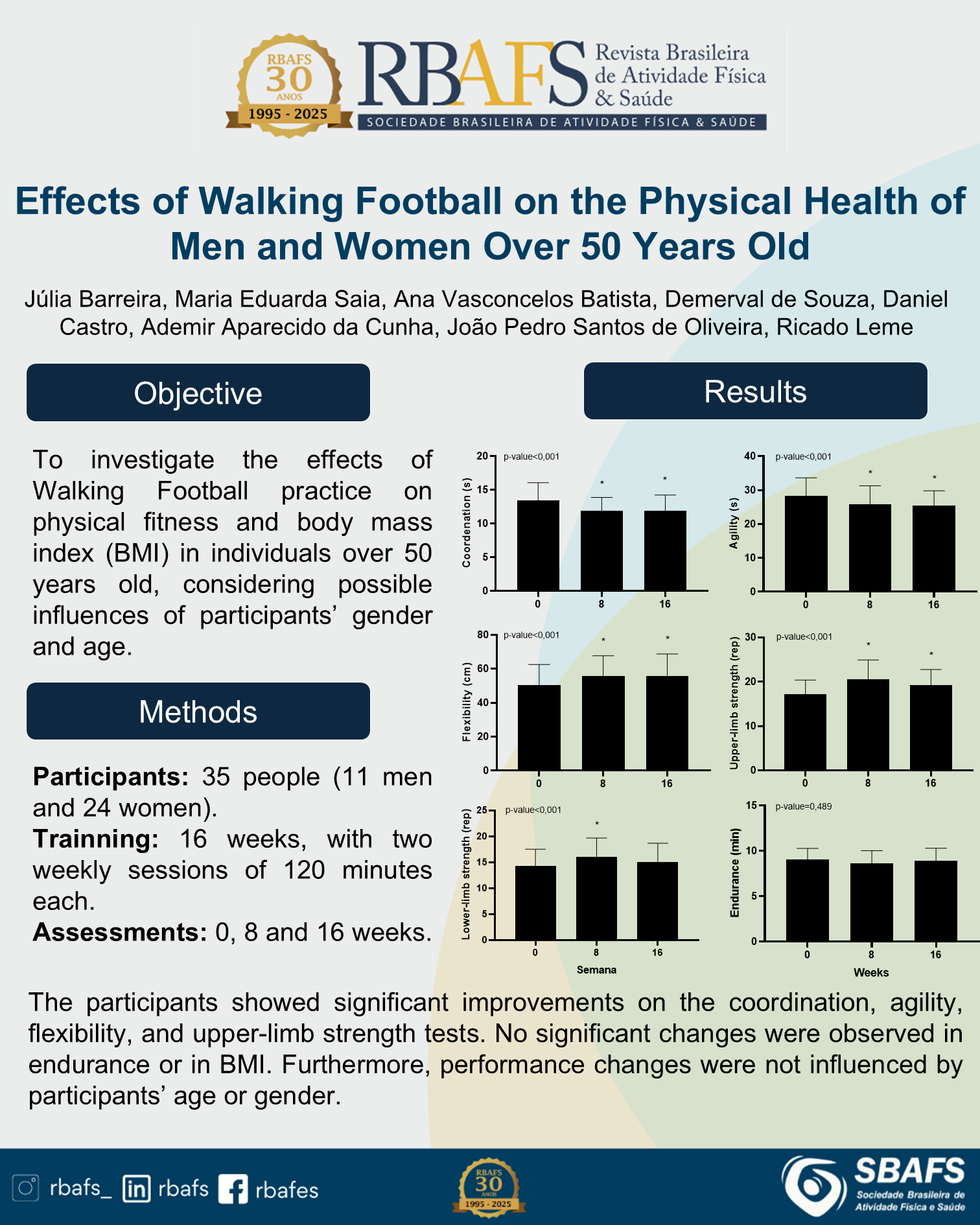
Objective: This study investigated the effects of Walking Football practice on physical fitness and body mass index in individuals over 50 years old, considering possible influences of participants’ gender and age. Methods: The participants had no previous experience with the sport. The training protocol lasted 16 weeks, with two weekly sessions of 120 minutes each, totaling 240 minutes per week, distributed across 32 sessions. Assessments were conducted at weeks 0, 8, and 16, using physical tests from the American Alliance for Health, Physical Education, Recreation and Dance protocol to evaluate coordination, flexibility, agility, strength, and endurance. Results: The 35 participants (11 men and 24 women, 67.7 ± 5.5 years old) showed significant improvements on the coordination (p < 0.001; η² = 0.10), agility (p < 0.001; η² = 0.07), flexibility (p < 0.001; η² = 0.03), and upper-limb strength tests (p < 0.001; η² = 0.16) at weeks 8 and 16 compared to baseline. Lower limb strength improved at week 8 but returned to baseline values at the end of the training. No significant changes were observed in endurance or in body mass index. Furthermore, performance changes were not influenced by participants’ age or gender. Conclusion: The findings highlight that Walking Football, when practiced with a weekly volume of at least 120 minutes, can be an effective strategy for maintaining and enhancing physical fitness in individuals aged 50 years and older.
Downloads
References
1. Instituto Brasileiro de Geografia e Estatística (IBGE). As Projeções da População: Brasil e Unidades da Federação: Revisão 2024. Rio de Janeiro: IBGE; 2024.
2. Gomes M, Figueiredo D, Teixeira L, Poveda V, Paul C, Santos-Silva A, et al. Physical inactivity among older adults across Europe based on the SHARE database. Age Ageing. 2017;46(1):71–7. DOI: https://doi.org/10.1093/ageing/afw165
3. Programa das Nações Unidas para o Desenvolvimento (PNUD). Relatório de Desenvolvimento Humano Nacional – Movimento é Vida: Atividades Físicas e Esportivas para Todas as Pessoas: 2017. Brasília: PNUD; 2017.
4. Soares MM, Caldeira TCM, Sousa TM, Rezende LFM, Claro RM. Atividade física no lazer entre idosos no Brasil: análise de séries temporais de um inquérito de base populacional (2009–2020). Cad Saúde Pública. 2022;38(7):e00272421.
5. Cholerton R, Breckon JD, Butt J, Quirk H. Experiences influencing walking football initiation in 55-to 75-year-old adults: A qualitative study. J Aging Phys Act. 2019;28(4):521–33. DOI: https://doi.org/10.1123/japa.2019-0123
6. McPhee JS, French DP, Jackson D, Nazroo J, Pendleton N, Degens H. Physical activity in older age: perspectives for healthy ageing and frailty. Biogerontology. 2016;17(3):567–80. DOI: https://doi.org/10.1007/s10522-016-9641-0
7. Mowle S, Eyre E, Noon M, Tallis J, Duncan MJ. Football–It’s in Your Blood—Lived Experiences of Undertaking Recreational Football for Health in Older Adults. Int J Environ Res Public Health. 2022;19(22):14816. DOI: https://doi.org/10.3390/ijerph192214816
8. Duncan MJ, Mowle S, Noon M, Eyre E, Clarke ND, Hill M, et al. The Effect of 12-Weeks Recreational Football (Soccer) for Health Intervention on Functional Movement in Older Adults. Int J Environ Res Public Health. 2022;19(20):13625. DOI: https://doi.org/10.3390/ijerph192013625
9. Corepal R, Zhang JY, Grover S, Hubball H, Ashe MC. Walking soccer: A systematic review of a modified sport. Scand J Med Sci Sports. 2020;30(12):2282–90. DOI: https://doi.org/10.1111/sms.13772
10. Barreira J, Fernandes MOM, Leme R, Gomes MSP. Walking football: uma possibilidade de prática do futebol para a população 60+. In: Ferrari C, Mocarzel R, editors. Universo do futebol: Futebol e suas variações ao redor do mundo. Vassouras: Universidade de Vassouras; 2024.
11. McEwan G, Buchan D, Cowan D, Arthur R, Sanderson M, Macrae E. Recruiting older men to walking football: A pilot feasibility study. Explore. 2019;15(3):206-14. DOI: https://doi.org/10.1016/j.explore.2018.12.001
12. Reddy P, Dias I, Holland C, Campbell N, Nagar I, Connolly L, et al. Walking football as sustainable exercise for older adults–A pilot investigation. Eur J Sport Sci. 2017;17(5):638–45. DOI: https://doi.org/10.1080/17461391.2017.1298671
13. Arnold JT, Bruce-Low S, Sammut L. The impact of 12 weeks walking football on health and fitness in males over 50 years of age. BMJ Open Sport Exerc Med. 2015;1(1):e000067. DOI: https://doi.org/10.1136/bmjsem-2015-000048
14. Barreira J, Saia ME, Leme R, Gomes MSP. Walking football for older adults: A scoping review of research and health benefits. Cog Ger. 2025; 4(1). DOI: https://doi.org/10.1080/28324897.2025.2503176
15. Caspers A, Andersson H, Godhe M, Fransson D, Ekblom-Bak E, Börjesson M. Walking football for men and women 60+: A 12-week non-controlled intervention affects health parameters. Res Q Exerc Sport. 2025;96(3):532-44. DOI: https://doi.org/10.1080/02701367.2024.2448824
16. Hunter GR, McCarthy JP, Bamman MM. Effects of resistance training on older adults. Sports Med. 2004;34(5):329–48. DOI: https://doi.org/10.2165/00007256-200434050-00005
17. Jones MD, Wewege MA, Hackett DA, Keogh JW, Hagstrom AD. Sex differences in adaptations in muscle strength and size following resistance training in older adults: A systematic review and meta-analysis. Sports Med. 2021;51(3):503–17. DOI: https://doi.org/10.1007/s40279-020-01388-4
18. Miangindula B, Bofosa T, Nkıama C, Kam E. Mobility of sedentary older people: benefit from an adapted physical activity program. Turk J Kinesiol. 2020;6(4):134–41. DOI: https://doi.org/10.31459/turkjkin.738939
19. Benedetti TRB, Mazo GZ, Gonçalves LHT. Bateria de testes da AAHPERD: adaptação para idosos institucionalizados. Rev Bras Cineantropom Desempenho Hum. 2014;16(1):1–14. DOI: https://doi.org/10.5007/1980-0037.2014v16n1p1
20. Cohen J. Statistical power analysis for the behavioral sciences. 2nd ed. Hillsdale: Lawrence Erlbaum Associates; 1988.
21. Stiegler P, Cunliffe A. The role of diet and exercise for the maintenance of fat-free mass and resting metabolic rate during weight loss. Sports Med. 2006;36(3):239–62. DOI: https://doi.org/10.2165/00007256-200636030-00005
22. Fragala MS, Cadore EL, Dorgo S, Izquierdo M, Kraemer WJ, Peterson MD, Ryan ED. Resistance training for older adults: position statement from the national strength and conditioning association. J Strength Cond Res. 2019;33(8):2019–52. DOI: https://doi.org/10.1519/JSC.0000000000003230
23. Cholerton R, Quirk H, Breckon J, Butt J. Experiences and strategies influencing older adults to continue playing walking football. J Aging Phys Act. 2021;29(4):573–85. DOI: https://doi.org/10.1123/japa.2020-0058
24. Cholerton R, Butt J, Quirk H, Breckon J. Differences in older adults walking football initiation and maintenance influences across respondent characteristics: A cross-sectional survey. J Aging Phys Act. 2022;30(6):936–49. DOI: https://doi.org/10.1123/japa.2021-0305
25. Eime RM, Young JA, Harvey JT, Charity MJ, Payne WR. A systematic review of the psychological and social benefits of participation in sport for children and adolescents: informing development of a conceptual model of health through sport. Int J Behav Nutr Phys Act. 2013;10:98. DOI: https://doi.org/10.1186/1479-5868-10-98
26. Burke LM, Hawley JA, Wong SH, Jeukendrup AE. Carbohydrates for training and competition. In: Burke LM, Deakin V, editors. Food, nutrition and sports performance III. London: Routledge; 2013. p. 17–27.
Downloads
Published
How to Cite
Issue
Section
License
Copyright (c) 2025 Júlia Barreira, Maria Eduarda Saia, Ana Beatriz Chaves Vasconcelos Batista, Demerval Souza, Daniel Castro, Ademir Aparecido da Cunha, João Pedro Santos de Oliveira, Ricardo Leme

This work is licensed under a Creative Commons Attribution 4.0 International License.
When submitting a manuscript to the Revista Brasileira de Atividade Física & Saúde, the authors retain the copyright to the article and authorize the Revista Brasileira de Atividade Física & Saúde to publish the manuscript under the Creative Commons Attribution 4.0 License and identify it as the original publication source.