Social support network of older people in physical activity programs
DOI:
https://doi.org/10.12820/rbafs.31e0424Keywords:
Social support, Elderly, Physical activity, Program, Interpersonal relationshipAbstract
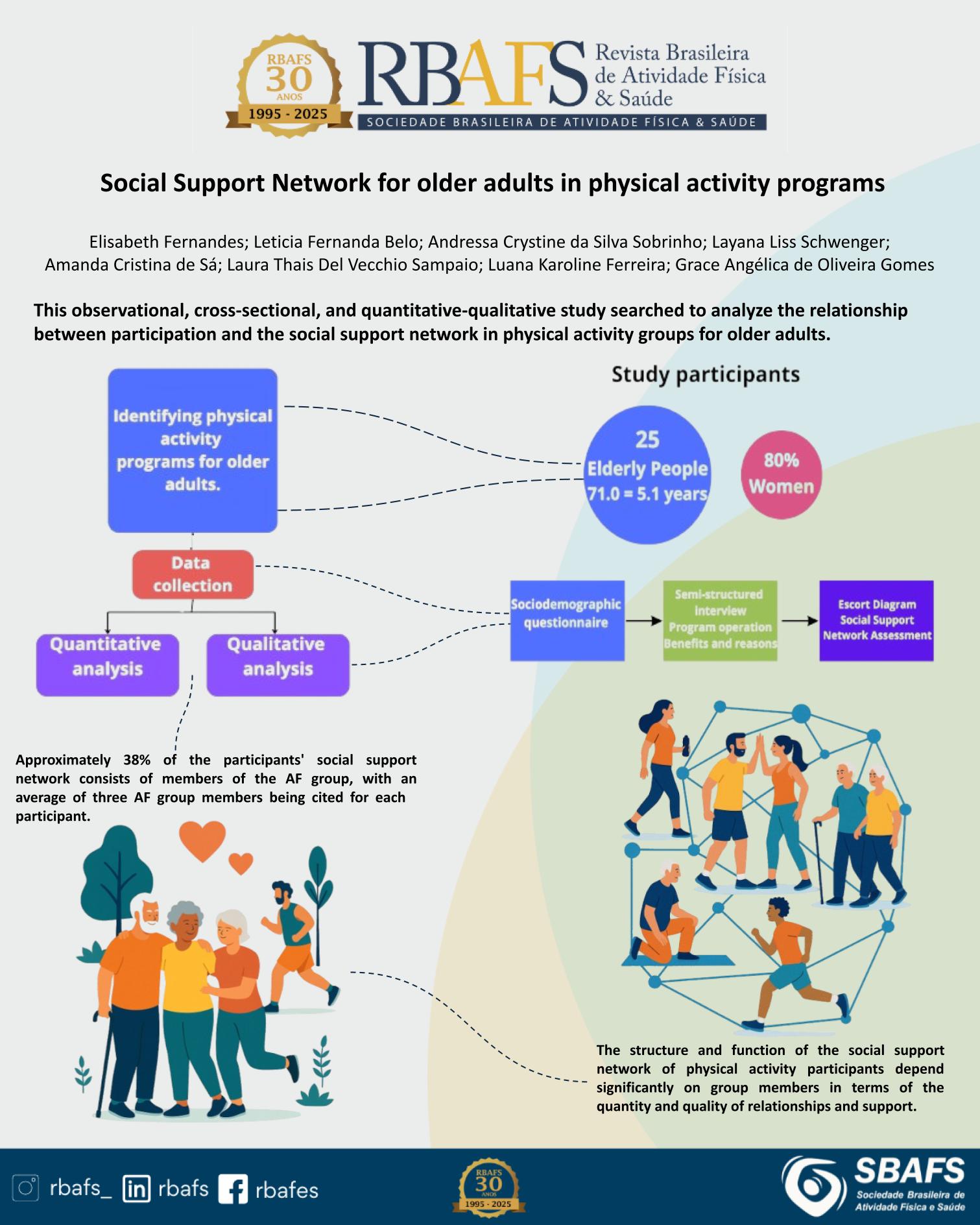
Objective: To analyze the relationship between participation in physical activity groups and the social support network of older people. Methods: This was an observational, cross sectional, quantitative and qualitative study, carried out in 2024, with older people participating in physical activity groups. The study included 25 older people (71.0 ± 5.1), 80% of whom were women, who answered a sociodemographic questionnaire, took part in a semi-structured interview about how the physical activity program worked and the benefits and reasons for taking part, and were assessed using the Escort Diagram to evaluate the structure and function of their social support network. Results: Approximately 38% of the participants’ social support networks were members of the physical activity group, with an average of three members for each participant. Around 90% of the bonds in the group members’ network were classified as friendships. The category “building and strengthening bonds” was cited as the main motivation for the participation in and benefits of the program (60%). Activity Physical Program participants were mentioned at all three levels of the social support network established by the Escort Diagram, with values of 28.1%, 33.3%, and 66.7% at the first, second and third levels, respectively. Around 10% cited the group participants as their emergency contact and 5% cited the program teacher. Conclusion: The structure and function of the social support network of physical activity participants relies significantly on group members in terms of the quantity and quality of relationships and support.
Downloads
References
1. Organização Mundial Da Saúde. Envelhecimento Ativo: uma política de saúde. Brasília: Organização Pan-Americana de Saúde, 2005. Disponível em: <https://bvsms.saude.gov.br/bvs/publicacoes/envelhecimento_ativo.pdf>. [2025 fevereiro]
2. Gonçalves RF, Leite MLH, Da Silveira MLM, De Assis LM. Benefícios da atividade física na terceira idade. Disponível em: https://www.editorarealize.com.br/editora/anais/cieh/2022/TRABALHO_COMPLETO_EV179_MD1_ID1789_TB744_16082022011949.pdf. [2025 janeiro.]
3. Julik AD. Fatores relacionados à qualidade de vida de idosos no contexto do desenvolvimento comunitário [tese de doutorado]. Irati, Paraná: Universidade Estadual do Centro-Oeste; 2024.
4. Kahn RL, Antonucci TC. Convoys over the life course: Attachment, roles, and social support. In: P. B. Baltes & O. G. Brim (Eds.), Life-span development and behavior. New York: Academic Press, 1980. p.253-286.
5. Baltes PB, Lindenberger U, Staudinger UM. Life-span theory in developmental psychology. In: Damon W, Lerner RM, editors. Handbook of child psychology. Vol. 5. New York, NY: Wiley; 1998. pp. 10291143
6. Glidden RF, Borges CD, Pianezer AA, Martins J. A participação de idosos em grupos de terceira idade e sua relação com satisfação com suporte social e otimismo. Bol. - Acad. Paul. Psicol. 2019:39(97):261-75. DOI: https://doi.org/10.5935/2176-3038.20190020
7. Silva FS, Menegaldo FR, Bortoleto MAC. Ginástica para todos: um olhar sobre o desenvolvimento das relações sociais em grupos de idosos. Rev. Bras. Ciênc. Mov. 2022;30(1). doi: https://doi.org/10.31501/rbcs.v30i1.12098 DOI: https://doi.org/10.31501/rbcm.v30i1.12098
8. Collado-Mateo D, Lavín-Pérez AM, Peñacoba C, Del Coso J, Leyton-Román M, Luque-Casado A, et al. Factors associated with adherence to physical exercise in patients with chronic diseases and older adults: An umbrella review. Int J Environ Res Public Health. 2021;18(4):2023. doi: https://doi.org/10.3390/ijerph18042023 DOI: https://doi.org/10.3390/ijerph18042023
9. Huang WY, Huang H, Wu CE. Physical activity and social support to promote a health-promoting lifestyle in older adults: An intervention study. Int J Environ Res Public Health. 2022;19(21):14382. doi: https://doi.org/10.3390/ijerph192114382 DOI: https://doi.org/10.3390/ijerph192114382
10. Freitas, R.T. Promoção da saúde através da prática de atividades físicas. Mostra de Trabalhos Científicos em Enfermagem. 2012. Disponível em: <https://www.coenf.ufv.br/wp-content/uploads/2018/12/ANAIS-Semana-da-Enfermagem-2012.pdf.> [2025 janeiro]
11. Marthammuthu T, Hairi FM, Choo WY, Salleh NAM, Naqiah Hairi N. The Prevalence and Association Between Social Support and Physical Activity Among the Rural Community-Dwelling Older Women in a Southeast Asian Country. J Aging Phys Act. 2023;31(4):611-20. doi: https://doi.org/10.1123/japa.2022-0201 DOI: https://doi.org/10.1123/japa.2022-0201
12. Antonucci TC, Akiyama H. H. Social networks in adult life and a preliminary examination of the convoy model. J Gerontol. 1987,42(5):519–27. doi: https://doi.org/10.1093/geronj/42.5.519 DOI: https://doi.org/10.1093/geronj/42.5.519
13. Paula-Couto MCP, Koller SH, Novo R, Sanchez-Soares P. Adaptação e utilização de uma medida de avaliação da rede de apoio social - diagrama da escolta - para idosos brasileiros. Universitas Psychologica. 2008;7(2):181-93.
14. Bardin L. Análise de conteúdo. São Paulo: Edições 70, 2011.
15. Kim I, An H, Yun S, Park HY. Effectiveness of community-based interventions for older adults living alone: a systematic review and meta-analysis. Epidemiol Health. 2024;46:e2024013. doi: https://doi.org/10.4178/epih.e2024013. DOI: https://doi.org/10.4178/epih.e2024013
16. Carstensen LL. Socioemotional Selectivity Theory: The Role of Perceived Endings in Human Motivation. Gerontologist. 2021;61(8):1188-96. doi: https://doi.org/10.1093/geront/gnab116 DOI: https://doi.org/10.1093/geront/gnab116
17. Doll J, Bernardo LD. Aprender a usar novas tecnologias. Rev. Bras. Ciênc. Envelhec. Hum. 2022;19(Supl.2). doi: https://doi.org/10.5335/rbceh.v19iSupl.2.14061 DOI: https://doi.org/10.29327/1108645.4-4
18. Chiarelli TM. Relações sociais na velhice via Facebook: um exame de extensão da teoria de seletividade socioemocional [dissertação]. São Paulo: Universidade de São Paulo, Escola de Artes, Ciências e Humanidades; 2017. doi: https://doi.org/10.11606/D.100.2017.tde-25072017-103441 DOI: https://doi.org/10.11606/D.100.2017.tde-25072017-103441
19. Zimmer C, McDonough MH, Hewson J, Toohey AM, Din C, Crocker PRE, et al. Social support among older adults in group physical activity programs. J. Appl. Sport Psychol. 2022;35(4):658–79. doi: https://doi.org/10.1080/10413200.2022.2055223 DOI: https://doi.org/10.1080/10413200.2022.2055223
20. Pernambuco CS, Moreira CHR, Dantas KBA. Exercício Físico e Qualidade de Vida Para Pessoa Idosa. In: Envelhecer Com Resiliência: Cuidando do Corpo e da Mente. Ponta Grossa: Editora Atena, 2024. p. 72–86. DOI: https://doi.org/10.22533/at.ed.4012418107
21. Abadia HR, Rocha CS, Curado PF, Ferreira MG, Souza GB, Lamounier JMS, et al. A importância da Prática da Atividade Física na Saúde Mental de idosos durante o isolamento social: Uma Revisão Integrativa. Rev. Contemp. Rev. Contemp. 2024;4(9):e5635. doi: https://doi.org/10.56083/RCV4N9-024 DOI: https://doi.org/10.56083/RCV4N9-024
22. Tóth EE, Ihász F, Ruiz-Barquín R, Szabó A. Physical Activity and Psychological Resilience in Older Adults: A Systematic Review of the Literature. J Aging Phys Act. 2023;32(2):276-86. doi: https://doi.org/10.1123/japa.2022-0427 DOI: https://doi.org/10.1123/japa.2022-0427
23. Gust A. Effect of health conditions and community program participation on physical activity and exercise motivation in older adults. J Health Psychol. 2025;30(6):1364-76. doi: https://doi.org/10.1177/13591053241275308 DOI: https://doi.org/10.1177/13591053241275308
24. Helsper N, Dippon L, Kohler S, Birkholz L, Weber P, Pfeifer K, et al. O.5.3-5 Existing structures for physical activity promotion: the role of resources, political support, intersectoral collaboration, and participation in six pilot communities - a comparative case study-. Eur J Public Health. 2023;33(Suppl 1):ckad133.256. doi: https://doi.org/10.1093/eurpub/ckad133.256 DOI: https://doi.org/10.1093/eurpub/ckad133.256
25. Levasseur M, Filiatrault J, Larivière N, Trépanier J, Lévesque MH, Beaudry M, et al. Influence of Lifestyle Redesign® on Health, Social Participation, Leisure, and Mobility of Older French-Canadians. Am J Occup Ther. 2019;73(5):7305205030p1-7305205030p18. doi: https://doi.org/10.5014/ajot.2019.031732 DOI: https://doi.org/10.5014/ajot.2019.031732
26. Sowa A, Tobiasz-Adamczyk B, Topór-Mądry R, Poscia A, la Milia DI. Predictors of healthy ageing: public health policy targets. BMC Health Serv Res. 2016;16(Suppl 5):289. doi: https://doi.org/10.1186/s12913-016-1520-5 DOI: https://doi.org/10.1186/s12913-016-1520-5
27. Zhuori N, Cai Y, Yan Y, Cui Y, Zhao M. Does Social Support Affect the Health of the Elderly in Rural China? A Meta-Analysis Approach. Int J Environ Res Public Health. 2019;16(18):3471. doi: https://doi.org/10.3390/ijerph16183471 DOI: https://doi.org/10.3390/ijerph16183471
28. Silva MVS, Rodrigues JDA, Ribas MDS, Sousa JCS, Castro TRO, Santos BA, et al. O impacto do isolamento social na qualidade de vida dos idosos durante a pandemia por COVID-19. Enferm Bras. 2020;19(4):34. doi: https://doi.org/10.33233/eb.v19i4.4337 DOI: https://doi.org/10.33233/eb.v19i4.4337
29. Costa DES, Rodrigues S. de A, Alves R de CL, Silva MRF da, Bezerra ADC, Santos DC, et al. A influência das tecnologias na saúde mental dos idosos em tempos de pandemia: uma revisão integrativa. Res. Soc Dev. 2021;10(2):e8210212198. doi: https://doi.org/10.33448/rsd-v10i2.12198 DOI: https://doi.org/10.33448/rsd-v10i2.12198
30. Fonseca AMG. “Aging in Place” –Envelhecer em casa e na comunidade. PerCursos, 2023;24:e0104. doi: https://doi.org/10.5965/19847246242023e0104 DOI: https://doi.org/10.5965/19847246242023e0104
Downloads
Published
How to Cite
Issue
Section
License
Copyright (c) 2026 Elisabeth Fernandes, Leticia Fernanda Belo, Andressa Crystine da Silva Sobrinho, Layana Liss Schwenger, Amanda Cristina de Sá, Laura Thais Del Vecchio Sampaio, Luana Karoline Ferreira, Grace Angélica de Oliveira Gomes

This work is licensed under a Creative Commons Attribution 4.0 International License.
When submitting a manuscript to the Revista Brasileira de Atividade Física & Saúde, the authors retain the copyright to the article and authorize the Revista Brasileira de Atividade Física & Saúde to publish the manuscript under the Creative Commons Attribution 4.0 License and identify it as the original publication source.