Effects of high-intensity interval training on different health outcomes among high school students in southern Brazil: Protocol for a cluster-randomized trial
DOI:
https://doi.org/10.12820/rbafs.30e0393Keywords:
Physical activity, Mental health, Cognitive performance, Adolescents, Randomized trialAbstract
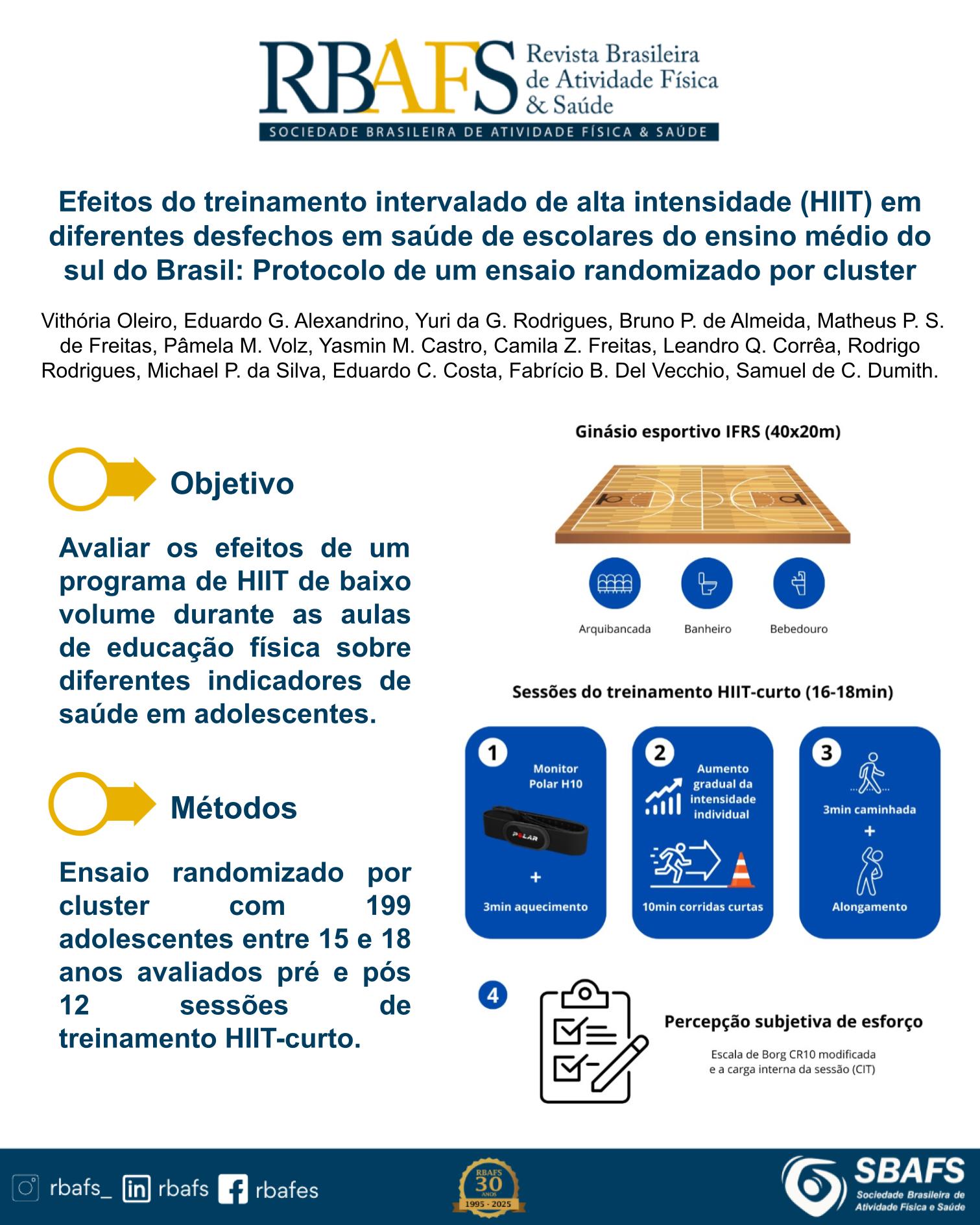
Introduction: Although the benefits of regular physical activity on mental health parameters and cognitiv performance are evident, there is a high prevalence of physical inactivity among adolescents. Therefore, it is important to identify exercise strategies that encourage greater participation within this population. Objective: To evaluate the effects of high-intensity interval training (HIIT) program on the mental health and cognitive performance of school-aged adolescents. Methods: This is a single center, two-arm (intervention and control) cluster randomized trial protocol. Adolescents aged 15 to 18 years were exposed to the intervention for 6 weeks. The primary outcomes are mental health symptoms, measured by the Depression, Anxiety, and Stress Scale for adolescents, cognitive profile, inhibitory control, and executive function, measured by the General Cognitive Assessment Battery – Cognifit, Stroop Color Test and Trail Making Test,respectively. Secondary outcomes include weight and Body Mass Index, waist circumference and cardiorespiratory fitness. The results will be analyzed according to the protocol and on an intention-to-treat basis. The effects of the intervention will be analyzed with Generalized Estimating Equations, using linear and Poisson models, incorporating time variables, group, an interaction term and adjustment covariates. A significance level of 5% will be adopted for all two-tailed tests. Final considerations: This study is expected to produce results that can recommend HIIT as an effective training strategy for mental health and cognitive performance of adolescents.
Trial record: Brazilian Registry of Clinical Trials - ReBEC (RBR-733y6zq).
Downloads
References
1. World Health Organization. Physical activity. What is physical activity? [S.I.] [Online]. 2022. Disponível em: <https://www.who.int/news-room/fact-sheets/detail/physical-activity> [2024 Maio].
2. Guthold R, Stevens GA, Riley LM, Bull FC. Global trends in insufficient physical activity among adolescents: a pooled analysis of 298 population-based surveys with 1· 6 million participants. Lancet Child Adolesc Health. 2020;4(1):23-35. DOI: https://doi.org/10.1016/S2352-4642(19)30323-2
3. Alves AR, Dias R, Neiva HP, Marinho DA, Marques MC, Sousa AC, et al. High-intensity interval training upon cognitive and psychological outcomes in youth: a systematic review. Int J Environ Res Public Health. 2021;18(10):5344. DOI: https://doi.org/10.3390/ijerph18105344
4. World Health Organization. Mental Health of Adolescents. 2021 Disponível em: <https://www.who.int/news-room/fact-sheets/detail/adolescent-mental-health> [2025 Fevereiro].
5. Lopes CS, Abreu GA, Santos DF, Menezes PR, Carvalho KMB, Cunha CF, et al. ERICA: prevalência de transtornos mentais comuns em adolescentes brasileiros. Rev Saúde Pública. 2016;50(2).
6. Martland R, Korman N, Firth J, Vancampfort D, Thompson T, Stubbs B. Can high-intensity interval training improve mental health outcomes in the general population and those with physical illnesses? A systematic review and meta-analysis. Br J Sports Med. 2022;56(5):279-91. DOI: https://doi.org/10.1136/bjsports-2021-103984
7. Yuksel HS, Sahin FN, Maksimovic N, Drid P, Bianco A. School-based intervention programs for preventing obesity and promoting physical activity and fitness: A systematic review. Int J Environ Res Public Health. 2020;17(1):347. DOI: https://doi.org/10.3390/ijerph17010347
8. Ramires VV, Dos Santos PC, Barbosa Filho VC, Da Silva AB, Tenório MCM, De Camargo EM, et al. Physical education for health among school-aged children and adolescents: a scoping review of reviews. J Phys Act Health. 2023;20(7):586-99. DOI: https://doi.org/10.1123/jpah.2022-0395
9. Duncombe SL, Barker AR, Bond B, Earle, R, Varley-Campbell J, Vlachopoulos, D, et al. School-based high-intensity interval training programs in children and adolescents: A systematic review and meta-analysis. PLoS One. 2022;17(5):e0266427. DOI: https://doi.org/10.1371/journal.pone.0266427
10. Costigan SA, Eather N, Plotnikoff RC, Taaffe DR, Pollock E, Kennedy SG, et al. Preliminary efficacy and feasibility of embedding high intensity interval training into the school day: a pilot randomized controlled trial. Prev Med Rep. 2015;2:973-9. DOI: https://doi.org/10.1016/j.pmedr.2015.11.001
11. Cao M, Quan M, Zhuang J. Effect of high-intensity interval training versus moderate-intensity continuous training on cardiorespiratory fitness in children and adolescents: a meta-analysis. Int J Environ Res Public Health. 2019;16(9):1533. d DOI: https://doi.org/10.3390/ijerph16091533
12. Martin-Smith R, Cox A, Buchan DS, Baker JS, Grace F, Sculthorpe N. High Intensity Interval Training (HIIT) improves cardiorespiratory fitness (CRF) in healthy, overweight and obese adolescents: A systematic review and meta-analysis of controlled studies. Int J Environ Res Public Health. 2020;17:2955. DOI: https://doi.org/10.3390/ijerph17082955
13. Bauer N, Sperlich B, Holmberg HC, Engel FS. Effects of high-intensity interval training in school on the physical performance and health of children and adolescents: a systematic review with meta-analysis. Sports Med Open. 2022;8(1):50. DOI: https://doi.org/10.1186/s40798-022-00437-8
14. Zhu Y, Nan N, Wei L, Li T, Gao X, Lu, D. The effect and safety of high-intensity interval training in the treatment of adolescent obesity: a meta-analysis. Ann Palliat Med. 2021;10(8):8596-8606. DOI: https://doi.org/10.21037/apm-21-757
15. Logan GRM, Harris, N, Duncan S, Plank LD, Merien F, Schofield G. Low-active male adolescents: a dose response to high-intensity interval training. Med Sci Sports Exerc. 2016;48(3):481-90. DOI: https://doi.org/10.1249/MSS.0000000000000799
16. Thums IA, Antunes FR. O método HIIT e seus benefícios para a qualidade de vida no século XXI. Rev Saúde AJES. 2019;5(9).
17. Costigan SA, Eather N, Plotnikoff RC, Hillman CH, Lubans DR. High-intensity interval training for cognitive and mental health in adolescents. Med Sci Sports Exerc. 2016;48(10):1985-93. DOI: https://doi.org/10.1249/MSS.0000000000000993
18. Leahy AA, Mavilidi MF, Smith JJ, Hillman CH, Eather N, Barker D, et al. Review of high-intensity interval training for cognitive and mental health in youth. Med Sci Sports Exerc. 2020;52(10):2224-34. DOI: https://doi.org/10.1249/MSS.0000000000002359
19. Gibala MJ, Little JP, MacDonald MJ, Hawley JÁ. Physiological adaptations to low‐volume, high‐intensity interval training in health and disease. J Physiol. 2012;590(5):1077-84. DOI: https://doi.org/10.1113/jphysiol.2011.224725
20. Lubans DR, Smith JJ, Eather N, Leahy AA, Morgan P, Londsdale C, et al. Time-efficient intervention to improve older adolescents’ cardiorespiratory fitness: findings from the ‘Burn 2 Learn’ cluster randomised controlled trial. Br J Sports Med. 2021;55(13):751-8. DOI: https://doi.org/10.1136/bjsports-2020-103277
21. Vecchio FBD. HIIT: como dominar a prescrição do treinamento intervalado de alta intensidade. 2019.
22. Min L, Wang D, You Y, Fu Y, Ma X. Effects of high-intensity interval training on sleep: a systematic review and meta-analysis. Int J Environ Res Public Health. 2021;18(20):10973. DOI: https://doi.org/10.3390/ijerph182010973
23. Farah BQ, Ritti-Dias RM, Balagopal PB, Colina JO, Prado WL. Does exercise intensity affect blood pressure and heart rate in obese adolescents? A 6-month multidisciplinary randomized intervention study. Pediatr Obes. 2014;9:111-31. DOI: https://doi.org/10.1111/j.2047-6310.2012.00145.x
24. Pizzi J, Furtado-Alle L, Schiavon D, Lopes WA, Silva LR, Bono GF, et al. Reduction in butyrylcholinesterase activity and cardiovascular risk factors in obese adolescents after 12-weeks of high-intensity interval training. J Exerc Physiol Online. 2017;20:110-20.
25. Lonsdale C, Sanders T, Parker P, Noetel M, Hartwig T, Vasconcellos D, et al. Effect of a scalable school-based intervention on cardiorespiratory fitness in children: A cluster randomized clinical trial. JAMA Pediatr. 2021;175(7):680-8. DOI: https://doi.org/10.1001/jamapediatrics.2021.0417
26. Chan A, Tetzlaff JM, Altman DG, Laupacis A, Gotzsche P, Krleza-Jeric K. SPIRIT 2013 Statement: Defining standard protocol items for clinical trials. Ann Intern Med. 2013;158(3):200–7. DOI: https://doi.org/10.7326/0003-4819-158-3-201302050-00583
27. Rosa SAS, Costa MPS, Castro AM, Côrrea KS. Análise do nível de atividade física, depressão, ansiedade e estresse segundo o sexo em adolescentes escolares: estudo transversal. Rev Eletr Enferm. 2023;25:73389. DOI: https://doi.org/10.5216/ree.v25.73389
28. Foster C, Florhaug JA, Franklin J, Gottschall L, Hrovatin LA, Parker S, et al. A new approach to monitoring exercise training. J Strength Cond Res. 2001;15(1):109-15. DOI: https://doi.org/10.1519/00124278-200102000-00019
29. Leger LA, Lambert J. A maximal multistage 20-m shuttle run test to predict VO2 max. Eur J Appl Physiol Occup Physiol. 1982;49(1):1–12. DOI: https://doi.org/10.1007/BF00428958
30. Mahar MT, Guerieri AM, Hanna MS, Kemble CD. Estimation of aerobic fitness from 20-m multistage shuttle run test performance. Am J Prev Med. 2011;41(2):117-23. DOI: https://doi.org/10.1016/j.amepre.2011.07.008
31. Guilherme FR. Efeitos do treinamento aeróbio intervalado de alta intensidade e contínuo de moderada intensidade sobre indicadores de saúde em escolares com obesidade central. 2017. Tese (Doutorado em Educação Física) – Centro de Ciências da Saúde, Universidade Estadual de Maringá, Maringá; 2017.
32. Eddolls WT, McNarry MA, Stratton G, Winn CO, Mackintosh KA. High-intensity interval training interventions in children and adolescents: a systematic review. Sports Med. 2017;47:2363-74. DOI: https://doi.org/10.1007/s40279-017-0753-8
33. Wen D, Utesch T, Wu J, Robertson S, Liu J, Hu G, et al. Effects of different protocols of high intensity interval training for VO2max improvements in adults: A meta-analysis of randomised controlled trials. J Sci Med Sport. 2019;22(8):941-7. DOI: https://doi.org/10.1016/j.jsams.2019.01.013
34. Cao M, Thang Y, Li S, Zou Y. Effects of high-intensity interval training and moderate-intensity continuous training on cardiometabolic risk factors in overweight and obesity children and adolescents: a meta-analysis of randomized controlled trials. Int J Environ Res Public Health. 2021;18(22):11905. DOI: https://doi.org/10.3390/ijerph182211905
35. Ai JY, Chen FT, Hsieh SS, Kao SC, Chen AG, Hung TM, et al. The effect of acute high-intensity interval training on executive function: A systematic review. Int J Environ Res Public Health. 2021;18(7):3593. DOI: https://doi.org/10.3390/ijerph18073593
36. Wu Q, Niu X, Zhang Y, Song J, Chi A. A comparative study of inhibition function between high-intensity interval training and moderate-intensity continuous training in healthy people: A systematic review with meta-analysis. Int J Environ Res Public Health. 2023;20(4):2859. DOI: https://doi.org/10.3390/ijerph20042859
Downloads
Published
How to Cite
Issue
Section
License
Copyright (c) 2025 Vithória Oleiro, Eduardo Guaze Alexandrino, Yuri da Gama Rodrigues, Bruno Pedrini de Almeida, Matheus Pintanel Silva de Freitas, Pâmela Moraes Volz, Yasmin Marques Castro, Camila Zabisky, Leandro Quadro Corrêa, Rodrigo Rodrigues, Michael Pereira da Silva, Eduardo Caldas Costa, Fabrício Boscolo Del Vecchio, Samuel de Carvalho Dumith

This work is licensed under a Creative Commons Attribution 4.0 International License.
When submitting a manuscript to the Revista Brasileira de Atividade Física & Saúde, the authors retain the copyright to the article and authorize the Revista Brasileira de Atividade Física & Saúde to publish the manuscript under the Creative Commons Attribution 4.0 License and identify it as the original publication source.