Satisfação com a vida e percepção do ambiente de atividade física em adultos mais velhos
DOI:
https://doi.org/10.12820/rbafs.31e0447Palavras-chave:
Características da vizinhança, Exercício físico, Saúde do idoso, Satisfação pessoalResumo
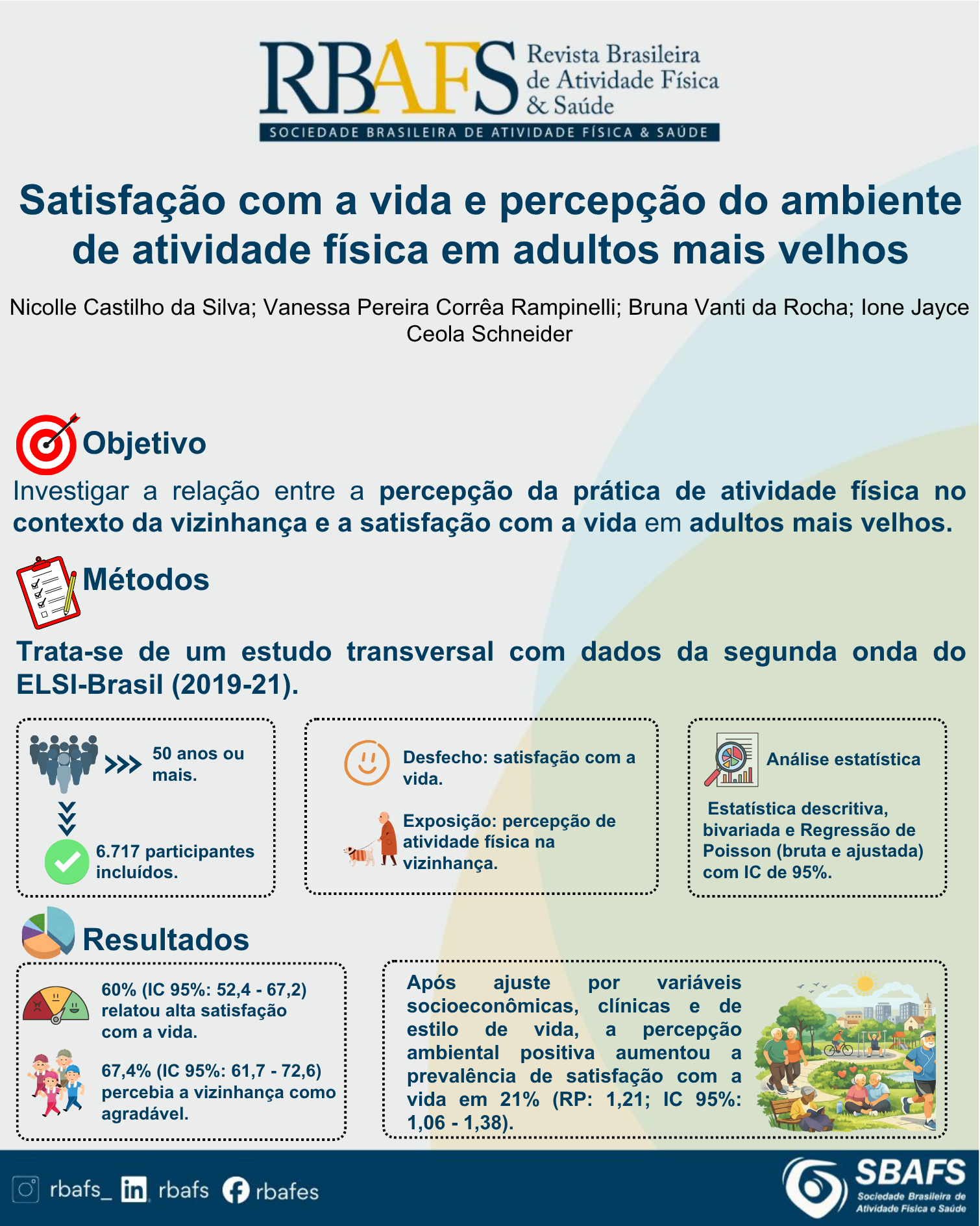
Introdução: A vizinhança é o local mais utilizado para a prática de atividade física em razão das limitações funcionais de adultos mais velhos; consequentemente, a percepção do ambiente pode interferir em sua adesão e na satisfação com a vida. Objetivo: Investigar a relação entre a percepção da prática de atividade física no contexto da vizinhança e a satisfação com a vida em adultos mais velhos. Métodos: Estudo transversal com dados do ELSI-Brasil (2019-21). Avaliou-se a associação entre satisfação com a vida (desfecho) e percepção de atividade física na vizinhança (exposição), ambos autorreferidos. A análise incluiu estatística descritiva, bivariada e regressão de Poisson (bruta e ajustada), com IC de 95%. Resultados: Dos 6.717 participantes, 60% (IC 95%: 52,4 - 67,2) relataram alta satisfação com a vida e 67,4% (IC 95%: 61,7 - 72,6) percebiam a vizinhança como agradável para atividades físicas. A maior satisfação associou-se a: idade de 60-69 anos, escolaridade ≥ 12 anos, ter parceiro, maior renda, ausência de déficit cognitivo ou depressivo, nunca ter fumado, consumo pesado e ser ativo. Após ajuste por variáveis socioeconômicas, clínicas e de estilo de vida, a percepção ambiental positiva aumentou a prevalência de satisfação com a vida em 21% (RP: 1,21; IC 95%: 1,06 - 1,38). Conclusão: Vizinhanças que favorecem a mobilidade ativa aumentam a satisfação com a vida em idosos. Portanto, planejar espaços urbanos acessíveis é uma estratégia essencial para promover o bem-estar e o envelhecimento saudável.
Downloads
Referências
1. Diener E, Sapyta JJ, Suh E. Subjective Well-Being Is Essential to Well-Being. Psychol Inq. 1998;9(1):33-7. DOI: https://doi.org/10.1207/s15327965pli0901_3
2. Veenhoven R. The Overall Satisfaction with Life: Subjective Approaches (1). In: Glatzer W, editor. Global Handbook of Quality of Life. Dordrecht: Springer Netherlands; 2015. p. 207-38. DOI: https://doi.org/10.1007/978-94-017-9178-6_9
3. Golgher A, Coutinho RZ. Life satisfaction in Brazil: an exploration of theoretical correlates and age, period and cohort variations using the World Values Survey (1991-2014). Rev Bras Estud Popul. 2020;37:e0108. DOI: https://doi.org/10.20947/s0102-3098a0108
4. Sposito G, D’Elboux MJ, Neri AL, Guariento ME. A satisfação com a vida e a funcionalidade em idosos atendidos em um ambulatório de geriatria. Cien Saude Colet. 2013;18(12):3475-82. DOI: https://doi.org/10.1590/S1413-81232013001200004
5. Tomomitsu MRSV, Perracini MR, Neri AL. Fatores associados à satisfação com a vida em idosos cuidadores e não cuidadores. Cien Saude Colet. 2014;19(8):3429-40. DOI: https://doi.org/10.1590/1413-81232014198.13952013
6. Teixeira Vaz C, de Souza Andrade AC, Proietti FA, Coelho Xavier C, de Lima Friche AA, Teixeira Caiaffa W. A multilevel model of life satisfaction among old people: individual characteristics and neighborhood physical disorder. BMC Public Health. 2019;19(1):861. DOI: https://doi.org/10.1186/s12889-019-7228-9
7. Nuzum H, Stickel A, Corona M, Zeller M, Melrose RJ, Wilkins SS. Potential Benefits of Physical Activity in MCI and Dementia. Behav Neurol. 2020;2020:7807856. DOI: https://doi.org/10.1155/2020/7807856
8. Liu J, Yin C, Sun B. Associations between neighborhood environments and health status among Chinese older people during the pandemic: Exploring mediation effects of physical activity. J Transp Health. 2024;35:101757. DOI: https://doi.org/10.1016/j.jth.2024.101757
9. Diez Roux AV. Investigating Neighborhood and Area Effects on Health. Am J Public Health. 2001;91(11):1783. DOI: https://doi.org/10.2105/AJPH.91.11.1783
10. Glass TA, Balfour JL. Neighborhoods, Aging, and Functional Limitations. In: Kawachi I, Berkman LF, editors. Neighborhoods and Health. New York: Oxford University Press; 2003. p. 303-34. DOI: https://doi.org/10.1093/acprof:oso/9780195138382.003.0014
11. Cerin E, Zhang CJP, Barnett DW, Lee RSY, Sit CHP, Barnett A. How the perceived neighbourhood environment influences active living in older dwellers of an Asian ultra-dense metropolis. Cities. 2023;141:104518. DOI: https://doi.org/10.1016/j.cities.2023.104518
12. Van Ham M, Tammaru T, Ubarevičienė R, Janssen H, editors. Urban Socio-Economic Segregation and Income Inequality. Cham (CH): Springer International Publishing; 2021. DOI: https://doi.org/10.1007/978-3-030-64569-4
13. Lima-Costa MF, de Andrade FB, Souza PRB, Neri AL, Duarte YA, Castro-Costa E, et al. The Brazilian Longitudinal Study of Aging (ELSI-Brazil): Objectives and Design. Am J Epidemiol. 2018;187(7):1345-53. DOI: https://doi.org/10.1093/aje/kwx387
14. Vandenbroucke JP, von Elm E, Altman DG, Gøtzsche PC, Mulrow CD, Pocock SJ, et al. Strengthening the Reporting of Observational Studies in Epidemiology (STROBE): explanation and elaboration. Epidemiology. 2007;18(6):805-35. DOI: https://doi.org/10.1097/EDE.0b013e3181577511
15. Lima-Costa MF, de Melo Mambrini JV, Bof de Andrade F, de Souza PRB, de Vasconcellos MTL, Neri AL, et al. Cohort Profile: The Brazilian Longitudinal Study of Ageing (ELSI-Brazil). Int J Epidemiol. 2023;52(1):e57-65. DOI: https://doi.org/10.1093/ije/dyac132
16. ELSI-Brasil – Estudo longitudinal da saúde dos idosos brasileiros [Internet]. Belo Horizonte: Fiocruz; c2025. Disponível em: <https://elsi.cpqrr.fiocruz.br/>[2025 Março].
17. Cantrill H. The pattern of human concerns. New Brunswick (NJ): Rutgers University Press; 1967.
18. World Health Organization. WHO guidelines on physical activity and sedentary behaviour [Internet]. Geneva: WHO; 2020. Disponível em: <https://www.who.int/publications/i/item/978924001512> [2025 Abril].
19. NIAAA - National Institute on Alcohol Abuse and Alcoholism. Understanding Binge Drinking [Internet]. Bethesda (MD): NIAAA; 2024. Disponível em: https://www.niaaa.nih.gov/publications/brochures-and-fact-sheets/binge-drinking> [2025 Abril].
20. World Health Organization. Multimorbidity [Internet]. Geneva: WHO; 2016. Disponível em: https://apps.who.int/iris/handle/10665/252275> [2025 Abril].
21. Park SH, Yu HY. How useful is the center for epidemiologic studies depression scale in screening for depression in adults? An updated systematic review and meta-analysis. Psychiatry Res. 2021;302:114037. DOI: https://doi.org/10.1016/j.psychres.2021.114037
22. Ruan Q, Xiao F, Gong K, Zhang W, Zhang M, Ruan J, et al. Demographically Corrected Normative Scores on the Neuropsychological Test Battery in Cognitively Normal Older Chinese Adults. Dement Geriatr Cogn Disord. 2020;49(4):375-83. DOI: https://doi.org/10.1159/000505618
23. Liu J, Yang L, Xiao L, Tao Z. Perceived Neighborhood Environment Impacts on Health Behavior, Multi-Dimensional Health, and Life Satisfaction. Front Public Health. 2022;10:850923. DOI: https://doi.org/10.3389/fpubh.2022.850923
24. van Cauwenberg J, Nathan A, Barnett A, Barnett DW, Cerin E. Relationships Between Neighbourhood Physical Environmental Attributes and Older Adults’ Leisure-Time Physical Activity: A Systematic Review and Meta-Analysis. Sports Med. 2018;48(7):1635-60. DOI: https://doi.org/10.1007/s40279-018-0917-1
25. Yu R, Cheung O, Lau K, Woo J. Associations between perceived neighborhood walkability and walking time, wellbeing, and loneliness in community-dwelling older Chinese people in Hong Kong. Int J Environ Res Public Health. 2017;14(10):1199. DOI: https://doi.org/10.3390/ijerph14101199
26. He Z, Ghose B, Yaya S, Cheng Z, Zhou Y. Perceived neighborhood safety and exercise behavior among community dwellers in Gauteng, South Africa. Medicine (Baltimore). 2020;99(51):e23552. DOI: https://doi.org/10.1097/MD.0000000000023552
27. Kawachi I, Subramanian SV. Neighbourhood influences on health. J Epidemiol Community Health. 2007;61(1):3. DOI: https://doi.org/10.1136/jech.2005.045203
28. Cramm JM, van Dijk HM, Nieboer AP. The importance of neighborhood social cohesion and social capital for the well being of older adults in the community. Gerontologist. 2013;53(1):142-50. DOI: https://doi.org/10.1093/geront/gns052
29. Kim ES, Chen Y, Kawachi I, VanderWeele TJ. Perceived neighborhood social cohesion and subsequent health and well-being in older adults: An outcome-wide longitudinal approach. Health Place. 2020;66:102420. DOI: https://doi.org/10.1016/j.healthplace.2020.102420
30. Ngamaba KH, Panagioti M, Armitage CJ. How strongly related are health status and subjective well-being? Systematic review and meta-analysis. Eur J Public Health. 2017;27(5):879-85. DOI: https://doi.org/10.1093/eurpub/ckx081
31. Duberstein PR, Sörensen S, Lyness JM, King DA, Conwell Y, Seidlitz L, et al. Personality is associated with perceived health and functional status in older primary care patients. Psychol Aging. 2003;18(1):25-37. DOI: https://doi.org/10.1037/0882-7974.18.1.25
32. Farooq S, Khan T, Zaheer S, Shafique K. Prevalence of anxiety and depressive symptoms and their association with multimorbidity and demographic factors: a community-based, cross-sectional survey in Karachi, Pakistan. BMJ Open. 2019;9(11):e029315. DOI: https://doi.org/10.1136/bmjopen-2019-029315
33. Ando T, Nishimoto Y, Hirata T, Abe Y, Takayama M, Maeno T, et al. Association between multimorbidity, self-rated health and life satisfaction among independent, community-dwelling very old persons in Japan: longitudinal cohort analysis from the Kawasaki Ageing and Well-being Project. BMJ Open. 2022;12(2):e049262. DOI: https://doi.org/10.1136/bmjopen-2021-049262
34. Nakamura JS, Hong JH, Smith J, Chopik WJ, Chen Y, Vanderweele TJ, et al. Associations between Satisfaction with Aging and Health and Well-being Outcomes among Older US Adults. JAMA Netw Open. 2022;5(2):e2147797. DOI: https://doi.org/10.1001/jamanetworkopen.2021.47797
35. Grønkjær M, Wimmelmann CL, Mortensen EL, Flensborg-Madsen T. Prospective associations between alcohol consumption and psychological well-being in midlife. BMC Public Health. 2022;22(1):204. DOI: https://doi.org/10.1186/s12889-021-12463-4
36. Koivumaa-Honkanen H, Kaprio J, Korhonen T, Honkanen RJ, Heikkilä K, Koskenvuo M. Self-reported life satisfaction and alcohol use: A 15-year follow-up of healthy adult twins. Alcohol. 2012;47(2):160-8. DOI: https://doi.org/10.1093/alcalc/agr151
37. Bassil NK, Ohanian MLK, Bou Saba TG. Nicotine Use Disorder in Older Adults. Clin Geriatr Med. 2022;38(1):119-31. DOI: https://doi.org/10.1016/j.cger.2021.07.008
38. Mitchell UA, Ailshire JA, Brown LL, Levine ME, Crimmins EM. Education and Psychosocial Functioning Among Older Adults: 4-Year Change in Sense of Control and Hopelessness. J Gerontol B Psychol Sci Soc Sci. 2016;73(5):849. DOI: https://doi.org/10.1093/geronb/gbw031
39. Mirowsky J, Ross CE. Life course trajectories of perceived control and their relationship to education. Am J Sociol. 2007;112:1339-82 DOI: https://doi.org/10.1086/511800
Downloads
Publicado
Como Citar
Edição
Seção
Licença
Copyright (c) 2026 Nicolle Castilho da Silva, Vanessa Pereira Corrêa Rampinelli, Bruna Vanti da Rocha, Ione Jayce Ceola Schneider

Este trabalho está licenciado sob uma licença Creative Commons Attribution 4.0 International License.
Ao submeter um manuscrito à Revista Brasileira de Atividade Física & Saúde, os autores mantêm a titularidade dos direitos autorais sobre o artigo, e autorizam a Revista Brasileira de Atividade Física & Saúde a publicar esse manuscrito sob a Licença Creative Commons Atribuição 4.0 e identificá-la como veículo de sua publicação original.