Desvantagens sociais modificam relação entre comportamento sedentário e gravidade da depressão em pacientes depressivos
DOI:
https://doi.org/10.12820/rbafs.31e0453Palavras-chave:
Tempo sedentário, Saúde mental, Transtorno depressivoResumo
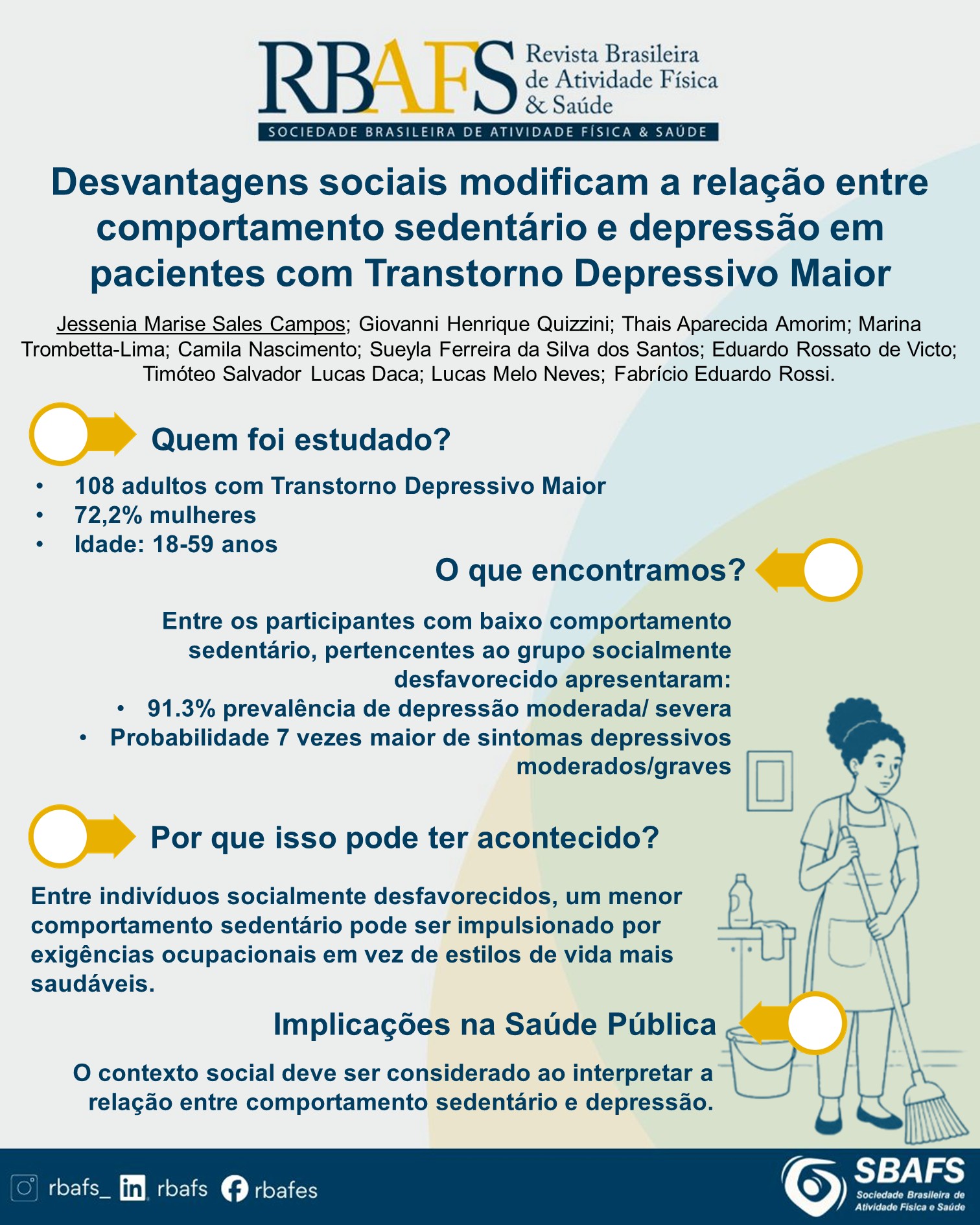
Introdução: O transtorno depressivo maior (TDM) é um transtorno mental incapacitante, com alta prevalência global. Embora o comportamento sedentário (CS) esteja consistentemente associado a desfechos adversos de saúde, a influência dos determinantes sociais sobre o CS em indivíduos com TDM, especialmente sob uma perspectiva interseccional, permanece pouco explorada. Objetivo: Investigar se os determinantes sociais, analisados sob a ótica da interseccionalidade, estão associados à gravidade dos sintomas depressivos em adultos com TDM, considerando diferentes níveis de CS. Métodos: Um total de 108 adultos (18-59 anos) com diagnóstico clínico de TDM respondeu um formulário online. O CS foi avaliado pelo Questionário Internacional de Atividade Física. Os sintomas depressivos foram mensurados pelo Inventário de Depressão de Beck. Os determinantes sociais foram combinados em um Índice de Vulnerabilidade para classificar os participantes em grupo dominante e grupo minoritário. Resultados: A associação entre determinantes sociais e a gravidade da depressão foi moderada pelo nível de CS. No grupo com baixo CS, pertencer ao grupo minoritário esteve associado a uma maior proporção de depressão moderada/grave (91,3% vs. 8,7%; p = 0,039) e a um risco sete vezes maior para esses sintomas (OR = 7,0; IC 95%: 1,27 - 38,47) em comparação ao grupo dominante. Em contraste, nenhuma associação foi encontrada no grupo com alto CS. Conclusão: A interseccionalidade dos determinantes sociais esteve associada à gravidade da depressão no grupo com baixo CS. Esses achados reforçam a necessidade de políticas de saúde pública que considerem vulnerabilidades sociais para mitigar o impacto do TDM, mesmo em populações que não apresentam comportamento sedentário de alto risco.
Downloads
Referências
1. World Health Organization. Depression and Other Common Mental Disorders. 2017. Available from: https://www.who.int/publications/i/item/depression-global-health-estimates> [2026 march].
2. Anderson E, Crawford CM, Fava M, Ingelfinger J, Nikayin S, Sanacora G, et al. Depression — Understanding, Identifying, and Diagnosing. N Engl J Med. 2024;390(17):e41. DOI: https://doi.org/10.1056/NEJMp2310179
3. Taylor D, Richards D. Triple Jeopardy: Complexities of Racism, Sexism, and Ageism on the Experiences of Mental Health Stigma Among Young Canadian Black Women of Caribbean Descent. Front Sociol. 2019;4:43. DOI: https://doi.org/10.3389/fsoc.2019.00043
4. Bauer GR, Churchill SM, Mahendran M, Walwyn C, Lizotte D, Villa-Rueda AA. Intersectionality in quantitative research: A systematic review of its emergence and applications of theory and methods. SSM Popul Health. 2021;14:100798. DOI: https://doi.org/10.1016/j.ssmph.2021.100798
5. Patel V, Saxena S, Lund C, Thornicroft G, Baingana F, Bolton P, et al. The Lancet Commission on global mental health and sustainable development. The Lancet. 2018;392(10157):1553–98. DOI: https://doi.org/10.1016/S0140-6736(18)31612-X
6. Frankish H, Boyce N, Horton R. Mental health for all: a global goal. The Lancet. 2018;392(10157):1493–4. DOI: https://doi.org/10.1016/S0140-6736(18)32271-2
7. Kandola AA, del Pozo Cruz B, Osborn DPJ, Stubbs B, Choi KW, Hayes JF. Impact of replacing sedentary behaviour with other movement behaviours on depression and anxiety symptoms: a prospective cohort study in the UK Biobank. BMC Med. 2021;19(1):133. DOI: https://doi.org/10.1186/s12916-021-02007-3
8. Hamer M, Stamatakis E. Prospective Study of Sedentary Behavior, Risk of Depression, and Cognitive Impairment. Med Sci Sports Exerc. 2014;46(4):718–23. DOI: https://doi.org/10.1249/MSS.0000000000000156
9. Zhai L, Zhang Y, Zhang D. Sedentary behaviour and the risk of depression: a meta-analysis. Br J Sports Med. 2015;49(11):705–9. DOI: https://doi.org/10.1136/bjsports-2014-093613
10. Ainsworth BE, Haskell WL, Herrmann SD, Meckes N, Bassett DR Jr, Tudor-Locke C, et al. 2011 Compendium of Physical Activities: a second update of codes and MET values. Med Sci Sports Exerc. 2011;43(8):1575-81. DOI: https://doi.org/10.1249/MSS.0b013e31821ece12
11. Powers SK. Exercise physiology: Theory and application to fitness and performances. Med Sci Sports Exerc. 1995;27(3):1-466. DOI: https://doi.org/10.1249/00005768-199503000-00027
12. Tremblay MS, Aubert S, Barnes JD, Saunders TJ, Carson V, Latimer-Cheung AE, et al. Sedentary Behavior Research Network (SBRN) – Terminology Consensus Project process and outcome. Int J Behav Nutr Phys Act. 2017;14(1):75. DOI: https://doi.org/10.1186/s12966-017-0525-8
13. Collins PH. Intersectionality’s definitional dilemmas. Annu Rev Sociol. 2015;41(1):1–20. DOI: https://doi.org/10.1146/annurev-soc-073014-112142
14. Beck AT, Ward CH, Mendelson M, Mock J, Erbaugh J. An Inventory for Measuring Depression. Arch Gen Psychiatry. 1961;4(6):561-71. DOI: https://doi.org/10.1001/archpsyc.1961.01710120031004
15. Beck AT, Steer RA, Carbin MG. Psychometric properties of the Beck Depression Inventory: Twenty-five years of evaluation. Clin Psychol Rev. 1988;8(1):77–100. DOI: https://doi.org/10.1016/0272-7358(88)90050-5
16. Craig CL, Marshall AL, Sjöström M, Bauman AE, Booth ML, Ainsworth BE, et al. International Physical Activity Questionnaire: 12-Country Reliability and Validity. Med Sci Sports Exerc. 2003;35(8):1381–95. DOI: https://doi.org/10.1249/01.MSS.0000078924.61453.FB
17. IPAQ Research Committee. Guidelines for data processing and analysis of the International Physical Activity Questionnaire (IPAQ)-short and long forms. 2005.
18. Dowd JJ, Bengtson VL. Aging in Minority Populations an Examination of the Double Jeopardy Hypothesis. J Gerontol. 1978;33(3):427–36. DOI: https://doi.org/10.1093/geronj/33.3.427
19. King DK. Multiple jeopardy, multiple consciousness: The context of a Black feminist ideology. Signs: Journal of women in culture and society. 1988;14(1):42–72. DOI: https://doi.org/10.1086/494491
20. Hu D, Xie P, Xia L, Hou H, Wang H, Zheng X, et al. The associations between sedentary behavior and risk of depression: a systematic review and dose response meta-analysis. BMC Public Health. 2025;25(1):2254. DOI: https://doi.org/10.1186/s12889-025-23418-4
21. Wang D, Zhang Y, Guo Z, Lu S. Sedentary behavior and physical activity are associated with risk of depression among adult and older populations: a systematic review and dose–response meta-analysis. Front Psychol. 2025;16:1542340. DOI: https://doi.org/10.3389/fpsyg.2025.1542340
22. Assari S. General Self-Efficacy and Mortality in the USA; Racial Differences. J Racial Ethn Health Disparities. 2017;4(4):746–57. DOI: https://doi.org/10.1007/s40615-016-0278-0
23. Cairney SA, Durrant SJ, Hulleman J, Lewis PA. Targeted Memory Reactivation During Slow Wave Sleep Facilitates Emotional Memory Consolidation. Sleep. 2014;37(4):701-7. DOI: https://doi.org/10.5665/sleep.3572
24. Alghamdi AA, Alghamdi AH. Determining the Best Approach: Comparing and Contrasting the Impact of Different Coping Strategies on Work-Related Stress and Burnout Among Saudi Commercial Pilots. Cureus. 2023;15(7):e41948. DOI: https://doi.org/10.7759/cureus.41948
25. Alon N, Macrynikola N, Jester DJ, Keshavan M, Reynolds CF, Saxena S, et al. Social determinants of mental health in major depressive disorder: Umbrella review of 26 meta-analyses and systematic reviews. Psychiatry Res. 2024;335:115854. DOI: https://doi.org/10.1016/j.psychres.2024.115854
26. Teychenne M, Sousa GM, Baker T, Liddelow C, Babic M, Chauntry AJ, et al. Domain-specific physical activity and mental health: an updated systematic review and multilevel meta-analysis in a combined sample of 3.3 million people. Br J Sports Med. 2025;60(4):267-85. DOI: https://doi.org/10.1136/bjsports-2025-109806
27. Scaranni POS, Griep RH, Pitanga FJG, Barreto SM, Matos SMA, Fonseca MJM. Work from home and the association with sedentary behaviors, leisure-time and domestic physical activity in the ELSA-Brasil study. BMC Public Health. 2023;23(1):305. DOI: https://doi.org/10.1186/s12889-023-15167-z
28. Holtermann A, Krause N, Van Der Beek AJ, Straker L. The physical activity paradox: six reasons why occupational physical activity (OPA) does not confer the cardiovascular health benefits that leisure time physical activity does. Br J Sports Med. 2018;52(3):149–50. DOI: https://doi.org/10.1136/bjsports-2017-097965
29. Ekelund U, Steene-Johannessen J, Brown WJ, Fagerland MW, Owen N, Powell KE, et al. Does physical activity attenuate, or even eliminate, the detrimental association of sitting time with mortality? A harmonised meta-analysis of data from more than 1 million men and women. The Lancet. 2016;388(10051):1302–10. DOI: https://doi.org/10.1016/S0140-6736(16)30370-1
30. Guidetti M, Averna A, Castellini G, Dini M, Marino D, Bocci T, et al. Physical Activity during COVID-19 Lockdown: Data from an Italian Survey. Healthcare. 2021;9(5):513. DOI: https://doi.org/10.3390/healthcare9050513
31. Murphy MH, Donnelly P, Breslin G, Shibli S, Nevill AM. Does doing housework keep you healthy? The contribution of domestic physical activity to meeting current recommendations for health. BMC Public Health. 2013;13(1):966. DOI: https://doi.org/10.1186/1471-2458-13-966
32. Kuehner C. Why is depression more common among women than among men? Lancet Psychiatry. 2017;4(2):146–58. DOI: https://doi.org/10.1016/S2215-0366(16)30263-2
33. Seedat S, Scott KM, Angermeyer MC, Berglund P, Bromet EJ, Brugha TS, et al. Cross-National Associations Between Gender and Mental Disorders in the World Health Organization World Mental Health Surveys. Arch Gen Psychiatry. 2009;66(7):785-95. DOI: https://doi.org/10.1001/archgenpsychiatry.2009.36
34. Ladwig KH, Marten-Mittag B, Formanek B, Dammann G. Gender differences of symptom reporting and medical health care utilization in the German population. Eur J Epidemiol. 2000;16(6):511–8. DOI: https://doi.org/10.1023/A:1007629920752
35. Redondo-Sendino Á, Guallar-Castillón P, Banegas JR, Rodríguez-Artalejo F. Gender differences in the utilization of health-care services among the older adult population of Spain. BMC Public Health. 2006;6(1):155. DOI: https://doi.org/10.1186/1471-2458-6-155
Downloads
Publicado
Como Citar
Edição
Seção
Licença
Copyright (c) 2026 Jessenia Marise Sales Campos, Giovanni Henrique Quizzini, Thais Aparecida Amorim, Marina Trombetta-Lima, Camila Nascimento, Sueyla Ferreira da Silva dos Santos, Eduardo Rossato de Victo, Timóteo Salvador Lucas Daca, Lucas Melo Neves, Fabrício Eduardo Rossi

Este trabalho está licenciado sob uma licença Creative Commons Attribution 4.0 International License.
Ao submeter um manuscrito à Revista Brasileira de Atividade Física & Saúde, os autores mantêm a titularidade dos direitos autorais sobre o artigo, e autorizam a Revista Brasileira de Atividade Física & Saúde a publicar esse manuscrito sob a Licença Creative Commons Atribuição 4.0 e identificá-la como veículo de sua publicação original.