Atividade física e comportamento sedentário de mães de crianças e adolescentes com transtorno do espectro autista: estudo transversal
DOI:
https://doi.org/10.12820/rbafs.31e0445Palavras-chave:
Atividade física, Comportamento sedentário, Mães, Crianças, Adolescentes, Transtorno do espectro autistaResumo
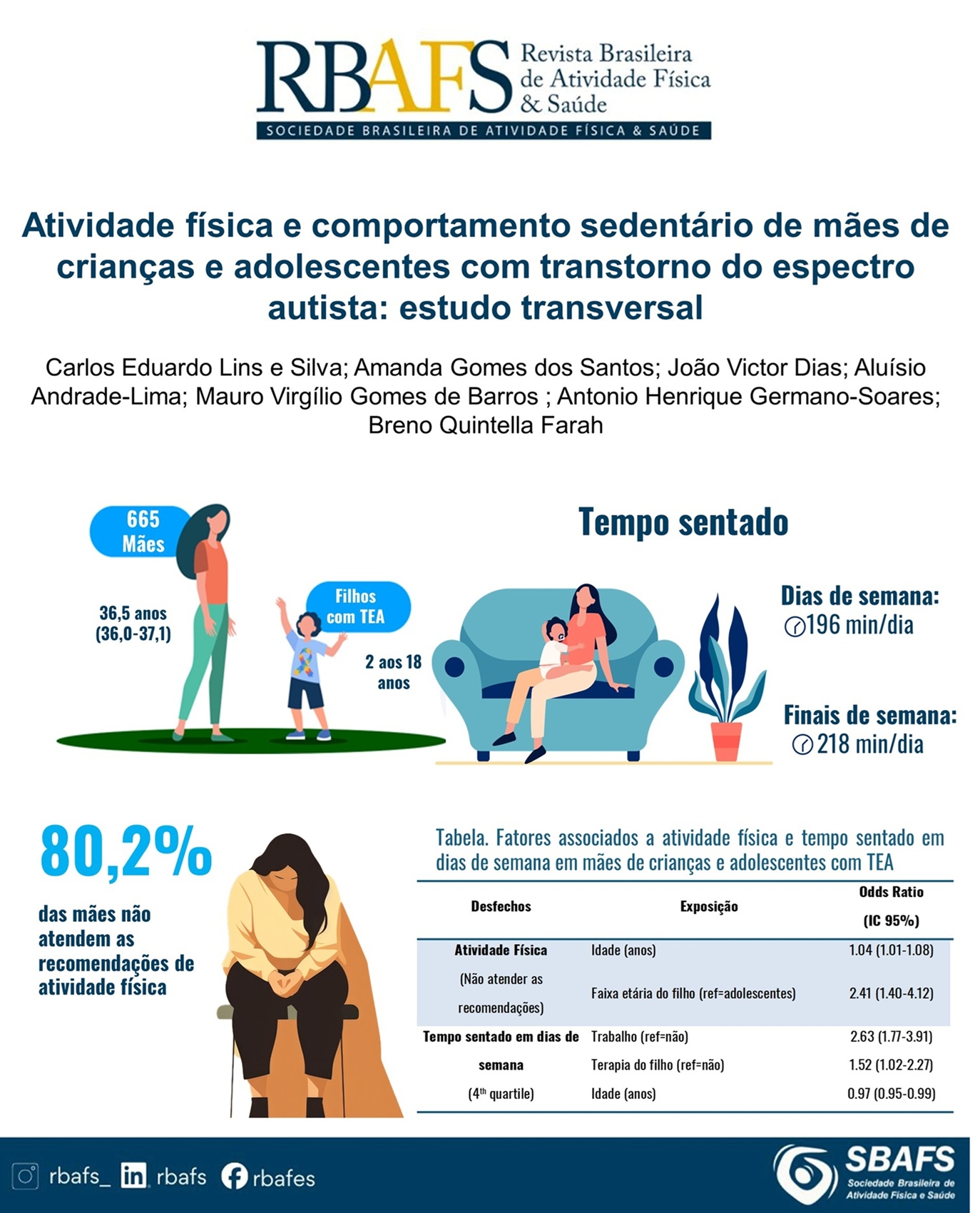
Introdução: Mães de filhos com transtorno do espectro autista (TEA) podem apresentar diversos problemas relacionados aos hábitos de saúde. No entanto, a atividade física (AF) e o comportamento sedentário (CS) ainda são pouco investigados nesse grupo. Objetivo: Analisar a proporção de mães de crianças e adolescentes com TEA que aderem às recomendações de AF e CS, bem como os fatores associados a essa aderência. Métodos: Trata-se de um estudo transversal com 665 mães de crianças e adolescentes com TEA. Os níveis de AF e CS foram avaliados por meio do International Physical Activity Questionnaire (versão curta). A AF foi classificada em “atende” ou “não atende” às recomendações (150 min/sem), enquanto o CS foi categorizado em quartis. Utilizou-se regressão logística binária para identificar fatores associados à AF e ao CS. Resultados: Cerca de 80% das mães não atenderam às recomendações de AF. Maior idade (OR: 1,040; IC 95%: 1,006 – 1,075) e ter filhos crianças (OR: 2,406; IC 95%: 1,404 – 4,124) aumentaram a chance de não adesão à AF. Mães cujos filhos realizavam terapia (OR: 1,518; IC 95%: 1,015 – 2,272), que trabalhavam (OR: 2,631; IC 95%: 1,770 – 3,911) e mais jovens (OR: 0,972; IC 95%: 0,946 – 0,998) apresentaram maior probabilidade de CS elevado. Conclusão: A maioria das mães não atendeu às recomendações de AF, especialmente aquelas mais velhas e com filhos crianças. Por outro lado, mães mais jovens, com filhos em terapia e que trabalhavam apresentaram maiores níveis de CS.
Downloads
Referências
1. American Psychiatric Association. Diagnostic and statistical manual of mental disorders. 5th, editor. Arlington: American Psychiatric Association; 2013. DOI: https://doi.org/10.1176/appi.books.9780890425596
2. Salari N, Rasoulpoor S, Rasoulpoor S, Shohaimi S, Jafarpour S, Abdoli N, et al. The global prevalence of autism spectrum disorder: a comprehensive systematic review and metaanalysis. Ital J Pediatr. 2022;48:112. DOI: https://doi.org/10.1186/s13052-022-01310-w
3. Instituto Brasileiro de Geografia e Estatística - IBGE. Censo Demográfico 2022: pessoas com deficiência e pessoas diagnosticadas com transtorno do espectro autista : resultados preliminares da amostra / IBGE. Rio de Janeiro 2025.
4. Hickey EJ, Nix RL, Hartley SL. Family Emotional Climate and Children with Autism Spectrum Disorder. J Autism Dev Disord. 2019;49:3244-56. DOI: https://doi.org/10.1007/s10803-019-04037-6
5. Ludlow A, Skelly C, Rohleder P. Challenges faced by parents of children diagnosed with autism spectrum disorder. J Health Psychol. 2012;17:702-11. DOI: https://doi.org/10.1177/1359105311422955
6. McStay RL, Trembath D, Dissanayake C. Maternal stress and family quality of life in response to raising a child with autism: from preschool to adolescence. Res Dev Disabil. 2014;35:3119-30. DOI: https://doi.org/10.1016/j.ridd.2014.07.043
7. Zhang X, Kern ZG, Yun J. Physical Activity and Mental Health of Parents of Children With Autism Spectrum Disorder. Adapt Phys Activ Q. 2023;40:649-63. DOI: https://doi.org/10.1123/apaq.2022-0175
8. Kütük M, Tufan AE, Kılıçaslan F, Güler G, Çelik F, Altıntaş E, et al. High Depression Symptoms and Burnout Levels Among Parents of Children with Autism Spectrum Disorders: A Multi-Center, Cross-Sectional, Case-Control Study. J Autism Dev Disord. 2021;51:4086-99. DOI: https://doi.org/10.1007/s10803-021-04874-4
9. Herrero R, Diaz A, Zueco J. The Burden and Psychological Distress of Family Caregivers of Individuals with Autism Spectrum Disorder: A Gender Approach. J Clin Med. 2024;13(10):2861. DOI: https://doi.org/10.3390/jcm13102861
10. Papadopoulos D. Mothers’ Experiences and Challenges Raising a Child with Autism Spectrum Disorder: A Qualitative Study. Brain sci. 2021;11(3):309. DOI: https://doi.org/10.3390/brainsci11030309
11. Zhang J, Han Y, Li W, Zhang Q, Chen D, Bao C. Global burden, inequalities, and predictions of autism spectrum disorders among children and adolescents aged 0-19 years: Results from the Global Burden of Disease 2021 Study. J affect disord. 2026;394(Pt B):120453. DOI: https://doi.org/10.1016/j.jad.2025.120453
12. Queiroga LL, Kaufmann O, Ritti-Dias RM, da Cunha PM, Minanni CA, Pitta RM, et al. Physical activity levels are associated with depressive symptoms: A cross-sectional study of 58,445 adults. J affect disord. 2025;369:298-302. DOI: https://doi.org/10.1016/j.jad.2024.09.158
13. Bull FC, Al-Ansari SS, Biddle S, Borodulin K, Buman MP, Cardon G, et al. World Health Organization 2020 guidelines on physical activity and sedentary behaviour. Br J Sports Med. 2020;54:1451-62. DOI: https://doi.org/10.1136/bjsports-2020-102955
14. Umpierre D, Coelho-Ravagnani C, Cecilia Tenorio M, Andrade DR, Autran R, Barros MVG, et al. Physical Activity Guidelines for the Brazilian Population: Recommendations Report. J Phys Act Health. 2022;19(5):374-81. DOI: https://doi.org/10.1123/jpah.2021-0757
15. Ritti-Dias RM, Trapé ÁA, Farah BQ, Petreça DR, Lemos ECd, Carvalho FFBd, et al. Physical activity for adults: Physical Activity Guidelines for the Brazilian Population. Rev Bras Ativ Fís Saúde. 2021;26:1-11. DOI: https://doi.org/10.12820/rbafs.26e0215
16. Ku B, Ghim S. Poor Physical Health in Caregivers of Children with ADHD or ASD and its Association with Health Risk Behaviours: NHIS 2016-2018. Int J Behav Med. 2025;32(3):431-42. DOI: https://doi.org/10.1007/s12529-023-10253-3
17. Warreman EB, Lloyd SE, Nooteboom LA, Leenen PJM, Terry MB, Hoek HW, et al. Psychological, behavioural, and physical aspects of caregiver strain in autism-caregivers: a cohort study. EClinicalMedicine. 2023;64:102211. DOI: https://doi.org/10.1016/j.eclinm.2023.102211
18. Johnson NL, Bekhet AK, Zint E, Wang J, Pena S, Van Hecke A, et al. Correlations of Physical and Psychological Health in Parents of Individuals With Autism Spectrum Disorder. West J Nurs Res. 2024;46(7):532-40. DOI: https://doi.org/10.1177/01939459241253221
19. Johnson NL, Bekhet AK, Sawdy R, Zint E, Wang J, Pena S, et al. Parent Physical Activity: A Systematic Review of the Literature and Recommendations for Parents of Children With Autism Spectrum Disorder. J Phys Act Health. 2022;19(2):132-47. DOI: https://doi.org/10.1123/jpah.2021-0438
20. von Elm E, Altman DG, Egger M, Pocock SJ, Gotzsche PC, Vandenbroucke JP, et al. The Strengthening the Reporting of Observational Studies in Epidemiology (STROBE) Statement: guidelines for reporting observational studies. Int J Surg. 2014;12(12):1495-9. DOI: https://doi.org/10.1016/j.ijsu.2014.07.013
21. Matsudo S, Araújo T, Matsudo V, Andrade D, Andrade E, Oliveira LC, et al. Questionário Internacional de Atividade Física (IPAQ): estudo de validade e reprodutibilidade no Brasil. Rev Bras Ativ Fís Saúde. 2001;6:5-18.
22. Ritti-Dias RM, Trapé ÁA, Farah BQ, Petreça DR, Lemos ECd, Carvalho FFBd, et al. Physical activity for adults: Physical Activity Guidelines for the Brazilian Population. Rev Bras Ativ Fís Saúde. 2021;26:1-11. DOI: https://doi.org/10.12820/rbafs.26e0215
23. Tsunoda K, Nagase K, Fujita K. Association of physical activity with psychological distress and happiness in mothers of children with autism spectrum disorders during the COVID-19 pandemic. BMC women’s health. 2023;23(1):450. DOI: https://doi.org/10.1186/s12905-023-02597-5
24. Sfm C, Van Cauwenberg J, Maenhout L, Cardon G, Lambert EV, Van Dyck D. Inequality in physical activity, global trends by income inequality and gender in adults. Int J Behav Nutr Phys Act. 2020;17(1):142. DOI: https://doi.org/10.1186/s12966-020-01039-x
25. Marsack-Topolewski CN, Hughesdon K, Samuel PS. Differential Levels of Caregiver Burden Among Parents of Adults With Autism. West J Nurs Res. 2025;47(8):720-31. DOI: https://doi.org/10.1177/01939459251338421
26. Ghim S, Ku B. The prevalence of health problems and their association with physical activity in caregivers of children with disabilities: 2018 National Health Interview Survey. Child care health dev. 2022;48(2):347-57. DOI: https://doi.org/10.1111/cch.12934
27. Ghanouni P, Quirke S, Blok J, Casey A. Independent living in adults with autism spectrum disorder: Stakeholders’ perspectives and experiences. Res Dev Disabil. 2021;119:104085. DOI: https://doi.org/10.1016/j.ridd.2021.104085
28. Ho H, Fergus K, Perry A. Looking back and moving forward: The experiences of canadian parents raising an adolescent with autism spectrum disorder. Res Autism Spectr Disord. 2018;52:12-22. DOI: https://doi.org/10.1016/j.rasd.2018.05.004
29. Padden C, James JE. Stress among Parents of Children with and without Autism Spectrum Disorder: A Comparison Involving Physiological Indicators and Parent Self-Reports. J Dev Phys Disabil. 2017;29:567-86. DOI: https://doi.org/10.1007/s10882-017-9547-z
30. Julius BR, O’Shea AMJ, Francis SL, Janz KF, Laroche H. Leading by Example: Association Between Mother and Child Objectively Measured Physical Activity and Sedentary Behavior. Pediatr Exerc Sci. 2021;33(2):49-60. DOI: https://doi.org/10.1123/pes.2020-0058
31. Chang Q, Zhu Y, Liu Z, Cheng J, Liang H, Lin F, et al. Replacement of sedentary behavior with various physical activities and the risk of all-cause and cause-specific mortality. BMC med. 2024;22(1):385. DOI: https://doi.org/10.1186/s12916-024-03599-2
32. Ferrari GLM, Kovalskys I, Fisberg M, Gómez G, Rigotti A, Sanabria LYC, et al. Socio-demographic patterning of objectively measured physical activity and sedentary behaviours in eight Latin American countries: Findings from the ELANS study. Eur J Sport Sci. 2020;20:670-81. DOI: https://doi.org/10.1080/17461391.2019.1678671
33. Parry S, Straker L. The contribution of office work to sedentary behaviour associated risk. BMC public health. 2013;13:296. DOI: https://doi.org/10.1186/1471-2458-13-296
34. Silva JM, Cavalcante A, Rego TVAS, Henriques DKS, Cucato GG, Ritti-Dias RM, et al. Breaking up Sitting Time With Isometric Wall Squat Exercise During Occupational Activities: A Feasibility Randomized Trial. J Occup Environ Med. 2024;66(10):e521-e527. DOI: https://doi.org/10.1097/JOM.0000000000003207
35. Hadgraft NT, Winkler E, Climie RE, Grace MS, Romero L, Owen N, et al. Effects of sedentary behaviour interventions on biomarkers of cardiometabolic risk in adults: systematic review with meta-analyses. Br J Sports Med. 2021;55(3):144-54. DOI: https://doi.org/10.1136/bjsports-2019-101154
36. Yao CA, Rhodes RE. Parental correlates in child and adolescent physical activity: a meta-analysis. Int J Behav Nutr Phys Act. 2015;12:10. DOI: https://doi.org/10.1186/s12966-015-0163-y
37. Celis-Morales C, Salas C, Alduhishy A, Sanzana R, Martinez MA, Leiva A, et al. Socio-demographic patterns of physical activity and sedentary behaviour in Chile: results from the National Health Survey 2009-2010. J Public Health. 2016;38(2):e98-e105. DOI: https://doi.org/10.1093/pubmed/fdv079
Downloads
Publicado
Como Citar
Edição
Seção
Licença
Copyright (c) 2026 Carlos Eduardo Lins e Silva, Amanda Gomes dos Santos, João Victor Dias, Aluísio Andrade-Lima, Mauro Gomes Virgílio de Barros, Antonio Henrique Germano-Soares, Breno Quintella Farah

Este trabalho está licenciado sob uma licença Creative Commons Attribution 4.0 International License.
Ao submeter um manuscrito à Revista Brasileira de Atividade Física & Saúde, os autores mantêm a titularidade dos direitos autorais sobre o artigo, e autorizam a Revista Brasileira de Atividade Física & Saúde a publicar esse manuscrito sob a Licença Creative Commons Atribuição 4.0 e identificá-la como veículo de sua publicação original.