A competência motora pode ser um melhor preditor dos indicadores de adiposidade do que a atividade física em crianças? Um estudo longitudinal
DOI:
https://doi.org/10.12820/rbafs.31e0423Palavras-chave:
Adiposidade, Competência motora, Atividade física, CriançasResumo
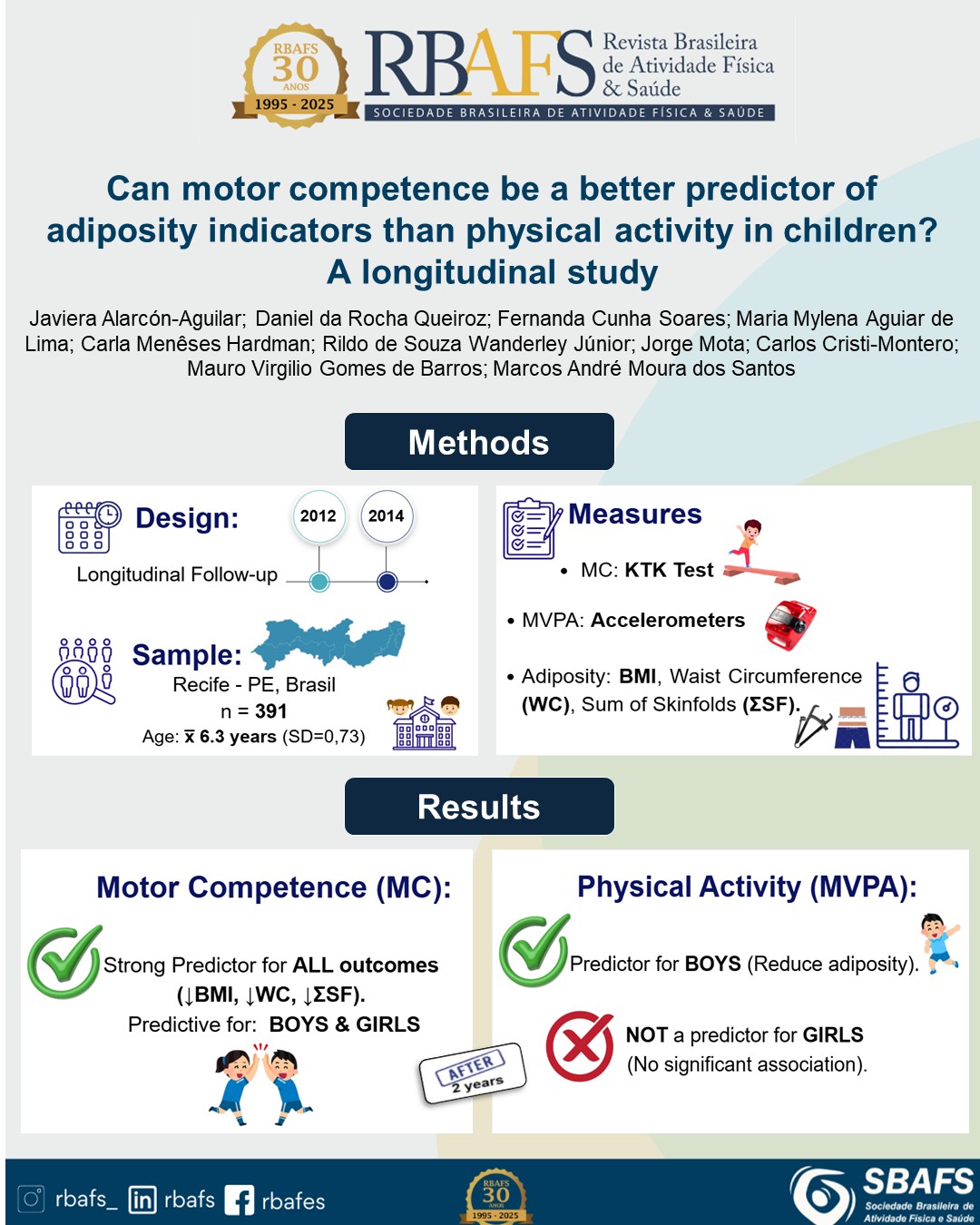
Introdução: Os indicadores de adiposidade são considerados componentes-chave da composição corporal e marcadores de saúde confiáveis durante a infância. Objetivo: Este estudo analisou se a competência motora (CM) e a atividade física de moderada a vigorosa (AFMV) em crianças foram preditores de indicadores de adiposidade após dois anos. Método: Um estudo longitudinal (Estudo Longitudinal de Observação da Saúde e Bem-estar da Criança em Idade Pré-escolar - ELOS-Pré) foi conduzido desde 2010 e reavaliado em 2012 e 2014. O estudo atual acompanhou 391 crianças (6,34 ± 0,72 anos) matriculadas em escolas públicas e privadas durante 2012 e 2014, de Recife, Pernambuco, Brasil. Os indicadores de adiposidade foram avaliados usando a circunferência da cintura, a soma das dobras cutâneas tricipital e subescapular (ΣDC) e o índice de massa corporal (IMC). A AFMV foi medida com acelerômetros. A CM foi avaliada usando o Körperkoordination Test für Kinder, considerando a soma dos escores. Regressões lineares foram realizadas para todas as análises. Resultados: A CM mostrou associação negativa com ΣDC (β = -0,09; p < 0,01), IMC (β = -0,02; p < 0,01) e CC (β = -0,07; p < 0,01); tanto para a amostra total quanto para meninas/meninos separadamente. A AFMV foi negativamente associada ao IMC (β = -0,01; p = 0,01); no entanto, foram observadas diferenças entre meninas e meninos. Conclusões: CM e AFMV predizem indicadores de adiposidade em crianças após dois anos. No entanto, a CM parece ser um preditor mais adequado dos indicadores de adiposidade na infância.
Downloads
Referências
1. Zhang X, Liu J, Ni Y, Yi C, Fang Y, Ning Q, et al. Global prevalence of overweight and obesity in children and adolescents: a systematic review and meta-analysis. JAMA Pediatr. 2024;178(8):800-13. doi: https://doi.org/10.1001/jamapediatrics.2024.1576
2. De Lorenzo A, Gratteri S, Gualtieri P, Cammarano A, Bertucci P, Di Renzo L. Why primary obesity is a disease? J Transl Med. 2019;17(1):1-13. doi: https://doi.org/10.1186/s12967-019-1919-y
3. Okely AD, Booth ML, Chey T. Relationships between body composition and fundamental movement skills among children and adolescents. Res Q Exerc Sport. 2004;75(3):238-47. doi: https://doi.org/10.1080/02701367.2004.10609157
4. Maffeis C, Grezzani A, Pietrobelli A, Provera S, Tatò L. Does waist circumference predict fat gain in children? Int J Obes Relat Metab Disord. 2001;25(7):978-83. doi: https://doi.org/10.1038/sj.ijo.0801641
5. Malina RM, Bouchard C, Bar-Or O. Growth, maturation, and physical activity. Champaign, IL: Human Kinetics; 2004.
6. Arhab A, Eiben G, Lanfer A, Rachow A, Kroke A, Hebestreit A. Association of physical activity with adiposity in preschoolers using different clinical adiposity measures: A cross-sectional study. BMC Pediatr. 2019;19(1):268. doi: https://doi.org/10.1186/s12887-019-1764-4
7. Stodden DF, Goodway JD, Langendorfer SJ, Roberton MA, Rudisill ME, Garcia C, et al. A developmental perspective on the role of motor skill competence in physical activity: An emergent relationship. Quest. 2008;60(2):290-306. doi: https://doi.org/10.1080/00336297.2008.10483582
8. Janssen I, Leblanc AG. Systematic review of the health benefits of physical activity and fitness in school-aged children and youth. Int J Behav Nutr Phys Act. 2010;7:40. doi: https://doi.org/10.1186/1479-5868-7-40
9. Bürgi F, Meyer U, Granacher U, Schindler C, Marques-Vidal P, Kriemler S, et al. Relationship of physical activity with motor skills, aerobic fitness and body fat in preschool children: a cross-sectional and longitudinal study (Ballabeina). Int J Obes (Lond). 2011;35(7):937-44. doi: https://doi.org/10.1038/ijo.2011.54
10. Ekelund U, Sardinha LB, Anderssen SA, Harro M, Franks PW, Brage S, et al. Associations between objectively assessed physical activity and indicators of body fatness in 9- to 10-y-old European children: a population-based study from 4 distinct regions in Europe (the European Youth Heart Study). Am J Clin Nutr. 2004;80(3):584-90. doi: https://doi.org/10.1093/ajcn/80.3.584
11. Farooq A, Martin A, Janssen X, Wilson MG, Gibson AM, Hughes A, et al. Longitudinal changes in moderate-to-vigorous-intensity physical activity in children and adolescents: A systematic review and meta-analysis. Obes Rev. 2020;21(1):e12953. doi: https://doi.org/10.1111/obr.12953
12. Janssen X, Basterfield L, Parkinson KN, Dillon S, Reilly JK, Mytton J, et al. Non-linear longitudinal associations between moderate-to-vigorous physical activity and adiposity across the adiposity distribution during childhood and adolescence: Gateshead Millennium Study. Int J Obes (Lond). 2019;43(4):744-50. doi: https://doi.org/10.1038/s41366-018-0188-9
13. Carson V, Rinaldi RL, Torrance B, Maximova K, Ball GDC, Majumdar SR, et al. Vigorous physical activity and longitudinal associations with cardiometabolic risk factors in youth. Int J Obes (Lond). 2014;38(1):16-21. doi: https://doi.org/10.1038/ijo.2013.135
14. Bourke M, Wang HFW, Wicks H, Barnett LM, Cairney J, Fortnum K. Children's and adolescents' actual motor competence, perceived physical competence and physical activity: a structural equation modelling meta-analysis. Sports Med. 2025. doi: https://doi.org/10.1007/s40279-025-02233-2
15. Moon J, Webster CA, Stodden DF, Brian A, Mulvey KL, Beets M, et al. Systematic review and meta-analysis of physical activity interventions to increase elementary children's motor competence: a comprehensive school physical activity program perspective. BMC Public Health. 2024;24(1):826. doi: https://doi.org/10.1186/s12889-024-18145-1
16. Lopes VP, Stodden DF, Bianchi MM, Maia JAR, Rodrigues LP. Correlation between BMI and motor coordination in children. J Sci Med Sport. 2012;15(1):38-43. doi: https://doi.org/10.1016/j.jsams.2011.07.005
17. Martins D, Maia J, Seabra A, Garganta R, Lopes V, Katzmarzyk P, et al. Correlates of changes in BMI of children from the Azores islands. Int J Obes (Lond). 2010;34(10):1487-93. doi: https://doi.org/10.1038/ijo.2010.56
18. Lima RA, Larsen LR, Bugge A, Dencker M, Møller NC, Riddoch C, et al. Tracking of Gross Motor Coordination From Childhood Into Adolescence. Res Q Exerc Sport. 2017;88(1):52-9. doi: https://doi.org/10.1080/02701367.2016.1264566
19. Haapala EA, Gao Y, Hartikainen J, Rantalainen T, Finni T. Associations of fitness, motor competence, and adiposity with the indicators of physical activity intensity during different physical activities in children. Sci Rep. 2021;11:12521. doi: https://doi.org/10.1038/s41598-021-92040-2
20. de Mello GT, Minatto G, Costa RM, Leech RM, Cao Y, Lee RE, et al. Clusters of 24-hour movement behavior and diet and their relationship with health indicators among youth: a systematic review. BMC Public Health. 2024;24:1080. doi: https://doi.org/10.1186/s12889-024-18364-6
21. Vandorpe B, Vandendriessche J, Lefevre J, Pion J, Vaeyens R, Matthys S, et al. The Körperkoordinations Test für Kinder: reference values and suitability for 6-12-year-old children in Flanders. Scand J Med Sci Sports. 2011;21(3):378-88. doi: https://doi.org/10.1111/j.1600-0838.2009.01067.x
22. Evenson KR, Catellier DJ, Gill K, Ondrak KS, McMurray RG. Calibration of two objective measures of physical activity for children. J Sports Sci. 2008;26(14):1557-65. doi: https://doi.org/10.1080/02640410802334196
23. Lohman TG, Roche AF, Martorell R. Anthropometric standardization reference manual. Champaign, IL: Human Kinetics Books; 1988.
24. Mirwald RL, Baxter-Jones AD, Bailey DA, Beunen GP. An assessment of maturity from anthropometric measurements. Med Sci Sports Exerc. 2002;34(4):689-94. doi: https://doi.org/10.1097/00005768-200204000-00020
25. Lubans DR, Morgan PJ, Cliff DP, Barnett LM, Okely AD. Fundamental movement skills in children and adolescents: review of associated health benefits. Sports Med. 2010;40(12):1019-35. doi: https://doi.org/10.2165/11536850-000000000-00000
26. D'Hondt E, Deforche B, De Bourdeaudhuij I, Lenoir M. Gross motor coordination in relation to weight status and age in 5- to 12-year-old boys and girls: a cross-sectional study. Int J Pediatr Obes. 2011;6(2-2):e556-64. doi: https://doi.org/10.3109/17477166.2010.500388
27. Lopes VP, Rodrigues LP, Maia JA, Malina RM. Motor coordination, physical activity and fitness as predictors of longitudinal change in adiposity during childhood. Eur J Sport Sci. 2012;12(4):384-91. doi: https://doi.org/10.1080/17461391.2011.566368
28. Malina RM. Basic principles of growth and maturation. In: Coelho-Silva MJ, Figueiredo AJ, Elferink-Gemser MT, Malina RM, editors. Youth sports: growth, maturation and talent. Coimbra: Imprensa da Universidade de Coimbra; 2010. p. 2-17.
29. D'Hondt E, Deforche B, De Bourdeaudhuij I, Lenoir M. A longitudinal study of gross motor coordination and weight status in children. Obesity (Silver Spring). 2014;22(6):1505-11. doi: https://doi.org/10.1002/oby.20723
30. Rolland-Cachera MF, Deheeger M, Bellisle F, Sempé M, Guilloud-Bataille M, Patois E. Adiposity rebound in children: a simple indicator for predicting obesity. Am J Clin Nutr. 1984;39(1):129-35. doi: https://doi.org/10.1093/ajcn/39.1.129
Downloads
Publicado
Como Citar
Edição
Seção
Licença
Copyright (c) 2026 Javiera Alarcón-Aguilar, Daniel da Rocha Queiroz, Fernanda Cunha Soares, Maria Mylena Aguiar de Lima, Carla Menêses Hardman, Rildo de Souza Wanderley Júnior, Jorge Mota, Carlos Cristi-Montero, Mauro Virgilio Gomes de Barros, Marcos André Moura dos Santos

Este trabalho está licenciado sob uma licença Creative Commons Attribution 4.0 International License.
Ao submeter um manuscrito à Revista Brasileira de Atividade Física & Saúde, os autores mantêm a titularidade dos direitos autorais sobre o artigo, e autorizam a Revista Brasileira de Atividade Física & Saúde a publicar esse manuscrito sob a Licença Creative Commons Atribuição 4.0 e identificá-la como veículo de sua publicação original.